
Scotland holds a unique place in Masonic history…
While England may have established the first Grand Lodge in 1717, Scotland’s Masonic roots run deeper, with documented lodge meetings dating back to 1599 and traditions extending even further into the medieval period.
The connection between operative stonemasons building Scotland’s castles and abbeys and modern speculative Freemasonry can be traced more directly here than anywhere else in the world.
This week-long itinerary takes you through the heart of Scottish Freemasonry, from the oldest lodge minutes in existence to mysterious chapels that may have witnessed the birth of modern ritual.
You’ll visit working lodges, grand temples, and ancient sites where the line between operative and speculative masonry blurs into history.
Whether you’re a Master Mason seeking to understand your Craft’s origins or a Masonic traveler collecting experiences, Scotland offers an unmatched journey into our fraternity’s past.
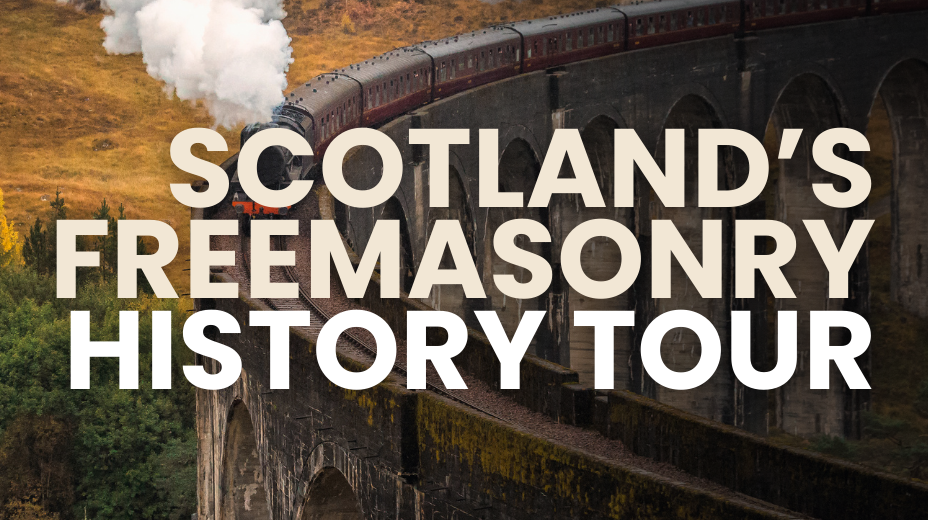
Day 1: Edinburgh – The Heart of Scottish Freemasonry
Start your Scottish Masonic pilgrimage where it all officially began. Edinburgh is home to both the oldest Masonic minutes in the world and the headquarters of Scottish Freemasonry itself.
Morning: Freemasons’ Hall, George Street
Begin at 96 George Street, where the Grand Lodge of Scotland has been headquartered since 1912. This Category A listed building replaced an earlier hall designed by architect David Bryce, himself a Freemason and Grand Architect. Above the entrance stands a statue of St. Andrew, patron saint of both Scotland and Scottish Freemasonry.
The building offers tours that provide access to the Grand Hall, with its elegant stairway beneath a gilded dome, the Grand Committee Room, and most importantly, the museum and library. The museum houses an extraordinary collection of Scottish Masonic artifacts, regalia, and documents spanning centuries. Staff members are knowledgeable and can answer questions about Scottish Freemasonry’s unique characteristics, including the diversity of rituals practiced by Scottish lodges.
Tours must be arranged in advance by phone. The building is also available for hire and regularly serves as a venue during the Edinburgh Festival Fringe, demonstrating the modern integration of Masonic buildings into community life.
Afternoon: The Lodge of Edinburgh (Mary’s Chapel) No. 1
After lunch, seek out the historical site of Mary’s Chapel in the Old Town. While the lodge no longer meets at its original location, a sign on Burnett’s Close on High Street marks where this venerable institution held its earliest recorded meetings.
The Lodge of Edinburgh (Mary’s Chapel) holds the distinction of possessing the oldest continuous Masonic minutes in the world, with records beginning July 31, 1599. These first five pages incorporate the Schaw Statutes, dated December 28, 1598, which established regulations for Scottish operative masons. The lodge’s number “1” on the Grand Lodge of Scotland roll reflects this documented antiquity.
Today, the lodge meets elsewhere in Edinburgh. If your visit coincides with one of their meetings and you’re a visiting Mason in good standing, contact them in advance to arrange attendance. The experience of sitting in lodge with Brothers whose predecessors kept minutes before Shakespeare wrote Hamlet is genuinely moving.
Evening: Edinburgh Castle
End your first day at Edinburgh Castle, visible from almost anywhere in the city. While not specifically a Masonic site, the castle played host to one of the most significant ceremonies in Grand Lodge history. On St. Andrew’s Day, November 30, 1936, the installation of the Duke of York (later King George VI) as Grand Master Mason of Scotland took place in the castle’s Banquet Hall, marking the bicentenary of the Grand Lodge’s founding.
The castle itself stands 300 to 400 feet above the city on volcanic rock, a commanding presence that has witnessed Scottish history for centuries. Many of the stonemasons who built and expanded this fortress were part of the operative lodges that would eventually transition to speculative Masonry.
Day 2: Roslin and the Mysteries of Rosslyn Chapel
Just seven miles south of Edinburgh lies one of the most debated and fascinating sites in Masonic lore.
Rosslyn Chapel
Sir William St. Clair, 3rd Earl of Orkney, founded Rosslyn Chapel in 1446, though construction didn’t begin until September 20, 1456. The chapel took over 40 years to complete, with work continuing until 1496. What Sir William intended as the choir of a much larger cruciform collegiate church is all that was ever built, but this fragment contains some of the most intricate stone carving in Scotland.
The Sinclair family’s connection to Scottish Freemasonry is undeniable. A later William Sinclair of Roslin became the first Grand Master Mason of the Grand Lodge of Scotland in 1736, and several family members have held this position since. The St. Clair Charters of 1601 and 1628 acknowledged the family as hereditary “Patrons and Protectors” of the craft of operative masons in Scotland.
The chapel itself has been the subject of intense speculation about Masonic connections. On the south wall, near the entrance historically used by women, is a carving showing a blindfolded figure kneeling between two pillars, holding a Bible, with a noose around his neck. To anyone familiar with Masonic initiation ceremonies, the resemblance is striking.
Three pillars at the eastern end of the chapel have been associated with the three degrees of Freemasonry: the Apprentice Pillar, the middle pillar (Fellow Craft), and the north pillar (Master Mason). However, Robert L.D. Cooper, curator of the Grand Lodge of Scotland Museum and Library, has pointed out that this association is chronologically impossible, as the third degree was not invented until around 1720, nearly 300 years after Rosslyn Chapel was founded.
The legend of the Apprentice Pillar is familiar to all Freemasons. According to tradition, the Master Mason traveled to Rome to study examples of the pillar design requested by Sir William. During his absence, an apprentice carved the pillar from a dream or vision. Upon returning and seeing the apprentice’s superior work, the jealous Master Mason struck and killed him.
Whether or not Rosslyn Chapel directly influenced Masonic ritual, it represents the height of medieval Scottish stonemasonry. Master masons from across Europe came to Midlothian to work on this project. Some researchers believe these craftsmen, working under Sir William St. Clair’s patronage, formed what would become the first speculative Masonic lodges.
The chapel attracts about 150,000 visitors annually, a number that soared after Dan Brown’s “The Da Vinci Code” prominently featured it. The chapel is privately owned by the St. Clair family, with the present 7th Earl of Rosslyn maintaining control. It’s no longer Catholic but operates under the Anglican Episcopalian Church of Scotland.
Plan to spend at least two hours here. The carvings reward extended observation, and the small museum provides historical context. The village of Roslin itself is charming and offers several places for lunch or afternoon tea.
Day 3: West to Kilwinning – The Mother Lodge
Leave Edinburgh heading west toward Ayrshire and one of Freemasonry’s most significant sites.
Morning/Afternoon: Lodge Mother Kilwinning No. 0
At 99 Main Street in the Ayrshire town of Kilwinning sits the Mother Lodge of Scotland. Its designation as “Number 0” (referred to as “nothing,” not “zero”) on the Grand Lodge of Scotland roll reflects its unique status.
Tradition dates the lodge to the building of Kilwinning Abbey around 1140, making it potentially the oldest Masonic lodge in the world. The problem is documentation. The lodge’s original records were lost, and the earliest surviving minutes date only to December 20, 1642. When the Grand Lodge of Scotland formed in 1736, Mother Kilwinning petitioned to be recognized as the oldest lodge but couldn’t prove its claim without records. The petition was rejected.
In response, Mother Kilwinning seceded from the Grand Lodge and again acted as a grand lodge itself, chartering lodges in Scotland, on the continent, in Virginia, and in Ireland. As early as 1677, during the reign of James VII, Kilwinning had granted a warrant to form Canongate Kilwinning, the first known example in the world of a lodge chartered by another lodge rather than by a grand authority.
Despite being unable to provide new evidence, in 1807 Kilwinning reconciled with the Grand Lodge of Scotland, bringing all its daughter lodges back into the fold. The Grand Lodge acknowledged the lodge’s venerable tradition by permitting it to prefix “Mother” to its name and giving it the unique designation of “0” on the roll.
William Schaw, the “Maister o’ Work and Warden o’er a’ the masons,” wrote in his Second Statute of 1599 that Kilwinning was the “Heid Ludge o’ Scotland” (Head Lodge of Scotland). This document, which laid hidden in the muniment room of Eglinton Castle until its discovery in 1861, confirmed that before the Grand Lodge existed, Kilwinning held supreme authority among Scottish operative masons.
The current Masonic Temple was built relatively recently, but the lodge owns an excellent museum featuring Masonic artifacts and regalia, medals, seals, decorative items, photographs, and documents. The museum and gift shop offer unique merchandise specific to the Mother Lodge, including books on its history.
Meetings commence at 7:00 PM prompt. Visiting Masons should contact the secretary in advance. The hospitality extended to visiting Brothers at Mother Kilwinning is legendary, and many traveling Masons make arrangements to attend a meeting here.
The ruins of Kilwinning Abbey stand nearby. While only fragments remain, walking among them connects you to the operative masons who worked here almost 900 years ago, men whose guild traditions evolved into the speculative Freemasonry we practice today.
Day 4: Stirling – Where Operative Becomes Speculative
Travel northeast to Stirling, a city intimately connected with Scottish history and Masonic tradition.
Stirling Castle
Before visiting the lodge, tour Stirling Castle, one of Scotland’s largest and most important castles. The castle sits atop an intrusive volcanic crag, surrounded on three sides by steep cliffs. It guarded the lowest crossing point of the River Forth and has been fought over throughout Scottish history.
The castle underwent extensive building during the 15th and 16th centuries. Robert Cochrane was appointed Master Mason and Master of Works at Stirling Castle in 1473, with accounts of his work preserved in the Historical Department of Register House, Edinburgh. The Great Parliament Hall, with its magnificent Gothic windows and delicate mouldings, belongs to this period.
Under King James V, a French mason named Nicholas Roy created the Royal Palace, the castle’s centerpiece, bringing French Renaissance influence to Scotland. The contrast between the earlier Gothic work and Roy’s French-influenced decoration is striking.
The Schaw Statutes of 1599 named Stirling as the Third Head Lodge of Scotland, confirming the city’s importance in organized operative masonry. Operative masons working at the castle and building Stirling’s churches were organized into a structured lodge system well before the formation of Grand Lodge.
Lodge Ancient Stirling No. 30
The speculative Lodge Ancient Stirling’s minutes begin abruptly with the installation of office bearers on December 28, 1741, but the lodge’s history extends much further back through its operative predecessor. The lodge meets at 6 Forth Street, and while meetings are typically held in winter months, the building and its history are worth investigating.
The connection between the castle’s stonemasons and the modern lodge represents the transition from operative to speculative Masonry particularly clearly. Many of the operative masons who built Stirling Castle’s later additions were likely members of the lodge that would become Ancient Stirling No. 30.
Spend the afternoon exploring Stirling’s Old Town, where medieval buildings and narrow closes evoke the period when operative masons plied their trade. The view from the castle ramparts extends to Bannockburn, where Robert the Bruce defeated the English in 1314, a battle that figures prominently in Masonic legend.
Day 5: St. Andrews – Academic and Masonic Traditions
Head east to St. Andrews, famous for its university, golf, and ancient Masonic lodge.
Lodge St. Andrew No. 25
Lodge St. Andrew is over 400 years old and currently meets in the Town Hall of St. Andrews. The lodge operates during winter months, meeting every second Friday. The combination of St. Andrews’ academic atmosphere and its ancient lodge creates a unique environment.
The university, founded in 1413, is Scotland’s oldest, and the town has long attracted scholars, theologians, and intellectuals. This environment shaped Scottish Freemasonry’s character, contributing to its emphasis on intellectual and moral development alongside its operative roots.
Arrangements to visit or attend a meeting should be made well in advance through the lodge secretary. The welcome extended to visiting Brothers reflects both Scottish hospitality and the international character of university communities.
St. Andrews Cathedral and Castle
The ruins of St. Andrews Cathedral, once Scotland’s largest church, and the nearby castle ruins provide context for understanding the operative masons’ work. These massive medieval construction projects required highly skilled craftsmen organized into structured work groups, the direct ancestors of Masonic lodges.
The famous Old Course and other St. Andrews golf courses may tempt you to extend your stay. Many Masonic travelers plan extra time here to combine golf with their historical pilgrimage.
Day 6: Return to Edinburgh – Lesser-Known Lodges
Spend your second day in Edinburgh exploring some of the city’s other Masonic locations.
Lodge of Journeymen No. 8
Located at the bottom of Blackfriars Street in the Old Town, this lodge has an unusual history. Created as a breakaway from a larger group following disharmony in the 18th century, it was officially recognized in 1707 but actually established earlier. Legal arbitration by Scotland’s Court of Session in 1715 recognized it as a separate lodge, making it unique as the only Scottish lodge that doesn’t hold a charter from the Grand Lodge of Scotland.
Roman Eagle Lodge No. 160
During summer, Roman Eagle Lodge regularly hosts Edinburgh Festival Fringe performances. The ground floor houses Victoria Regalia shop, selling Masonic regalia and serving as a connection point between the Masonic community and the general public.
The Old Freemasons Hall, 1812
Walk down to the Cowgate and find the building that backs onto it, where the legend “Freemasons Hall 1812” can still be seen. From 1809, the Grand Lodge met at St. Cecilia’s Hall on Niddry Street, near where the original Mary’s Chapel stood. The building was constructed as a concert hall in 1762, purchased from the Baptist church, and converted to Masonic use. A new meeting space was built adjacent to the original concert hall, and this 1812 building served until the Grand Lodge moved to David Bryce’s new premises on George Street in 1844.
Evening: Final Masonic Dinner
Many lodges in Edinburgh hold their festive boards (post-meeting dinners) at local restaurants or the Freemasons’ Hall. If your timing is right, attending a lodge meeting followed by the festive board provides the quintessential Scottish Masonic experience. The combination of ritual diversity, Scottish hospitality, and the deep sense of history makes these occasions memorable.
Scottish festive boards often include toasts to the Grand Lodge of Scotland, the visiting Brethren, and various Masonic dignitaries, interspersed with traditional Scottish music and song. The atmosphere is simultaneously formal and warm, reflecting the Scottish Masonic character.
Day 7: Dunfermline and Departure Reflections
Morning: Lodge St. John Dunfermline No. 26
If time permits before your departure, visit Dunfermline. The Lodge of Dunfermline claims to be one of the most ancient Masonic lodges in Scotland, connecting directly with the “Ludge of Masons of Dunfermling” which held St. Clair Charters in 1598 and 1628. The lodge undoubtedly existed before these dates, likely playing a role in the construction of Dunfermline Palace around 1540. The earliest record in the lodge’s possession is dated 1698.
At the meeting in Edinburgh on November 30, 1736, when the Grand Lodge was formed, the Lodge of Dunfermline had three representatives present: Captain Arthur Forbes of Pittencrieff (Master), Bailie Charles Chalmers, and Henry Finlay (Wardens).
Dunfermline Abbey
The abbey, burial place of Robert the Bruce and numerous Scottish kings and queens, was built and expanded by successive generations of operative stonemasons. Walking through the ruins and the adjacent church (still in use) connects you to the work of medieval craftsmen whose guilds preserved the traditions that became Freemasonry.
Practical Information for Your Scottish Masonic Journey
Visiting Lodges
If you’re a Master Mason in good standing under a recognized Grand Lodge, you can visit most Scottish lodges. Always contact the lodge secretary well in advance.
Scottish lodges meet less frequently than American lodges (typically monthly or bimonthly) and only during winter months (September/October through April/May).
Bring proof of your Masonic status, such as a current dues card and a letter of introduction from your home lodge. Scottish lodges maintain high standards regarding visitors and may require references.
Dress Code
Scottish Freemasonry is formal. Dark suits are standard. Some lodges wear white tie and tails for special occasions. Ask about dress requirements when you contact the secretary.
Ritual Differences
Scottish Freemasonry differs significantly from other jurisdictions. Each lodge under the Scottish Constitution is sovereign and may develop its own ritual, provided it contains the principal points of each degree.
This means the ritual you observe at one lodge may differ from another. Lodge regalia varies by lodge, making meetings particularly colorful when visitors from multiple lodges attend.
The Mark Master Mason degree is part of Scottish Craft Masonry and can be taken after the Master Mason degree but before any Chapter degrees. This reflects the Scottish system’s unique structure.
Accommodation
Edinburgh offers accommodation ranging from luxury hotels to budget hostels. Booking several months in advance is advisable, especially during summer or festival periods.
For a Masonic atmosphere, ask at Freemasons’ Hall about any reciprocal arrangements with hotels.
Kilwinning, Stirling, and St. Andrews all have good accommodation options. Smaller towns may have limited choices, so book early.
Transportation
Renting a car provides maximum flexibility for this itinerary. Scottish roads are generally good, though rural areas may have narrow lanes. Many Scots drive manual transmission vehicles; automatic cars should be reserved in advance.
Alternatively, Scotland’s bus and train networks can reach most of these destinations, though travel times will be longer. Edinburgh has excellent public transportation.
Best Time to Visit
For attending lodge meetings, plan your visit between October and April. Summer months see most lodges “dark” (not meeting).
For sightseeing and weather, May through September offers the longest daylight hours and mildest temperatures. Keep in mind that Scottish weather is changeable; pack layers and waterproof clothing year-round.
Additional Resources
The Grand Lodge of Scotland website (grandlodgescotland.com) provides contact information for all Scottish lodges and current Grand Lodge leadership. Individual lodge websites often have historical information and visitor policies.
The Scottish Masonic Museum and Library at Freemasons’ Hall in Edinburgh should be contacted in advance to arrange research visits if you’re interested in specific topics or family history.
The Journey’s Significance
This week-long journey through Scotland isn’t merely tourism.
It’s a pilgrimage to the roots of modern Freemasonry. While England established the first Grand Lodge and standardized ritual, Scotland preserved the direct connection between operative stonemasonry and speculative Freemasonry.
The minutes from 1599, the St. Clair Charters, the operative lodges named in the Schaw Statutes – these aren’t legendary or mythical documents. They’re preserved, accessible, and verifiable.
Walking through Rosslyn Chapel, standing in the Mother Lodge at Kilwinning, attending a meeting at Mary’s Chapel, these experiences connect you physically to the spaces where operative masons transitioned to philosophical brotherhood.
The Scottish landscape itself, dominated by castles, cathedrals, and abbeys built by skilled craftsmen, serves as a vast outdoor museum of the operative tradition.
Scottish Freemasonry’s unique characteristics – its ritual diversity, its lodge sovereignty, its Mark degree as part of Craft Masonry – reflect historical realities rather than innovations.
The Scottish system preserves what existed before centralization and standardization, offering a glimpse into Masonry’s organic development.
For American Masons, whose Freemasonry largely descends from English and Irish traditions but whose earliest lodges often held Scottish warrants, this journey provides missing context.
For all Masons, regardless of jurisdiction, Scotland offers the opportunity to stand where the Craft transitioned from building material temples to constructing spiritual ones, from shaping stone to shaping men.
The week concludes not with definitive answers to Masonry’s ultimate mysteries but with deeper questions and richer appreciation.
You return home not just with photos and souvenirs but with experiential understanding of why we do what we do, why our symbolism takes the forms it does, and how a craft guild of medieval stonemasons became a worldwide philosophical fraternity.
That’s the real treasure of a Scottish Masonic pilgrimage: not finding secrets, but discovering connections across time, understanding the genuine historical foundation beneath our ritual and symbolism, and feeling the unbroken chain linking you to Brothers who met in Edinburgh in 1599 and to those who will meet there centuries hence.
We also make a conscious effort to keep the site ad-free, so the experience stays focused and uncluttered.
If you’d like to help keep the project going, your support is genuinely appreciated.