
Few places on Earth concentrate as much Masonic history in such a compact area as the greater Washington D.C. region.
From the moment George Washington laid the Capitol’s cornerstone in full Masonic regalia to the towering memorial that bears his name in Alexandria, the nation’s capital tells the story of Freemasonry’s profound influence on American democracy.
This week-long itinerary takes you from the very lodges where Washington took his obligations to the monuments built in his honor, from underground vaults containing Masonic memorial stones to grand temples designed by the same architects who shaped official Washington.
Unlike Scotland’s medieval operative lodges or Philadelphia’s grand Victorian temples, D.C.’s Masonic heritage centers almost entirely on one man: George Washington, the Mason who became President.
His Masonic journey began at age 20 in Fredericksburg and continued until his death, when Brothers from Alexandria Lodge performed the funeral rites.
This weeklong tour follows his path while exploring the magnificent buildings and monuments that subsequent generations of Masons erected to honor him and preserve the Craft’s legacy.
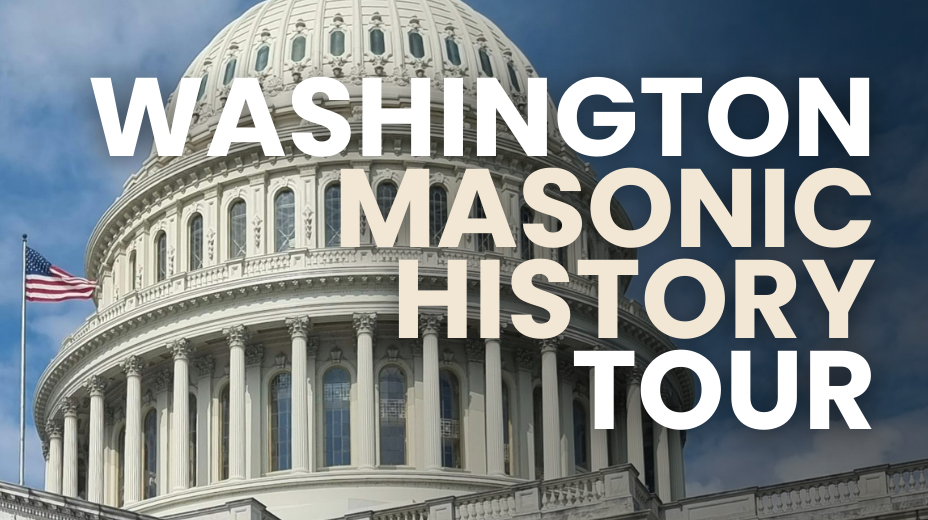
Day 1: Alexandria and the George Washington Masonic National Memorial
Begin your Masonic pilgrimage at the most visible landmark of American Freemasonry. The George Washington Masonic National Memorial dominates the Alexandria skyline, its 333-foot tower modeled after the ancient Lighthouse of Alexandria. This isn’t just Washington’s memorial. It’s a monument to Masonic cooperation on a scale never achieved before or since.
Morning: The Memorial’s Founding Story
The memorial’s story starts with tragedy. Alexandria-Washington Lodge No. 22 possessed invaluable artifacts from George Washington’s Masonic career, including items used when he was the lodge’s charter Master. In 1871, a fire destroyed portions of the lodge building and some of these irreplaceable treasures. The Brothers realized they needed a fireproof structure to protect what remained.
In 1907, Grand Masters from across the country gathered at Alexandria-Washington Lodge and established the George Washington Masonic National Memorial Association with a straightforward mission: to erect a memorial temple expressing the undying esteem of American Freemasons for George Washington. What made this project extraordinary was its funding model. Rather than accepting donations from wealthy patrons, the association asked each of the more than two million American Freemasons to contribute one dollar.
Construction began in 1922. The cornerstone ceremony took place November 1, 1923, drawing over 10,000 Freemasons. President Calvin Coolidge and Chief Justice William Howard Taft participated, using the same silver trowel Washington had employed at the Capitol cornerstone ceremony in 1793. That gavel and trowel have since consecrated cornerstones for the Washington Monument, Smithsonian Institution, Jefferson Memorial, National Cathedral, and dozens of other significant American buildings.
The Memorial Tour
Tours run daily at 9:30 AM, 11:00 AM, 12:30 PM, 2:00 PM, and 3:30 PM. Admission is $20 for adults; children 12 and under are free. The 90-minute guided tour takes you through multiple floors, each revealing different aspects of Washington’s life and Freemasonry’s influence.
Enter through the main door and ascend the granite stairs arranged in groups of three, five, seven, and nine steps. These are the sacred numbers of Pythagoras, instantly recognizable to any Master Mason. Memorial Hall awaits, dominated by a colossal 17-foot bronze statue of Washington in full Masonic regalia. Bryant Baker created this statue, dedicated in 1950 by President Harry Truman, himself a Past Grand Master of Missouri.
Three Allyn Cox murals surround the hall. The north wall depicts Washington attending Christ Church in Philadelphia for the Grand Lodge of Pennsylvania’s St. John’s Day Observance on December 28, 1778. The south wall shows Washington laying the Capitol cornerstone on September 18, 1793, wearing his Masonic apron and wielding the tools of the Craft.
Adjacent to Memorial Hall sits the Replica Lodge Room of Alexandria-Washington Lodge No. 22. This space recreates the old meeting room as it existed on Alexandria’s City Hall second floor for over 140 years. The original 1802 lodge furniture remains on display, including the altar, Master’s chair, and Wardens’ stations. The famous William Joseph Williams portrait of Washington hangs here, painted around 1796. Most significantly, visitors can see the Capitol Cornerstone Trowel, the actual tool Washington used during that historic 1793 ceremony.
Descending to the first level brings you to Grand Masonic Hall, an impressive space encircled by grille-lined balconies. Eight Doric columns of polished New Hampshire granite, each 4.5 feet in diameter and 18 feet high, support the ceiling. Six etched glass panels featuring the Memorial Crest and Square and Compasses enclose the room. A bronze bust of Washington sits in the east alcove, surrounded by a mural of Mount Vernon.
The first floor also houses the Form & Function of American Freemasonry exhibit, tracing the fraternity’s origins and colonial arrival. Key figures beyond Washington receive attention here: Benjamin Franklin, Andrew Jackson, and Harry Truman. A rotating Grand Lodge of the Month display highlights different jurisdictions throughout the year.
Ascending the tower, the third level presents the Family of Freemasonry exhibit, featuring affiliated organizations like the Order of the Eastern Star, Scottish Rite, York Rite, Shrine, and youth orders. The fourth level houses the George Washington Museum, with alcoves presenting Washington as Virginia Planter, Model Citizen, Military Officer, First President, Mourned Hero, and American Icon. Artifacts from Mount Vernon fill these spaces, donated by Washington family descendants, including the 1792 Washington Family Bible.
The eighth level holds an impressive Knights Templar chapel dedicated in 1957, featuring four stained glass windows designed by a Brother artist. Finally, the ninth floor opens onto the outdoor Observation Deck, offering a stunning 360-degree view of Alexandria, the Potomac, and Washington D.C. On clear days, you can see the Washington Monument in the distance, creating a visual connection between these two great memorials to the first President.
Afternoon: Old Town Alexandria
After touring the memorial, explore Old Town Alexandria, where Washington attended lodge meetings and socialized with his Masonic Brothers. Christ Church at 118 North Washington Street still stands where Washington worshipped. He purchased Pew 60 in 1773 and attended regularly when in Alexandria.
Walk down to King Street and the Potomac waterfront. This colonial port town attracted Washington frequently. He attended Masonic dinners at Gadsby’s Tavern, now both a museum and working restaurant. The tavern hosted Birthnight Balls in Washington’s honor, which he attended in 1798 and 1799.
Evening: Arlington
If time permits and you’re a Mason in good standing, contact Alexandria-Washington Lodge No. 22 in advance about attending one of their meetings. The lodge meets on the second Thursday of each month at 7:30 PM in the South Lodge Room at the Memorial itself. The experience of sitting in the lodge where Washington served as charter Master, in a building erected to his memory, surrounded by his actual lodge furniture, represents something unique in Masonic experience.
For non-Masons or those whose visit doesn’t align with a meeting night, enjoy dinner in Old Town Alexandria. Many restaurants occupy buildings from Washington’s era, and the atmosphere evokes the colonial period when Masons gathered here after lodge.
Day 2: Washington D.C. – The Capitol and National Mall
Today’s focus shifts to Washington’s most significant public Masonic act: laying the Capitol cornerstone.
Morning: The United States Capitol
September 18, 1793 witnessed one of American Freemasonry’s most important ceremonies. George Washington, serving as Grand Master pro tem, laid the Capitol cornerstone using full Masonic ritual. The ceremony began with an artillery company accompanying Washington across the Potomac. Masonic lodges from Maryland, Virginia, Georgetown, and the Federal City marched nearly two miles to the construction site.
Three Worshipful Masters bearing corn, wine, and oil stood with Washington. Joseph Clark, Grand Master of Maryland, received the President. Washington descended into the foundation trench and placed a silver plate made by Georgetown silversmith Caleb Bentley. The cornerstone was lowered onto it, and Washington consecrated the stone using ancient Masonic traditions. Chants accompanied his ascent. Artillery volleys punctuated speeches. A 500-pound ox was barbecued, and celebrations continued until dark.
That original cornerstone’s precise location remained lost for two centuries. In 1993, an extensive search using ground-penetrating radar and soil analysis identified its likely position beneath the southeast corner of the building. The silver plate was never recovered, presumably destroyed during 1850s construction.
Tours of the Capitol are free but require advance reservations through your Congressional representative or senator, or through the Capitol Visitor Center website. Tours don’t specifically mention the Masonic cornerstone ceremony, but knowing the history enriches the experience. Stand on the east front and imagine Washington in his Masonic apron, surrounded by hundreds of Brothers, consecrating the foundation of American democracy.
The Capitol Visitor Center, located underground on the east side, offers extensive exhibits about the building’s construction and history. While Masonic content is minimal, the architectural and historical displays provide context for understanding the Capitol’s significance in 1793.
Afternoon: Washington Monument
Walk west across the National Mall to the Washington Monument. At 555 feet, 5 inches, this obelisk dominates the D.C. skyline as the world’s tallest stone structure. Its Masonic connections run deep.
The cornerstone ceremony on July 4, 1848 mirrored the Capitol’s Masonic dedication. Benjamin Brown French, Grand Master of Masons for the District of Columbia, led the ritual in President James K. Polk’s presence. The 24,500-pound marble cornerstone was set using Washington’s original Masonic gavel. Inside a zinc case within the stone were 73 items including design plans, newspapers, coins, and a Bible.
What most visitors never see are the 22 Masonic memorial stones embedded in the monument’s interior walls. Fourteen Grand Lodges and eight individual lodges contributed these stones between 1848 and 1875. They range from simple granite blocks to elaborate marble carvings featuring compasses, squares, all-seeing eyes, and other Masonic emblems.
The standard elevator tour no longer stops to view these stones, but walking tours descending the 897 interior steps reveal all 193 commemorative stones, including the 22 Masonic contributions. These walking tours operate on a limited schedule and require advance booking. Check the National Park Service website or call ahead to arrange participation.
The Grand Lodge of Ohio’s stone displays a compass and square with an all-seeing eye and a sword on the Book of Constitutions. Kentucky’s stone specifically identifies Washington as a Christian Mason. The Grand Lodge of Arkansas contributed what may be the most ornate stone, with elaborate script and exaggerated Masonic symbols including a coffin at its base.
Even if you can’t take the walking tour, visit the monument’s base and imagine the 1848 ceremony. The same tools Washington used to consecrate the Capitol 55 years earlier were employed here, creating a direct link across generations of American Masonry.
Evening: The House of the Temple
End your second day at 1733 16th Street NW, about a mile directly north of the White House. The House of the Temple serves as headquarters for the Scottish Rite of Freemasonry, Southern Jurisdiction, and represents one of Washington’s most architecturally significant Masonic buildings.
John Russell Pope designed this masterpiece, modeling it after the Mausoleum of Halicarnassus, one of the Seven Wonders of the Ancient World. This was Pope’s first major commission in Washington, completed when he was only 36. He later designed the Jefferson Memorial, National Archives, and National Gallery of Art, but the House of the Temple established his reputation.
Two massive sphinxes flank the entrance. The right sphinx, with half-closed eyes, represents Wisdom. The left sphinx, alert and watchful, embodies Power. Sculptor Adolph A. Weinman created these guardians to set the tone for what lies beyond.
The building itself speaks in symbols. Thirty-three columns, each exactly 33 feet tall, surround the upper portion of the facade, representing the 33rd Degree of the Scottish Rite. A 13-step truncated pyramid sits atop the roof, echoing the pyramid on the Great Seal of the United States.
Tours run Monday through Thursday at 10:00 AM, 11:00 AM, 1:00 PM, and 2:00 PM. Admission is free, though the temple appreciates donations. The tour lasts approximately 90 minutes.
Inside, the granite stairs from the main entrance are arranged in groups of three, five, seven, and nine steps, the same Pythagorean progression as the Memorial in Alexandria. The Temple Room seems to expand rather than enclose space. Large windows flood the room with light, symbolizing the progressive search for illumination that defines the Masonic journey. The dome rises 100 feet above the altar, and an organ with over 14,000 pipes provides music for ceremonies.
The library, which Albert Pike insisted must be free and open to the public, contains one of the world’s largest collections of materials related to Scottish poet and Freemason Robert Burns. When the library opened in 1870, it was Washington D.C.’s first public library.
The museum houses numerous treasures, including a Masonic membership certificate signed by Paul Revere and a large painting of George Washington laying the Capitol cornerstone while wearing his Masonic apron. Albert Pike himself is buried beneath the building. In 1944, by an act of Congress, the Masons gained permission to exhume Pike’s remains from a local cemetery and inter them here.
Since Dan Brown’s “The Lost Symbol” featured the House of the Temple prominently, visits have increased by 60 percent. According to temple staff, Brown took the public tour multiple times while researching and was remarkably accurate in his descriptions.
Day 3: Fredericksburg – Washington’s Mother Lodge
Drive or take the train 50 miles south to Fredericksburg, Virginia. This colonial city holds the key to understanding Washington’s entry into Freemasonry and the lodge he remained faithful to throughout his life.
Morning: Ferry Farm
Before visiting the lodge, stop at Ferry Farm, where young George Washington lived from age six. The 80-acre site includes a reconstructed Washington house and extensive archaeological exhibits. While not specifically Masonic, Ferry Farm provides essential context for understanding Washington’s formative years in the Fredericksburg area.
The guided tour explores the lives of George, his mother Mary, and the enslaved community. The Visitor Center features colonial and Civil War artifacts excavated at Ferry Farm, with windows into the Archaeology Lab where researchers study thousands of discovered items.
Late Morning: Fredericksburg Lodge No. 4
At 803 Princess Anne Street stands the oldest continually occupied Masonic structure in Virginia. The building was completed in 1816 by builders George and Robert Ellis, who also constructed Fredericksburg’s Market House. Masons dedicated the new lodge on June 24, 1816, the feast day of St. John the Baptist. They have occupied it ever since.
But the lodge itself predates the building by more than 60 years. The first known meeting occurred in 1752. Just two months later, on November 4, 1752, George Washington was initiated into the mysteries of Freemasonry, paying a fee of two pounds, three shillings. He was 20 years old.
On March 3, 1753, Washington was passed to the Degree of Fellowcraft. On August 4, 1753, he was raised to the Sublime Degree of Master Mason. Lodge minutes record Washington attending only two more meetings: September 1, 1753, and January 4, 1755. This wasn’t unusual for the period. Many Masons never advanced beyond the Entered Apprentice degree, and frequent attendance wasn’t expected as it is today.
The lodge is closed to the public but available for group tours upon advance request. Contact the lodge secretary well ahead of your visit to arrange access. The tour reveals treasures that make Fredericksburg Lodge No. 4 one of Freemasonry’s most important sites.
The lodge possesses the Bible that George Washington took his Masonic obligations on. Placing your hand on the same Bible Washington used during his initiation creates a tangible connection across 270 years. An original Gilbert Stuart painting of Washington hangs in the lodge. Three hand-crafted colonial Wardens’ chairs sit in their positions, pieces of furniture that existed when Washington attended meetings.
A punchbowl used during the visit of Washington and the Marquis de Lafayette to the lodge in 1824 remains on display. Lafayette, also a Freemason, returned to America that year for a triumphal tour. After visiting Washington’s tomb at Mount Vernon, he traveled to Fredericksburg where the lodge made him an honorary member on November 20, 1824. Given that Washington had died in 1799, this was Lafayette’s opportunity to honor his friend’s memory at Washington’s Mother Lodge.
Perhaps most poignant is a lock of Washington’s hair and a handwritten eulogy delivered at the lodge upon his death in 1799. When Washington died on December 14, 1799, Fredericksburg Lodge mourned the loss of its most famous Brother. The Grand Lodge of Virginia proceedings list Washington as a deceased member of Fredericksburg Lodge No. 4.
Many of Washington’s Brothers in the Fredericksburg Lodge served in the Continental Army or Virginia Militia. Hugh Mercer, George Weedon, and Thomas Posey all belonged to this lodge. Fielding Lewis, who married Washington’s sister Betty, took responsibility with Charles Dick for running the local ammunition factory, sacrificing their fortunes to keep the Continental Army supplied.
Afternoon: Fredericksburg Walking Tour
After leaving the lodge, explore historic Fredericksburg. Washington knew this town intimately. He patronized specific shops, dined at particular taverns, and visited friends’ homes throughout the area.
The Rising Sun Tavern at 1304 Caroline Street operates as a museum. Built around 1760 by Washington’s brother Charles, it later became one of Fredericksburg’s most popular taverns. Costumed interpreters provide period atmosphere.
The Mary Washington House at 1200 Charles Street was purchased by George Washington in 1772 for his mother. She lived here from 1772 until her death in 1789. The small garden behind the house contains boxwood supposedly planted under her supervision.
Historic Kenmore at 1201 Washington Avenue was the home of Fielding Lewis and Betty Washington Lewis. This Georgian mansion showcases extraordinary plasterwork ceilings and provides insight into the lives of Washington’s extended family.
Evening: Return to Alexandria or D.C.
Drive back north, arriving in time for dinner. Reflect on the profound experience of visiting Washington’s Mother Lodge, standing in the same room where he took his obligations, touching the Bible he swore upon.
Day 4: Mount Vernon and the Potomac
While Mount Vernon isn’t specifically a Masonic site, no Washington tour would be complete without visiting his home. The estate provides context for understanding Washington the man, which enriches understanding Washington the Mason.
Morning/Afternoon: Mount Vernon
George Washington’s Mount Vernon sits on the Potomac River about 16 miles south of Washington D.C. The estate includes the mansion, outbuildings, gardens, a working farm, and Washington’s tomb.
The mansion tour highlights Washington’s life as a Virginia planter. The estate tour includes the kitchen, slave quarters, greenhouse, and other dependencies that made Mount Vernon a largely self-sufficient operation.
Most relevant to Masonic travelers, Mount Vernon occasionally displays Washington’s Masonic apron, presented to him at Mount Vernon in 1784 by the Marquis de Lafayette. This exquisite piece features Masonic symbols embroidered in silk and gold and silver-wrapped threads with metallic sequins, along with crossed flags of the United States and France. Thanks to a loan from Mt. Nebo Lodge No. 91 of Shepherdstown, West Virginia, Mount Vernon displays this apron around Washington’s birthday (mid-February) each year.
The Donald W. Reynolds Museum and Education Center contains 25 galleries and theaters presenting Washington’s life and legacy. One gallery focuses on Washington’s relationship with Freemasonry, displaying artifacts and explaining his Masonic career.
Washington’s tomb sits in a quiet grove. The original vault, built in 1799, proved inadequate, and a new tomb was constructed in 1831. The bodies of George and Martha Washington rest in marble sarcophagi visible through the tomb’s iron gates. Twice yearly, on the anniversaries of Washington’s birth and death, Masonic groups conduct formal wreath-laying ceremonies at the tomb. These ceremonies occur at 8:00 AM before the estate opens to the public, maintaining a tradition for over a century.
Plan at least three hours for Mount Vernon. The grounds are extensive, and if you rush, you’ll miss the details that illuminate Washington’s character and daily life.
Late Afternoon: Return to D.C.
Drive back to Washington for dinner and rest. Tomorrow begins exploration of D.C.’s other Masonic sites and the broader context of Freemasonry’s influence on the capital’s development.
Day 5: Masonic Symbols Throughout Washington D.C.
Today’s tour focuses on Masonic imagery woven throughout Washington’s architecture and street plan.
Morning: The Pentagon and Arlington National Cemetery
While the Pentagon itself isn’t specifically Masonic, its cornerstone was laid September 11, 1941, exactly 148 years after Washington laid the Capitol cornerstone. The ceremony didn’t employ Masonic ritual, but the date’s selection wasn’t coincidental.
Arlington National Cemetery holds the graves of numerous prominent Freemasons. Section 1 contains the remains of several Past Grand Masters and other Masonic dignitaries. The cemetery’s website provides a database for locating specific graves.
Most significantly for Masons, the Tomb of the Unknown Soldier in Arlington represents one of America’s most solemn monuments. Many Brothers make a point of witnessing the changing of the guard ceremony, which occurs every hour October through March and every 30 minutes April through September.
Late Morning: Return to Downtown D.C.
Head back into the city for a walking tour of Masonic symbols in federal buildings and monuments.
The Library of Congress Thomas Jefferson Building at 10 First Street SE contains numerous Masonic symbols in its elaborate decoration. The building, completed in 1897, represents Beaux-Arts architecture at its finest. While not explicitly Masonic, many of the symbols used in the building’s decoration carry Masonic significance: all-seeing eyes, columns, various geometric patterns.
The Supreme Court Building at 1 First Street NE, completed in 1935, features classical architecture with symbolic elements that resonate with Masonic imagery. Cass Gilbert designed the building in the Corinthian style, with 24 columns in the west portico.
The National Archives Building at 700 Pennsylvania Avenue NW was designed by John Russell Pope, the same architect who created the House of the Temple. Completed in 1935, the building shares stylistic elements with Pope’s Masonic masterpiece. The rotunda, with its 75-foot-high dome, creates an impressive space for displaying the Declaration of Independence, Constitution, and Bill of Rights.
Afternoon: Dupont Circle and Embassy Row
Walk through the Dupont Circle neighborhood, passing the House of the Temple again in daylight. Continue north along 16th Street into Embassy Row. Many of the grand mansions along this stretch, now serving as embassies, were built by wealthy Americans in the early 20th century, the same period when Masonic membership peaked in America.
The Scottish Rite’s location on 16th Street places it among these impressive structures, deliberately positioned to reflect Masonry’s prominence in American society during that era.
Evening: A Masonic Dinner
If your visit coincides with a meeting at one of D.C.’s lodges and you’re a Mason in good standing, arrange to attend. Washington D.C. has numerous active lodges, many meeting in the 400 block of S. Street NW at the Grand Lodge of the District of Columbia building. Contact lodges in advance to confirm meeting schedules and visiting requirements.
For non-Masons or those unable to attend a meeting, dine at one of D.C.’s historic restaurants. The Old Ebbitt Grill, opened in 1856, has served presidents and dignitaries for over 150 years. While not specifically Masonic, it represents the type of establishment where 19th-century Masons gathered after meetings.
Day 6: Beyond the Famous Sites
Today explores lesser-known Masonic locations and the broader context of Washington’s architecture.
Morning: The National Cathedral
Washington National Cathedral, officially the Cathedral Church of Saint Peter and Saint Paul, took 83 years to complete (1907-1990). The cornerstone was laid September 29, 1907, using the same gavel and trowel George Washington employed at the Capitol ceremony in 1793.
While the cathedral isn’t Masonic, many of its donors and supporters were Freemasons. The building represents Gothic Revival architecture at its finest, with symbolic elements throughout. Guided tours explain the cathedral’s construction, history, and symbolism.
The cathedral sits at the highest point in Washington, offering views across the city from its towers (when tower access is open, which varies seasonally).
Afternoon: Georgetown
Walk through Georgetown, Washington’s oldest neighborhood. Many buildings predate the federal government’s arrival in 1800. Georgetown Lodge operated here in the 18th century, and several structures retain Masonic connections.
The Old Stone House at 3051 M Street NW, built in 1765, is the oldest unchanged building in Washington. While not Masonic, it represents the type of structure where early Georgetown Masons might have gathered.
Tudor Place at 1644 31st Street NW offers tours of a Federal-style mansion completed in 1816. The home stayed in the Custis-Peter family (Martha Washington’s descendants) for six generations. While tours don’t focus on Masonic connections, the family’s relationship with Washington provides context.
Evening: Reflection and Planning
Use this evening to revisit any sites that particularly interested you or to explore areas you didn’t have time for earlier in the week. Many of D.C.’s monuments are beautifully illuminated at night, and evening visits offer different perspectives on familiar buildings.
Day 7: Final Explorations and Departure
Your final day allows for completing any unfinished business and visiting sites that align with your specific interests.
Morning Options:
Option A: Return to the George Washington Masonic National Memorial If you rushed through the Memorial on Day 1, return for a more leisurely visit. The observation deck view is particularly stunning in morning light. Spend time in the museum sections you didn’t fully explore.
Option B: The Smithsonian Several Smithsonian museums contain items relevant to Washington and Freemasonry. The National Museum of American History includes some of Washington’s personal belongings and displays about his presidency. While not specifically Masonic, these exhibits add context to understanding his life.
Option C: The Masonic District Grand Lodge Building If you haven’t already visited, the Grand Lodge of the District of Columbia at 451 S. Street NW offers occasional tours by appointment. The building houses lodge rooms and Masonic library materials. Contact them well in advance to arrange access.
Afternoon: Christ Church Alexandria
If you haven’t yet visited Christ Church at 118 North Washington Street in Alexandria, make this your final stop before departing. This Georgian-style church, completed in 1773, holds Pew 60, which George Washington purchased. He attended regularly when residing at Mount Vernon.
The church remains an active Episcopal congregation. Guided tours are available, and the gift shop sells books about Washington and the church’s history. Standing in Washington’s pew, you can imagine him attending service here before or after Masonic meetings in Alexandria.
The churchyard contains graves of prominent Alexandrians, some of whom were Washington’s Masonic Brothers. Walking through the graveyard connects you to the community Washington knew intimately.
Practical Information for Your Washington D.C. Masonic Journey
Visiting Lodges as a Traveling Mason
If you’re a Master Mason in good standing, bring proof of your status: current dues card and a letter of introduction from your home lodge. Contact lodge secretaries well in advance of your visit to confirm meeting schedules, as many D.C. area lodges meet only monthly.
Virginia lodges generally meet in evening hours, typically 7:00 PM or 7:30 PM. Dress code is conservative: dark suit and tie minimum. Some lodges require tuxedos for special occasions.
Be prepared for ritual differences. Virginia’s ritual differs from other jurisdictions, though the essential elements remain the same. The experience of visiting Virginia lodges, particularly those connected with Washington, creates memories that last a lifetime.
Best Time to Visit
Spring (April-May) and fall (September-October) offer the best weather. Cherry blossoms bloom in late March or early April, drawing crowds. If you visit during cherry blossom season, book accommodations far in advance.
Summer (June-August) brings heat, humidity, and tourist crowds. Many D.C. residents escape the city during August, and some lodges don’t meet during summer months.
Winter (December-February) offers fewer crowds and lower hotel rates, but weather can be cold and occasionally snowy. However, lodges are most active during winter months, increasing your chances of attending a meeting.
Washington’s birthday (February 22) and the anniversary of his death (December 14) feature special Masonic ceremonies at Mount Vernon. These wreath-laying ceremonies begin at 8:00 AM before the estate opens to the public. Contact the George Washington Masonic National Memorial in advance if you’re interested in participating.
Transportation
Washington Metro provides excellent service to many sites on this itinerary. The King Street-Old Town station (Blue and Yellow lines) is about a mile from the George Washington Masonic National Memorial and puts you in the heart of Old Town Alexandria. The Dupont Circle station (Red Line) is a half-mile walk from the House of the Temple.
However, a rental car provides maximum flexibility, especially for visiting Fredericksburg and Mount Vernon. Parking in D.C. can be challenging and expensive, so consider using Metro when exploring downtown and your car for excursions to Virginia.
Accommodation
Alexandria offers numerous hotels within walking distance or short Metro rides of the Memorial and Old Town. Staying in Alexandria reduces travel time to Virginia sites while maintaining easy Metro access to D.C.
Washington D.C. hotels range from budget to luxury. Georgetown, Dupont Circle, and Downtown all offer good options with Metro accessibility.
Dining
Old Town Alexandria and Georgetown offer the best dining related to Washington’s era. Gadsby’s Tavern in Alexandria still operates as a restaurant and provides 18th-century atmosphere.
Modern D.C. offers diverse dining options at all price points. The area around Dupont Circle, near the House of the Temple, features numerous restaurants.
Additional Considerations
Many Masonic sites require advance planning. Contact lodges, arrange tours, and confirm operating hours before your visit.
The George Washington Masonic National Memorial is closed on federal holidays. The House of the Temple is closed Friday through Sunday for public tours, though weekend group tours can be arranged with advance notice.
Security screening is required for all federal buildings. Bring government-issued photo ID and allow extra time for security lines, especially at the Capitol and Supreme Court.
Photography policies vary. The Masonic Memorial permits personal photography. Federal buildings often restrict photography. Always ask before taking pictures in lodges or during Masonic ceremonies.
The Deeper Meaning
This week-long journey through Washington D.C.’s Masonic heritage isn’t just about seeing historic buildings and artifacts.
It’s about understanding how Freemasonry shaped American democracy at its inception and continues to influence American civic life.
George Washington’s decision to employ full Masonic ritual when laying the Capitol cornerstone in 1793 sent a clear message: the new nation’s seat of government would be consecrated according to ancient traditions of craft and brotherhood.
He could have used any ceremony or none at all. He chose Masonic ritual, publicly and proudly, with thousands witnessing.
That choice echoed through subsequent generations. When the Washington Monument cornerstone was laid in 1848, Masons again performed the ceremony using Washington’s tools.
When the George Washington Masonic National Memorial was begun in 1923, the cornerstone ceremony employed those same tools, creating an unbroken chain of ceremonial continuity spanning 130 years.
The buildings themselves tell stories beyond their obvious purposes. John Russell Pope’s House of the Temple deliberately invokes one of the Seven Wonders of the Ancient World, positioning Freemasonry alongside humanity’s greatest achievements.
The George Washington Masonic National Memorial’s lighthouse form references another Wonder, the Lighthouse of Alexandria, connecting Washington’s enlightenment to ancient wisdom.
These aren’t subtle architectural choices. They’re bold declarations of Masonic values and Masonic pride, created during Freemasonry’s peak influence in American society.
Walking through Washington D.C. with awareness of its Masonic heritage transforms the experience. Those cornerstones aren’t merely foundation stones. That symbolism isn’t just decoration.
The geometric relationships in the city’s design aren’t coincidental. Everything connects to a philosophical system that sought to build not just material structures but better men and better societies.
For Masons, this pilgrimage offers connection to their Craft’s American roots. Standing where Washington stood, using spaces he used, seeing artifacts he touched creates tangible links across centuries.
For non-Masons interested in American history, these sites reveal how one fraternal organization profoundly influenced the nation’s founding and development.
The week concludes not with all questions answered but with deeper appreciation for the complex relationship between Freemasonry and American democracy.
You return home with stories to share, photographs to treasure, and understanding that the Craft you practice or study wasn’t marginal to American history. It was central.
That’s the real gift of a Washington D.C. Masonic pilgrimage: seeing clearly what was always there but often overlooked, understanding the philosophical foundations beneath the political structures, and recognizing that the Masonic principles of brotherly love, relief, and truth helped shape the nation that emerged from those lodges in 18th-century Virginia.
We also make a conscious effort to keep the site ad-free, so the experience stays focused and uncluttered.
If you’d like to help keep the project going, your support is genuinely appreciated.
DGADU
Brother!