
Every day, thousands of tourists wander through Washington D.C., snapping photos of monuments and marveling at grand federal buildings.
What most don’t realize is that they’re walking through one of the most symbol-rich cities in the world, where Masonic imagery has been woven into the very fabric of America’s capital.
From the street layout to building designs, from cornerstones to interior decorations, the influence of Freemasonry is everywhere, hiding in plain sight.
The story of Masonic Washington begins with the city’s founding. Many of the men who shaped the capital were Brothers, including George Washington himself.
Their vision for the new nation’s seat of power went beyond mere functionality. They created a city infused with symbolism, geometry, and meaning that speaks to those who know how to read it.
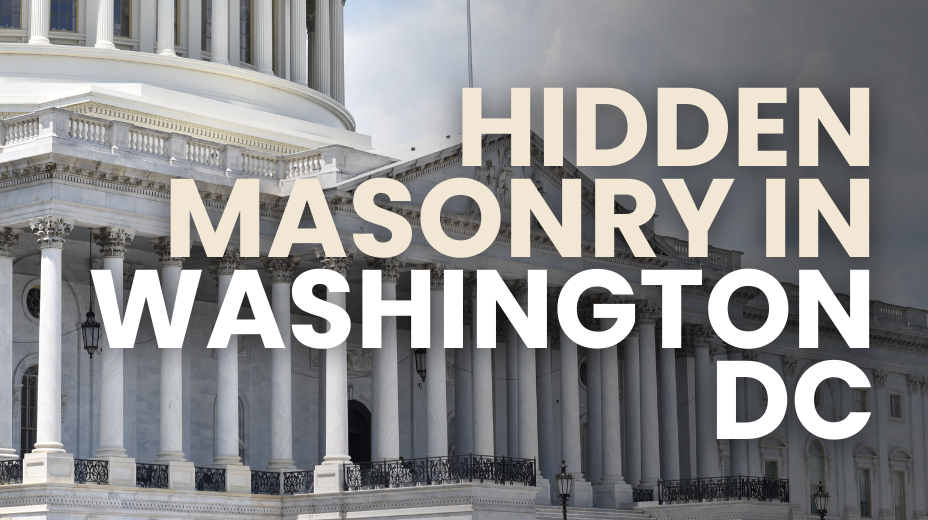
The Capitol Building’s Masonic Birth
The most significant Masonic ceremony in Washington’s history took place on September 18, 1793. On that day, President George Washington, wearing his Masonic apron embroidered with symbols of the Craft, laid the cornerstone of the United States Capitol in full Masonic ritual.
The ceremony was spectacular. Washington crossed the Potomac with an artillery company, joined by Masonic lodges from Maryland, Virginia, Georgetown, and the Federal City.
They marched nearly two miles to the construction site, where Washington was received by Joseph Clark, Grand Master of Maryland. The president descended into the foundation trench and placed a silver plate made by Georgetown silversmith Caleb Bentley before the cornerstone was lowered onto it.
Three Worshipful Masters stood with Washington, bearing corn, wine, and oil used to consecrate the stone according to ancient Masonic tradition. Chants accompanied Washington’s ascent from the trench. Artillery volleys punctuated speeches. When the formalities concluded, a 500-pound ox was barbecued and the celebration continued until dark.
The tools Washington used that day have become sacred relics. His gavel has since been used to lay cornerstones for the Washington Monument, the Smithsonian Institution, the Jefferson Memorial, the National Cathedral, and dozens of other significant buildings.
The trowel he employed remains on display at the George Washington Masonic National Memorial in Alexandria.
The precise location of that original Capitol cornerstone was lost to history for two centuries. In 1993, after an extensive search using ground-penetrating radar and soil analysis, officials announced they had likely found it beneath the southeast corner of the building.
The silver plate was never recovered, possibly destroyed during 1850s construction.
The Washington Monument’s Hidden Masonry
Standing at 555 feet, 5 inches tall, the Washington Monument dominates the D.C. skyline as the world’s tallest stone structure. Its Masonic connections run deep, both literally and figuratively.
The cornerstone ceremony on July 4, 1848, mirrored the Capitol’s Masonic dedication. Benjamin Brown French, Grand Master of Masons for the District of Columbia, led the ritual in the presence of President James K. Polk.
The 24,500-pound marble cornerstone was set using Washington’s original Masonic gavel. Inside a zinc case within the stone were 73 items including design plans, newspapers, coins, and a Bible.
What most visitors never see are the 22 Masonic memorial stones embedded in the monument’s interior walls. Fourteen Grand Lodges and eight individual lodges contributed these stones between 1848 and 1875.
They range from simple granite blocks to elaborate marble carvings featuring compasses, squares, all-seeing eyes, and other Masonic emblems.
The Grand Lodge of Ohio’s stone displays a compass and square with an all-seeing eye and a sword on the Book of Constitutions. Kentucky’s stone specifically identifies Washington as a Christian Mason.
The Grand Lodge of Arkansas contributed what may be the most ornate stone, with elaborate script and exaggerated Masonic symbols including a coffin at its base.
These stones sit alongside memorial blocks from all 50 states, foreign countries, and various organizations. Among the most unusual are contributions made from Michigan copper, Arizona petrified wood, and Alaskan jade.
All 193 commemorative stones are visible to visitors who take the walking tour down the monument’s 897 interior steps.
The House of the Temple: Washington’s Masonic Crown Jewel
At 1733 16th Street NW, about a mile directly north of the White House, stands one of Washington’s most imposing yet least understood buildings.
The House of the Temple serves as headquarters for the Scottish Rite of Freemasonry, Southern Jurisdiction, and it’s a masterpiece of symbolic architecture.
Designed by John Russell Pope, the same architect behind the Jefferson Memorial and National Archives, the House of the Temple was modeled after the Mausoleum of Halicarnassus, one of the Seven Wonders of the Ancient World.
This was Pope’s first major commission in Washington, completed when he was only 36 years old.
Two massive sphinxes flank the entrance. The one on the right, with half-closed eyes, represents Wisdom. The one on the left, alert and watchful, embodies Power. Sculptor Adolph A. Weinman created these guardians to set the tone for what lies beyond.
The building itself is thick with symbolism. Thirty-three columns, each exactly 33 feet tall, surround the upper portion of the facade, representing the 33rd Degree of the Scottish Rite.
A 13-step truncated pyramid sits atop the roof, echoing the pyramid on the Great Seal of the United States.
Inside, the granite stairs from the main entrance are arranged in groups of three, five, seven, and nine steps. These are the sacred numbers of Pythagoras, instantly recognizable to any Master Mason.
The dark green marble floors lead to a grand staircase and eventually to the Temple Room, where the walls seem to expand rather than enclose the space. Large windows flood the room with light, symbolizing the progressive search for illumination that defines the Masonic journey.
The building houses numerous treasures, including a Masonic membership certificate signed by Paul Revere and a large painting of George Washington laying the Capitol cornerstone while wearing his Masonic apron.
Albert Pike, the controversial Confederate general who spent 32 years developing Scottish Rite rituals, is actually buried in the temple itself. In 1944, by an act of Congress, the Masons gained permission to dig up Pike’s remains from a local cemetery and inter them beneath the building.
Since Dan Brown’s novel “The Lost Symbol” featured the House of the Temple prominently in its opening scene, visits to the building have increased by 60 percent.
The author took the public tour multiple times while researching, and according to the temple’s staff, he was remarkably accurate in his descriptions.
The George Washington Masonic National Memorial
Visible for miles around, the 333-foot-tall George Washington Masonic National Memorial sits atop Shooter’s Hill in Alexandria, Virginia.
This towering structure, modeled after the ancient Lighthouse of Alexandria (another Wonder of the Ancient World), took nearly 50 years to complete.
The memorial’s cornerstone ceremony on November 1, 1923, drew over 10,000 Freemasons from across the country. President Calvin Coolidge and Chief Justice William Howard Taft both participated, using the same silver trowel Washington had used at the Capitol cornerstone ceremony 130 years earlier.
The building was designed to be permanent in the truest sense. It’s constructed almost entirely of masonry with minimal metal, based on the principle that pure stone construction would outlast any other method. Each of the eight fluted Conway granite columns supporting the portico weighs 63 tons and stands 33 feet high.
Inside Memorial Hall on the second floor, eight more green granite columns support the ceiling. Each stands 38.5 feet tall and weighs 63 tons.
At the western end stands a 17-foot-tall bronze statue of Washington in full Masonic regalia, weighing seven tons. Murals by Allyn Cox depict Washington attending services at Christ Church and laying the Capitol cornerstone in his Masonic apron.
The building houses Washington’s personal Masonic artifacts, collectively known as “Washingtonia.”
These include items from his time as the first Master of Alexandria Lodge No. 22, the Bible he used when initiated into Fredericksburg Lodge No. 4 in 1752, and the gavel and trowel he employed at the Capitol ceremony.
Masonic Influence on D.C.’s Street Design
Some researchers have identified geometric patterns in Washington’s street layout that they interpret as Masonic symbols. The city’s unique design, created by Pierre L’Enfant but substantially modified by Washington, Jefferson, and others (many of them Masons), departs from the simple grid patterns common in other American cities.
Diagonal avenues radiating from circles create complex geometric relationships throughout the city.
Some have noted that certain street intersections, when viewed from above, appear to form pentagrams and other symbolic shapes. Whether these were intentional designs or merely coincidental products of practical city planning remains a subject of debate.
What’s undeniable is that the original ten-mile square boundary of the District of Columbia, established by George Washington in 1791, was centered on the originally proposed location for the Washington Monument.
The diagonals of this square cross both the Capitol and the White House, creating geometric relationships that some view as significant.
The Persistent Masonic Presence
Freemasons laid cornerstones for most of Washington’s major buildings throughout the 19th and early 20th centuries. The tradition continues today.
The same tools Washington used in 1793 have consecrated foundations for the Herbert Hoover Building, the British Embassy chancery, and countless other structures.
This pattern reveals something fundamental about Freemasonry’s role in American civic life. For the nation’s founders and the generations that followed, Masonic ceremony provided a way to sanctify public buildings, connecting new construction to ancient traditions of craft and brotherhood.
The symbols embedded throughout Washington aren’t secret codes or conspiracy markers. They’re public declarations of the values the builders held dear: geometry and order, light and knowledge, brotherhood and service.
The Masons who shaped Washington’s physical form saw themselves as part of a tradition stretching back to the stonemasons who built Solomon’s Temple, and they wanted their work to reflect that heritage.
Discovering Masonic Washington Today
Most of these Masonic sites are accessible to the public. The House of the Temple offers tours Monday through Thursday. The George Washington Masonic National Memorial welcomes visitors and houses a museum open to all.
The Washington Monument’s interior stones can be seen on walking tours (though you’ll need to be in good physical condition to manage the descent).
Walking through Washington with an awareness of its Masonic heritage transforms the experience. That cornerstone you pass carries more than a date.
Those geometric patterns in the pavement aren’t merely decorative. The buildings themselves become books written in stone, telling stories of the men who built them and the ideals they hoped to preserve.
The next time you visit the nation’s capital, look a little closer. The symbols are there, waiting to be recognized. Some speak only to those who’ve taken Masonic obligations.
Others communicate universal principles of order, light, and brotherhood that anyone can appreciate.
Either way, they remind us that Washington D.C. is more than a collection of government buildings. It’s a physical manifestation of the philosophical principles that shaped America itself.
These hidden symbols aren’t relics of a forgotten past. They’re living connections to the ideals that motivated the nation’s founders. Understanding them enriches our appreciation of both the city and the history it represents.
So the next time you’re standing before the Capitol or looking up at the Washington Monument, remember: you’re not just seeing stone and marble. You’re witnessing a conversation in symbols that has continued for more than two centuries, written by Masons for anyone with eyes to see.
We also make a conscious effort to keep the site ad-free, so the experience stays focused and uncluttered.
If you’d like to help keep the project going, your support is genuinely appreciated.