
Rome is a city of layers. Walk its streets and you’re treading on 2,800 years of continuous civilization. Dig down a few feet and you’ll find a medieval church. Dig deeper and there’s a Roman temple.
Deeper still, Etruscan foundations. Every era builds upon what came before, creating a vertical history that extends from bedrock to sky.
For Freemasons, Rome offers something unique. This is where our operative ancestors perfected the arch, the dome, and the principles of classical architecture that later became our symbolic language.
This is where Renaissance masters transformed stone into living art. And this is where modern Italian Freemasonry was forged in the revolutionary fires of the Risorgimento, emerging as a force that helped unify a fractured peninsula into a nation.
Today, over 22,000 Freemasons meet in more than 840 lodges across Italy, with Rome remaining the heart of Italian Masonry.
The Grand Orient of Italy, founded in 1805, operates from Villa del Vascello on the Janiculum Hill, a building that witnessed Garibaldi’s last stand for the Roman Republic in 1849.
But Rome’s Masonic story begins much earlier, in a city where the Pope’s temporal power made even whispered Masonic meetings acts of defiance.
The Inquisition and the First Lodges (1733-1870)
Freemasonry arrived in Rome in 1733 through an English-speaking lodge that admitted George Seton, 5th Earl of Winton, a Scottish Jacobite in exile.
This first lodge, often called the Jacobite Lodge of Rome, operated cautiously in a city where the Inquisition watched everything.
The caution proved warranted. In 1737, just four years after the lodge’s founding, Inquisition agents arrested its officers. The lodge closed down immediately. The following year, 1738, Pope Clement XII issued “In eminenti apostolatus,” the first papal bull condemning Freemasonry.
The bull made Masonic activity illegal in the Papal States and threatened excommunication for Catholic Masons. Every subsequent pope through the 19th century renewed and expanded these condemnations.
Yet Freemasonry refused to die. Foreign Masons continued meeting in secret, protected by diplomatic immunity.
In 1742, they issued a medal honoring Martin Folkes, President of the Royal Society and a prominent English Mason, a quiet declaration that the Craft survived despite persecution. In 1787, a permanent lodge was established, only to be erased by the Inquisition two years later, the same day they captured the notorious Alessandro Cagliostro.
Cagliostro, whose real name was Giuseppe Balsamo, deserves mention in any Masonic history of Rome. This charlatan, confidence man, and self-styled “Grand Cophta” of Egyptian Freemasonry arrived in Rome in 1789 with his wife Lorenza. The Inquisition arrested them both.
Cagliostro was tried, convicted of heresy and Freemasonry, and sentenced to death. Pope Pius VI commuted the sentence to life imprisonment.
Cagliostro died in the fortress of San Leo in 1795. His story demonstrates the dangers facing Masons in 18th-century Rome and explains why the Craft operated so carefully in the Eternal City.
Napoleon and the Grande Oriente d’Italia
Everything changed when French forces occupied Rome in 1809. Napoleon’s armies brought revolutionary ideas and religious tolerance.
Freemasonry flourished openly for the first time. In Milan, the Grand Orient of Italy was founded on March 16, 1805, with Napoleon’s viceroy Eugene de Beauharnais instrumental in its establishment.
This marked the beginning of organized Italian Freemasonry.
The freedom was brief. When the Pope returned to power in 1814 following Napoleon’s defeat, suppression resumed immediately. For the next 56 years, Roman Freemasonry operated underground or not at all.
The Grand Orient of Turin managed to establish a lodge in Rome in 1861, but it remained precarious until the final defeat of papal temporal power.
September 20, 1870: The Breach of Porta Pia
The date September 20 holds sacred significance for Italian Masons. On that day in 1870, Italian troops breached Rome’s walls at Porta Pia, ending papal temporal rule and making Rome the capital of unified Italy.
Many officers who led the assault were Freemasons. General Raffaele Cadorna, who commanded the operation, was a Brother. The artillery officer who first breached the wall reportedly wore his Masonic apron under his uniform.
The Grand Orient celebrates September 20 annually, commemorating the day when Rome finally became free for Masonic activity. Within months, lodges opened throughout the city.
On April 21, 1901, the Grand Orient inaugurated its new headquarters at Palazzo Giustiniani, a Renaissance palace near the Pantheon.
For the first time, Italian Masons had a permanent, public home in the city that had persecuted them for over a century.
Giuseppe Garibaldi: The Masonic Hero of Italian Unity
No figure better represents Italian Freemasonry than Giuseppe Garibaldi. Initiated in 1844, Garibaldi rose to become honorary Past Grand Master of the Grand Orient.
His red-shirted volunteers, the Garibaldini, included many Masons. When internal disputes threatened to fragment Italian Freemasonry into competing factions, Garibaldi personally intervened, convening a congress in Naples in 1867 that began the process of unification completed in 1873.
Garibaldi embodied Masonic principles in action.
His lifelong fight for Italian unity, his commitment to republicanism and democracy, his opposition to papal temporal power, all reflected Masonic ideals of liberty, equality, and fraternity.
Italian Masons revere him not merely as a great general but as the Brother who proved that Masonic principles could transform nations.
Today, monuments to Garibaldi stand throughout Rome, most prominently on the Janiculum Hill where he defended the short-lived Roman Republic in 1849.
For visiting Masons, these monuments take on special meaning. You’re not just honoring a military hero but a Brother who changed history.
Fascism and Suppression (1925-1945)
Italian Freemasonry’s golden age ended abruptly on February 13, 1923, when Benito Mussolini declared Freemasonry incompatible with Fascism.
The ban became official in 1925. Lodges closed. Property was confiscated. Prominent Masons were exiled to the Lipari Islands without trial. General Luigi Capello was expelled from the Fascist Party in 1923 for refusing to leave his lodge.
The next year he was accused of plotting to assassinate Mussolini and sentenced to 30 years’ imprisonment.
The persecution mirrored what was happening across fascist Europe. Hitler banned Freemasonry in Germany. Franco did the same in Spain.
Totalitarian regimes recognized that Masonic principles of individual liberty, tolerance, and brotherhood directly threatened their authority.
Many Fascists had previously been Freemasons, creating bitter betrayals. The connection between early Fascism and Freemasonry remains controversial in Italy.
What’s clear is that once Mussolini consolidated power, he viewed lodges as potential centers of opposition and moved ruthlessly to eliminate them.
Italian Freemasonry continued in exile. Italian Masons contributed to the Republican cause in the Spanish Civil War. They participated in anti-Fascist movements throughout Europe. But within Italy itself, organized Masonic activity ceased until liberation in 1944.
Rebirth and Scandal
On June 10, 1944, just six days after Rome’s liberation, the Grand Orient issued a manifesto announcing its resurrection. The Grand Master who had been exiled to the Lipari Islands returned to Rome. Lodges began meeting again.
The Palazzo Giustiniani, which had been seized by Fascists, was recovered.
The post-war decades saw steady growth. By the 1970s, Italian Freemasonry appeared to have recovered fully from Fascist suppression. Then came the P2 scandal, which nearly destroyed Italian Masonry’s reputation.
Propaganda Due, known as P2, was chartered by the Grand Orient in 1877. In the 1960s, businessman Licio Gelli became its master and transformed it into something far beyond a normal lodge. P2 became a secret network of influential Italians: politicians, military officers, businessmen, journalists, even Mafia members.
When authorities discovered P2’s membership list in 1981, it read like a who’s who of Italian power.
Investigations linked P2 to numerous scandals, including the collapse of Banco Ambrosiano and the murder of banker Roberto Calvi, found hanging under London’s Blackfriars Bridge in 1982.
The Grand Orient revoked P2’s charter in 1974, but the damage was done. For decades, “Masonic” became synonymous with “conspiracy” in Italian public discourse.
In 1993, the United Grand Lodge of England withdrew recognition from the Grand Orient of Italy due to corruption concerns, though it continued to recognize most other regular Grand Lodges worldwide.
This created an unusual situation: the Grand Orient remained recognized by the vast majority of regular jurisdictions but lacked recognition from the three most senior Grand Lodges (England, Scotland, Ireland).
This was finally rectified in March 2023, when the UGLE restored full recognition to the Grand Orient of Italy.
Visiting Villa del Vascello: The Heart of Italian Freemasonry
The Grand Orient’s headquarters sits on the Janiculum Hill, Rome’s highest point on the west bank of the Tiber. Villa del Vascello gets its name from its unique shape, resembling a ship (vascello).
The villa’s history intertwines with Italian unity in the most dramatic way possible.
In 1849, Giuseppe Garibaldi and his volunteers defended the short-lived Roman Republic against French forces sent to restore papal power.
Villa del Vascello became the last Republican bastion. General Giacomo Medici commanded its defense, holding out against overwhelming odds. When the Republicans finally surrendered, the villa lay in ruins, shattered by artillery.
In 1877, Medici purchased the damaged property. King Vittorio Emanuele II had granted him the title “Marquis del Vascello” for his heroic defense.
Medici’s brother Luigi consolidated the remains of what had been called the “Citrus Lodge,” preserving it as a symbol of Risorgimento heroism.
In 1983, the Grand Orient purchased the property and transformed it into their headquarters, completing the move in 1985 when they were forced to leave Palazzo Giustiniani. Today, the villa houses lodge rooms, a library open to scholars, and extensive archives.
Paintings with Masonic subjects decorate the large rooms. The garden contains busts and monuments to eminent Italian Masons, set among century-old trees. A majestic lime tree in the foreground frames a perfect view of St. Peter’s dome, creating a symbolic connection between the Masonic and Catholic hearts of Rome.
Visiting Information: Address: Via di San Pancrazio 8, 00152 Rome The villa is not open for casual tourist visits, but Masons from recognized jurisdictions can arrange tours by contacting the Grand Orient office in advance. Bring current dues cards and a letter of introduction from your home lodge. The Grand Orient maintains fraternal relations with 191 regular Grand Lodges worldwide, so Brothers from most jurisdictions can visit.
The easiest approach is to contact them via email through their website (grandeoriente.it) at least two weeks before your visit.
Explain your jurisdiction, provide your credentials, and request a tour. English-speaking staff can usually accommodate visiting Brothers.
The villa is accessible by public transportation. Take Tram 8 from Trastevere to Piazza Gioacchino Belli, then walk about 10 minutes up the hill. Alternatively, take bus 870 to Stazione Trastevere, then walk 15 minutes. The climb is steep but worth it for the views alone.
Ancient Roman Sites Through Masonic Eyes
While Rome’s organized Freemasonry dates only to the 18th century, the city’s ancient architecture directly influenced Masonic symbolism. Walking through Roman ruins, you’re seeing the work that inspired our allegorical lessons about building.
The Pantheon: The Pantheon’s perfect proportions and massive dome represent the height of Roman engineering. Built by Emperor Hadrian around 126 CE, it remains the world’s largest unreinforced concrete dome. The oculus at the dome’s apex allows sunlight to stream through, moving across the interior as the day progresses, a natural representation of the sun’s course that Masons will recognize from ritual.
The Pantheon originally served as a temple to all gods. Its transformation into a Christian church in 609 CE ensured its preservation when other pagan temples were destroyed. Today it’s free to visit, though expect crowds. Go early in the morning or late afternoon for the best light and fewer tourists.
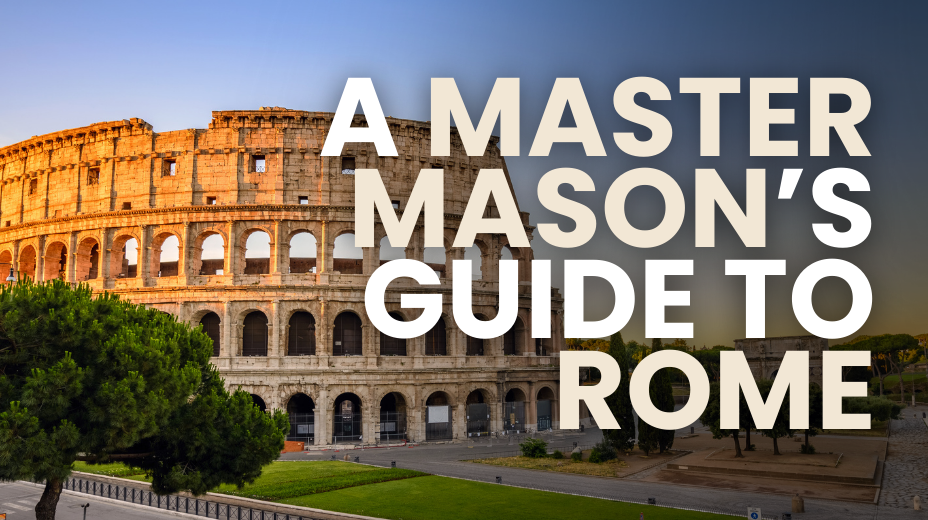
The Colosseum: The Colosseum showcases Roman mastery of the arch and vault. Every Entered Apprentice learns about the keystone’s significance. Here you can see thousands of arches, each depending on its keystone for structural integrity. The Colosseum’s builders understood principles that Masons later adopted symbolically.
The building’s original name was the Flavian Amphitheater. “Colosseum” derives from a colossal bronze statue of Nero that once stood nearby. Despite centuries of earthquakes, stone-robbing, and neglect, the structure endures, testifying to its builders’ skill.
The Roman Forum: The Forum was ancient Rome’s civic center, where citizens gathered for commerce, politics, and justice. Walking through the ruins, you’re treading where Julius Caesar walked, where senators debated, where the republic gave way to empire. Several ancient temples here were built by guilds of skilled craftsmen, the collegia, which some Masonic historians view as precursors to medieval stonemasons’ guilds.
The Arch of Titus displays relief sculptures showing spoils from Jerusalem’s temple, including the menorah. These images influenced later architectural decoration and connect Rome to the Temple of Solomon that figures so prominently in Masonic tradition.
Renaissance Architecture: The Operative Craft at Its Peak
Rome’s Renaissance and Baroque buildings demonstrate what operative masons accomplished at their craft’s peak.
The architects and builders who created these masterpieces were the last generation to directly connect medieval building traditions with emerging Renaissance ideas.
St. Peter’s Basilica: St. Peter’s took 120 years to build (1506-1626) and involved the era’s greatest architects: Bramante, Raphael, Michelangelo, and Bernini. Michelangelo designed the massive dome, still among the world’s largest. Bernini created the colonnade embracing St. Peter’s Square, with 284 columns arranged in a perfect oval.
For Masons, St. Peter’s presents a paradox. This is the headquarters of the institution that persecuted Freemasonry for centuries. Yet the building itself represents operative masonry’s greatest achievement, built by craftsmen whose guild traditions influenced speculative Freemasonry’s development.
The basilica is free to enter, though expect long lines and security screening. Dress modestly (covered shoulders and knees). The dome climb costs extra but offers spectacular views. Go early to avoid the worst crowds.
Castel Sant’Angelo: Originally built as Emperor Hadrian’s mausoleum in 139 CE, this massive cylindrical building was later converted to a fortress and papal residence. A secret passage connects it to the Vatican, used by popes fleeing danger. The building’s transformation over 1,900 years illustrates how Rome continuously adapts its past to present needs.
The geometric precision of Hadrian’s original design appeals to Masons. The building is essentially a perfect cylinder topped by a square structure, combining two fundamental geometric forms. Climb to the top for panoramic views of Rome.
Piazza Navona and Bernini’s Fountains: Gian Lorenzo Bernini, baroque Rome’s master artist, was not a Freemason (he lived before speculative Masonry’s founding), but his architectural genius influenced later Masonic symbolism. His fountains in Piazza Navona demonstrate how skilled craftsmen transformed stone into seemingly living sculptures. Water flows through carved stone as if the marble itself were animated.
The Four Rivers Fountain in the piazza’s center represents four great rivers: the Nile, Ganges, Danube, and Rio de la Plata. Each represents a continent, expressing baroque universalism that echoes Masonic ideals of worldwide brotherhood.
Modern Italian Freemasonry
Today’s Italian Freemasonry operates openly but carefully. The P2 scandal created lasting suspicion. Conspiracy theories about Masonic influence persist in Italian media and politics.
Yet the Grand Orient continues growing, adding approximately 600 members annually. The average age of Italian Master Masons is 50, with most petitioners around 40, suggesting healthy renewal.
Italian Masonry differs from Anglo-American practice in several ways. The Grand Orient practices the Emulation ritual but also allows latitude for individual lodges.
Political and religious discussions, strictly forbidden in Anglo-American lodges, are more tolerated in continental European Masonry, though the Grand Orient officially prohibits them to maintain regularity.
Italian Masonry also emphasizes public engagement. The Grand Orient hosts conferences, debates, and cultural events open to the public.
Grand Master Stefano Bisi regularly gives press interviews. This transparency aims to counter conspiracy theories by demonstrating that Freemasonry has nothing sinister to hide.
Several English-speaking lodges meet in Rome, making it easier for visiting Brothers to attend. Italian lodges welcome visitors warmly, especially those who’ve made the effort to connect in advance and travel to Rome specifically to visit.
Practical Tips for Masonic Travelers in Rome
Timing Your Visit: Italian lodges typically go dark during July and August. Plan your visit between September and June for the best chance of attending meetings. Contact lodges at least two weeks in advance.
Getting Around: Rome’s public transportation includes metro, buses, and trams. Buy a 72-hour pass if you’re staying several days. The historic center is walkable, though Rome’s seven hills provide serious exercise. Comfortable shoes are essential.
Combining Masonic Sites with General Tourism: Rome offers enough to fill weeks. Combine Villa del Vascello with a visit to the nearby Villa Doria Pamphilj, Rome’s largest park. The Janiculum Hill offers the city’s best panoramic views. After visiting ancient Masonic sites, explore Trastevere, the neighborhood at the hill’s base, known for excellent restaurants and nightlife.
Language: Many Italian Masons speak English, especially in Rome’s international lodges. However, learning basic Italian phrases shows respect and opens doors. “Buongiorno” (good morning/day), “buonasera” (good evening), and “grazie” (thank you) will serve you well.
Documentation: Carry copies of your Masonic credentials: current dues card, letter of introduction from your home lodge, and if possible, a letter from your Grand Secretary confirming your good standing. Italian Masons, like their continental counterparts, may be more formal about verification than American lodges.
The Eternal City’s Eternal Lessons
Rome teaches Masons that our craft has ancient roots. The arches, columns, and domes we reference symbolically were perfected here by operative masons whose skill rivaled any modern engineer.
The geometric principles we study as moral lessons were practical necessities for builders creating structures that have endured 2,000 years.
Rome also teaches that Masonic principles can transform societies. The Brothers who breached Porta Pia in 1870, who fought with Garibaldi for republican ideals, who resisted Fascist persecution, they proved that Masonic values of liberty, equality, and fraternity matter beyond lodge rooms.
Italian Freemasonry isn’t just a fraternal organization. It’s woven into the nation’s history, for better and worse.
Walking through Rome as a Mason, you experience multiple timelines simultaneously. You see ancient structures built by craftsmen whose traditions evolved into modern Freemasonry.
You visit sites where operative and speculative masonry’s symbolic language was literally carved in stone.
You stand where Brothers fought and died for principles that transcended personal safety.
And you connect with living Brothers whose lodges carry forward a tradition stretching back to Napoleon’s age.
That’s Rome’s gift to traveling Masons: the visceral understanding that we’re part of something larger than ourselves, something that connects ancient builders to medieval guilds to Enlightenment philosophers to modern Brothers around the world.
The chain is unbroken. The work continues. And in Rome, where every stone tells a story, those stories remind us why the work matters.
We also make a conscious effort to keep the site ad-free, so the experience stays focused and uncluttered.
If you’d like to help keep the project going, your support is genuinely appreciated.
Is it religion or society? And how can one become a member?
It’s a society with secrets, see the guide here:
https://masonicfind.gumroad.com/l/become-a-freemason