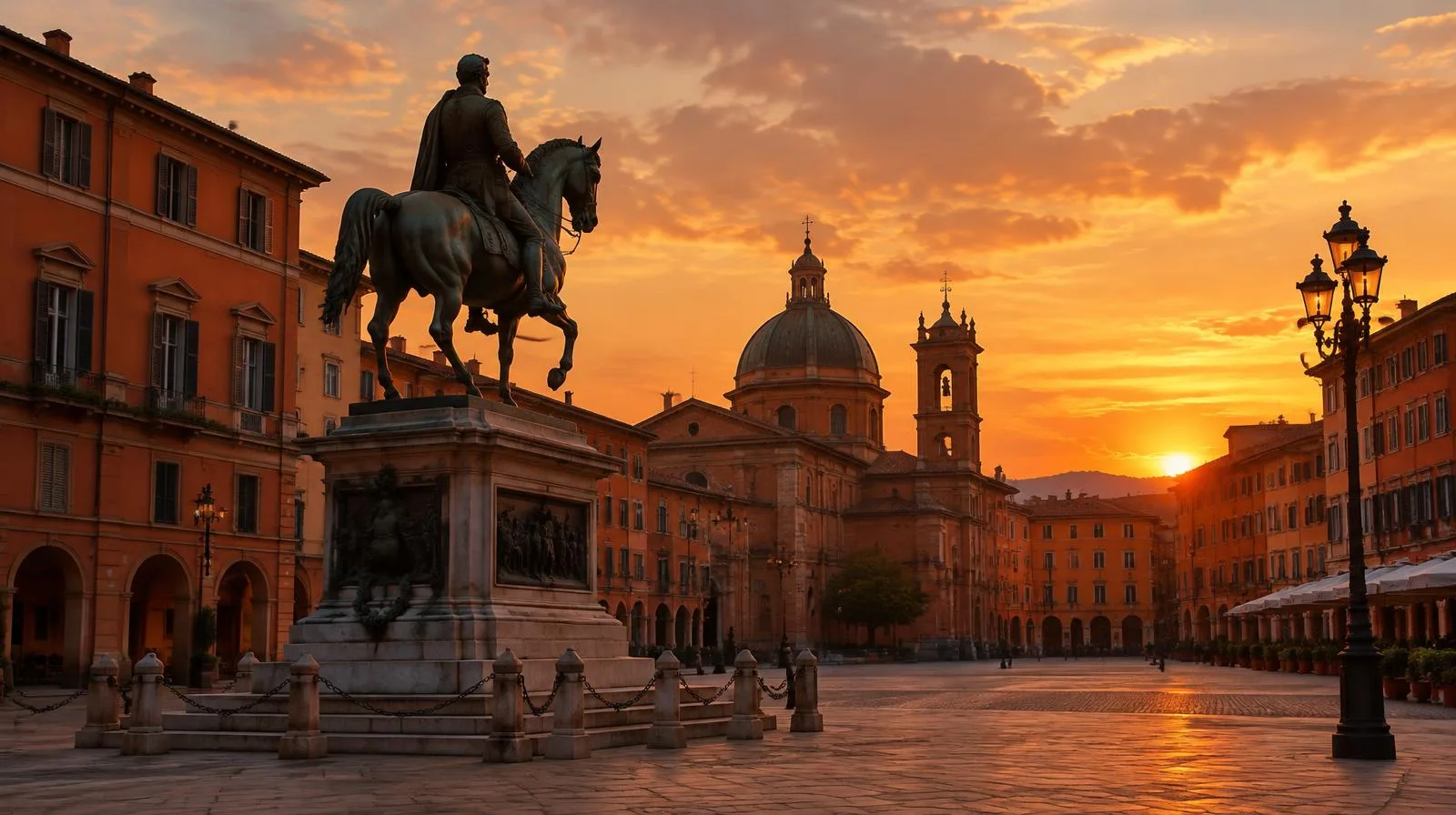
High atop Rome’s Janiculum Hill, the bronze equestrian monument to Giuseppe Garibaldi invites travellers to contemplate the turbulent making of modern Italy. Here is the “Hero of Two Worlds,” remembered for campaigns in South America and Europe, and one of the most celebrated figures of the Italian Risorgimento. Yet to view him solely as a soldier in a red shirt is to overlook another important allegiance: Garibaldi was a Freemason who also served briefly as Grand Master of the Grand Orient of Italy. His Masonic connections belong in the story of unification, but they should not be mistaken for its single driving force. Following his footsteps offers something richer than a tale of secret orchestration: a journey through competing political ambitions, international friendships, military struggle, and the landscapes in which a nation took shape.
The Hero of Two Worlds and the Craft
Before Garibaldi became a central military figure in Italian unification, he spent years in South America, participating in conflicts in Brazil and Uruguay. His service to the breakaway Riograndense Republic forms part of that transatlantic story, a wider setting explored in our Masonic guide to Brazil. These experiences preceded his return to Italy in 1848 and help explain why his reputation extended far beyond the peninsula.
The Grand Orient of Italy dates his entry into Freemasonry to 1844, naming his first lodge as “Asil de la Vertud.” Its account places the lodge in Montevideo while acknowledging alternative accounts locating the initiation in Rio Grande do Sul. It describes the lodge as outside the recognition of the major Masonic bodies of the time. More precisely, it records his regularization on 18 August 1844 in Montevideo’s Amis de la Patrie, under the Grand Orient of France. The spelling of the first lodge’s name varies between accounts, so an apparently tidy initiation story deserves a little caution.
His attachment to the fraternity was nevertheless substantial. A Masonic historical account published by the Grand Lodge of British Columbia and Yukon reproduces his farewell to the Montevideo brethren in 1848 and describes his later efforts to use Masonic organization to advance political and cultural projects. That account also notes his dislike of esoteric and ritual elaboration. For the travelling Mason, this is an important distinction: Garibaldi’s interest in the Craft should not be reduced to imagined mystical teachings or an invented personal theology. Brotherhood and organization offer a firmer starting point.
The Risorgimento: Lodges as Sanctuaries of Liberty
The Risorgimento was the movement through which the modern Italian state emerged during the nineteenth century. The Kingdom of Italy was proclaimed in 1861, but the territorial and political process continued, with Rome captured in 1870 and designated the capital in 1871. Its participants included monarchists, republicans, soldiers, diplomats, and volunteers whose objectives did not always coincide. Secret political societies such as the Carbonari belong to this history, but they should not simply be treated as interchangeable with Freemasonry.
The relationship between lodges and national renewal also changed over time. Anna Maria Isastia’s account in Treccani emphasizes the suppression and dissolution of Masonic organization during the Restoration, followed by its uneven revival. The Ausonia lodge was founded in Turin in October 1859, and the first programmatic assembly of Italian lodges followed at the end of 1861. This chronology challenges the image of a single, uninterrupted underground Masonic network directing the entire Risorgimento.
As readers of our survey of how Freemasonry conquered the world will appreciate, international connections can illuminate national histories. In Italy, however, the connections must be established person by person and institution by institution. Cavour’s supposed membership should not be presented as a settled fact. Scholarly work examines both that disputed attribution and the relationships between Cavourian liberals and the lodges, which are not the same question.
Garibaldi’s own office is firmly documented: the Grand Orient of Italy lists his Grand Mastership from 24 May to 8 August 1864. It was a brief tenure, not evidence that every Italian Masonic organization had merged into one harmonious body. Treccani instead describes competing groups that consolidated only with difficulty. The Craft was part of the political landscape, not a substitute for its complexity.
The Expedition of the Thousand: Sicily to Naples
For the travelling Mason, following the Risorgimento also means journeying into Sicily and southern Italy. In May 1860, Garibaldi launched the Expedition of the Thousand, sailing from Quarto near Genoa and landing at Marsala. The Genoa museums date the departure to dawn on 6 May and explain that the official list published in 1878 contains 1,089 names. Counts differ according to the roster and stage of the expedition, so “around a thousand volunteers” remains the clearest description of the original force.
The campaign did not remain the work of that initial band alone. Southern volunteers and incoming reinforcements enlarged Garibaldi’s army as it fought through Sicily and advanced onto the mainland. Its victories helped bring down the Bourbon Kingdom of the Two Sicilies and contributed decisively to unification under the House of Savoy. Neither the volunteers’ courage nor the campaign’s political consequences require an unsupported claim that local lodges coordinated its supply lines or opened their premises to the advancing forces.
Start a historical itinerary at Marsala, then continue to Palermo and Naples to consider the campaign’s changing scale. The useful question is not simply where Garibaldi went, but how a volunteer expedition became part of a much larger transformation of government. Along the way, distinguish later civic commemoration from surviving evidence of the events themselves. A monument can show how a city remembers unification without proving a particular Masonic role in it.
Following the Hero’s Footsteps: Rome and the Gianicolo
No city embodies Garibaldi’s complex relationship with Italian statehood more dramatically than Rome. In 1849, he helped lead the military defence of the short-lived Roman Republic against French intervention. Rome was then still outside the Italian kingdom that would be proclaimed more than a decade later. The republic’s defeat and the eventual incorporation of the city into a monarchy belong to different chapters of the struggle.
The Janiculum Hill, or Gianicolo, was a major setting of the fighting. Today, its viewpoints and monuments make it an evocative place to explore that history. As highlighted in our guide to exploring Rome’s Masonic history, this landscape rewards a slow walk. Its commemorative busts honour patriots associated with the Risorgimento, but visitors should not assume that everyone represented died defending the Roman Republic, or that each was a Freemason. Individual biographies matter more than a collective label.
Garibaldi’s equestrian monument and the nearby monument to Anita Garibaldi offer places to pause and consider the human cost behind the heroic imagery. For context, the Museo della Repubblica Romana e della memoria garibaldina at Porta San Pancrazio is a useful addition to the itinerary. Consult its official information before arranging a visit.
The chronology of Rome’s later transformation is precise. The Royal Italian Army captured the city on 20 September 1870, breaching the walls near Porta Pia. Garibaldi did not command that operation. The law of 3 February 1871 declared Rome the capital of the kingdom. Keeping these events separate allows the walk to reveal both continuity and difference: the republican aspirations of 1849 were not identical to the monarchical settlement that ultimately followed.
The Island Sanctuary: Caprera and the House of White Granite
If you wish to encounter Garibaldi away from grand civic plazas, travel to the La Maddalena archipelago off northeastern Sardinia. Ferries connect Palau with La Maddalena, from which a bridge leads to Caprera. This granite island deserves consideration for any traveller’s Masonic travel bucket list, not because every feature conceals a symbol, but because it preserves a more domestic setting for an internationally celebrated life.
The official museum website identifies Caprera as Garibaldi’s home from 1856 to 1882. The Ministry of Culture dates the construction of the Casa Bianca, or White House, to 1856-1857. The Compendio Garibaldino brings together the house, agricultural buildings, garden, and cemetery area. Rather than calling it a scene frozen exactly at the moment of his death, it is more accurate to describe it as a museum preserving original furnishings, family possessions, and other material connected with his life, including objects acquired after his death.
Here the scale changes from campaigns and constitutions to rooms, household objects, and the practical surroundings of daily life. The collections illuminate Garibaldi’s family as well as his public identity. Take time to look at what the museum actually identifies, rather than expecting a particular red shirt, nautical instrument, or cache of Masonic correspondence to be on display. Displays and accessible spaces can change, and an object’s provenance is part of its interest.
Garibaldi died on Caprera on 2 June 1882 and is buried there. A visit to the cemetery provides a quiet conclusion to the house tour without requiring embellished accounts of his funeral wishes. For a broader narrative, the separate Memoriale Giuseppe Garibaldi at Forte Arbuticci presents his life and campaigns through a historical and multimedia route. The two museums offer complementary perspectives: the public figure and the household in which he lived.
Echoes in Turin and the Secret Geometries of the North
While Garibaldi’s campaigns carried him across the peninsula, Turin was a central setting for the political institutions of unification. It served as the first capital of the Kingdom of Italy from 1861 to 1865. Its architecture and civic history make it a rewarding counterpart to Rome and Caprera, and a useful starting point for readers interested in Europe’s hidden Masonic sites. The strongest discoveries here begin with documented buildings and institutions, not assumptions about secret geometry.
A must-visit stop is the Museo Nazionale del Risorgimento Italiano in Palazzo Carignano. The palace preserves the Chamber of Deputies of the Subalpine Parliament, used from 1848 to 1860. This is not the same chamber in which the first Parliament of unified Italy met. That larger assembly occupied a temporary chamber built at the rear of the palace, used from 1861 to 1865 and subsequently demolished. The distinction is essential when imagining the parliamentary world in which Garibaldi served as a deputy.
The museum’s documents, artworks, and historical objects help place military achievements alongside debates about sovereignty and representation. Let the galleries complicate the heroic narrative rather than merely illustrate it. The surviving Subalpine chamber speaks to the institutions of the Kingdom of Sardinia; the lost temporary chamber reminds us how quickly those institutions had to adapt to territorial expansion.
Beyond the museum, enjoy Turin’s porticos, squares, and cafes on their own architectural terms. Stories about the city’s occult geometry belong to modern legend and esoteric interpretation, not established proof of Masonic planning. A triangle, owl, or beehive is not sufficient evidence that a building was designed by Freemasons. Look instead for a documented patron, architect, lodge connection, or contemporary explanation before assigning a specifically Masonic meaning.
Planning Your Risorgimento Masonic Pilgrimage
Tracing Garibaldi across Italy brings together major cities, coastal departure points, and an island home. Plan the journey around the history you most want to understand, rather than trying to turn every stop into a lodge-related destination. Museum access, transport schedules, and Masonic visitation each require their own checks.
- Rome & The Gianicolo: Combine the hill’s monuments with the Museo della Repubblica Romana e della memoria garibaldina at Porta San Pancrazio. Check current museum opening arrangements and any local access restrictions before visiting. Leave time to distinguish memorials to 1849 from the later story of Rome’s capture and designation as capital.
- Caprera (Sardinia): Travel by ferry from Palau to La Maddalena, then continue across the bridge to Caprera. Check current ferry and onward transport schedules. The museum website strongly recommends booking and specifies controlled entry slots for the Compendio. Confirm opening days, ticket prices, booking procedures, and access to both museums directly before departure, since official listings can differ.
- Turin: Palazzo Carignano and the National Museum of the Risorgimento are in the historic centre. Allow an unhurried visit, and check which spaces are accessible with your ticket. Museum galleries and archival research are different activities, so do not assume that an admission ticket provides access to research collections.
- Lodge Visitations: Italy has multiple Masonic obediences, including the Grande Oriente d’Italia, the Gran Loggia d’Italia, and the distinct Gran Loggia Regolare d’Italia. Recognition is not universal: your own Grand Lodge’s current relationships determine which visits it permits. Seek guidance through your home lodge or Grand Secretary before contacting a prospective host. Review our international Masonic visitation protocol and travel planning tips for Freemasons. Ask which documents, introductions, dress, and admission procedures apply rather than relying on a supposedly universal checklist.
Frequently Asked Questions About Garibaldi and Italian Freemasonry
When and where was Giuseppe Garibaldi initiated into Freemasonry?
The Grand Orient of Italy dates his initiation to 1844 in the lodge it calls “Asil de la Vertud,” generally located in Montevideo, while noting an alternative account placing it in Rio Grande do Sul. It records his regularization in Montevideo’s Amis de la Patrie, under the Grand Orient of France, on 18 August 1844. His later Grand Mastership of the Grand Orient of Italy lasted from 24 May to 8 August 1864.
Was the Italian Risorgimento strictly an orchestrated Masonic plot?
No. It involved competing political movements, governments, military forces, and popular initiatives. Garibaldi’s membership and leadership are documented, but they do not establish that Freemasonry directed unification. Treccani’s account emphasizes the late and fragmented revival of Italian lodges. Claims about particular financial, diplomatic, or logistical assistance require specific evidence rather than inference from membership alone.
Can travelling Freemasons visit active lodges in Italy today?
Potentially, subject to their own Grand Lodge’s recognition rules and the host body’s requirements. Good standing alone does not establish permission to visit every Italian obedience. Confirm the current position with your home Grand Lodge, arrange the appropriate introduction, and obtain the host’s instructions. A historical connection to Garibaldi is not a guarantee of present-day intervisitation rights.
What is the most meaningful single location in Italy to witness Garibaldi’s personal legacy?
For a personal rather than primarily monumental encounter, the Compendio Garibaldino on Caprera is an excellent choice. Its house, furnishings, family objects, agricultural setting, and cemetery bring his domestic world into view. It is a curated historic site, not an entirely untouched household. Pair it with the separate Memoriale if you want to connect that intimate setting with the wider story of his campaigns.
Sources
- Grand Orient of Italy: Garibaldi’s Masonic biography and Grand Mastership
- Treccani: Freemasonry and Italian unification, myth and reality
- Museums in Genoa: The Ligurians of the Thousand
- Normattiva: The 1871 law declaring Rome the capital
- National Museum of the Risorgimento: Palazzo Carignano
- University of Edinburgh: The temporary chamber of the first Italian Parliament
- Musei Garibaldini di Caprera: Collections, visits, and booking guidance
- United Grand Lodge of England: Foreign Grand Lodges and recognition