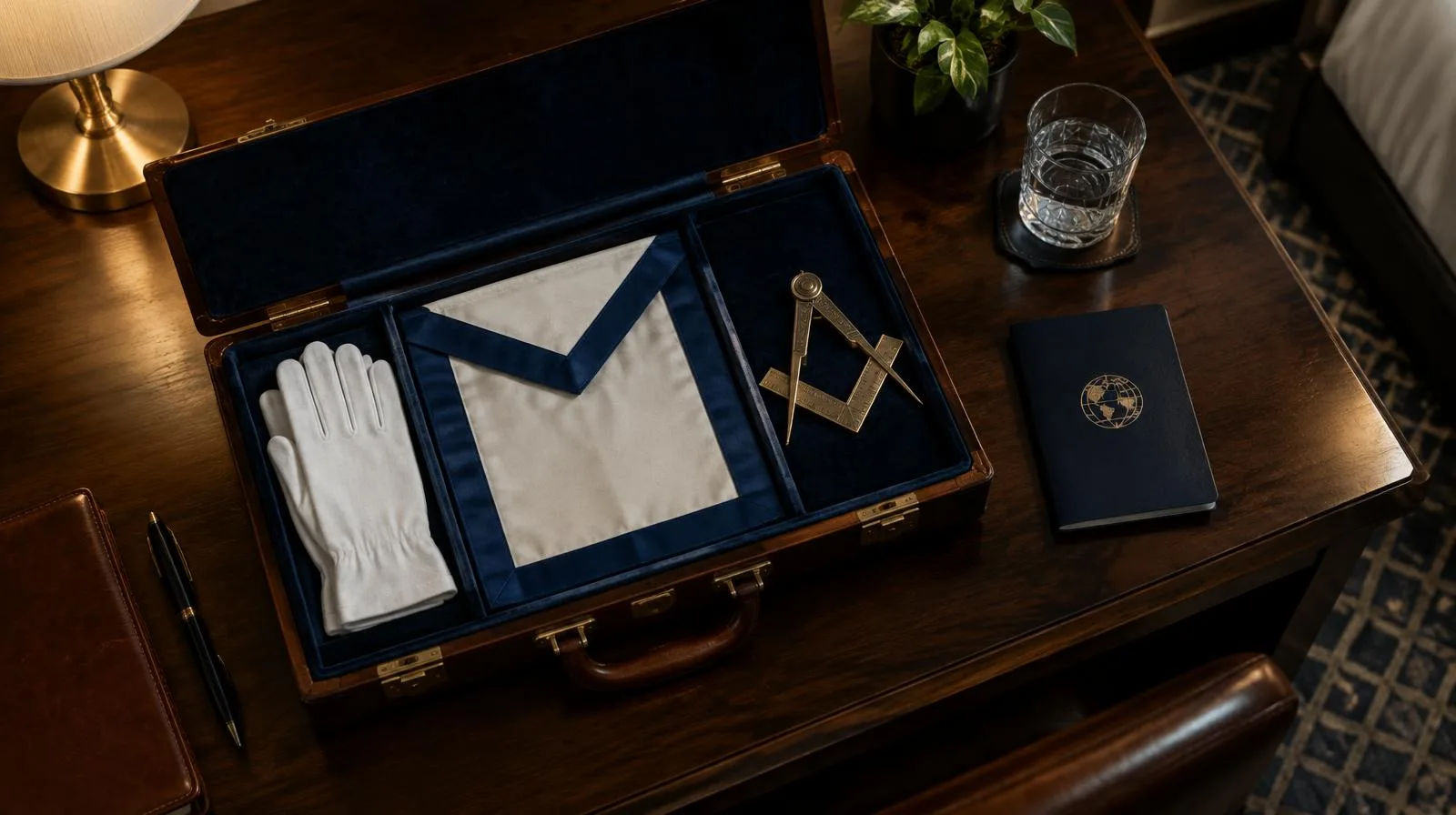
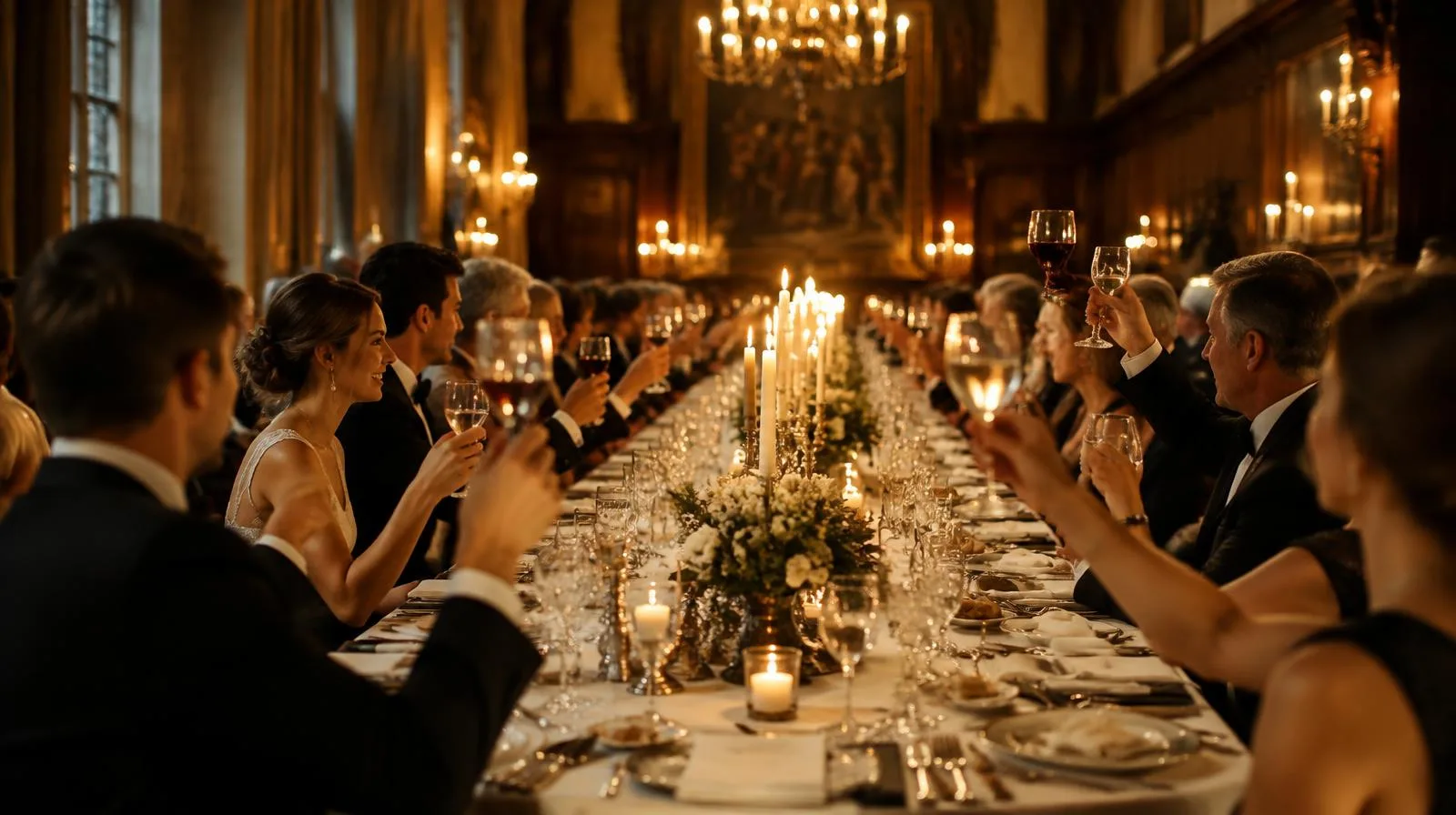
When the Master strikes his gavel and declares the lodge closed, the evening need not end. Downstairs or down the lane, a shared meal can offer another setting for fellowship. To step into a masonic festive board is to encounter a dining tradition with deep roots in the Craft, where conversation, songs, toasts, and companionship may share the table. Yet there is no single worldwide script: an informal supper and a ceremonially opened Table Lodge are not necessarily the same occasion.
For the travelling Freemason or curious cultural historian, discovering how different lodges break bread offers a rewarding glimpse of local Masonic life. Historical French table rituals turn glasses into symbolic cannons; other gatherings place greater emphasis on conversation or song. Understanding those differences is your passport to a more thoughtful evening. Come prepared to enjoy the hospitality, but let your hosts explain which customs belong to their lodge rather than assuming that every familiar gesture travels unchanged.
From Tavern Roots to Formal Banquets: The Origins of Masonic Dining
Early eighteenth-century London offers an important starting point, although not the beginning of all Masonic history. The United Grand Lodge of England records that four existing London lodges gathered at the Goose and Gridiron Tavern in St Paul's Churchyard on 24 June 1717, declared themselves a Grand Lodge, and elected Anthony Sayer as Grand Master. The lodges already existed: this was the formation of a governing body, not the invention of Freemasonry over a single dinner.
The familiar founding account also requires a historian's care. Grand Lodge's surviving minute-book record begins in 1723, and the narrative of its earliest years relies heavily on James Anderson's later account. The tavern connection is important, but it does not justify reconstructing every early meeting as an identical scene of ale, chalk drawings, and supper. The Bibliothèque nationale de France describes early meetings in apartments and inn back rooms, with lodge diagrams or carpets providing symbolic representations of Solomon's Temple. That temple belongs here to Masonic symbolism and traditional narrative, not proof of an unbroken institutional lineage from antiquity.
As explored in our survey of how Freemasonry conquered the world, the Craft developed across different societies and settings. Its meals likewise resist a single story of inevitable progress from rustic supper to luxurious banquet. Modern London Masons discuss both formal dining and relaxed alternatives, including a reported installation meal of pizza and beer served family style. Whether your destination is near Freemasons' Hall in London or somewhere much less grand, fellowship need not depend on elaborate tableware or an expensive menu.
The Table Lodge of the French Tradition: Cannons, Powder, and Fraternal Fire
French table-lodge texts give Masonic dining a particularly theatrical vocabulary. A published 1783 account in Louis Guillemain de Saint-Victor's Recueil précieux de la Maçonnerie adonhiramite describes a Loge de Table held in a protected setting, with a horseshoe-shaped table where space permits. The Master sits in the east, and the arrangement assigns places to officers and brethren. This is evidence for a particular historical ritual, not a seating plan binding every French lodge today.
In that account, glasses become canons, bottles become barrels, bread becomes rough stone, and food becomes materials. Even the table service is arranged in prescribed lines. The powder terminology, however, varies between texts. The 1783 account calls water poudre blanche, or white powder. Another banquet text calls water weak powder and distinguishes strong white or red powder for wine. A Connecticut Table Lodge programme similarly identifies white wine as strong white powder and water as weak powder. There is no need to force these different versions into one universal dictionary.
At a historical French table lodge, ordinary tableware acquires a symbolic vocabulary: glasses are cannons, bread is rough stone, and food is materials.
The military flavour of these expressions is unmistakable, but the vocabulary alone does not establish that French military lodges invented the ceremony. Nor should a traveller expect one fixed sequence of commands, movements, or blows upon the table. Our guide to Parisian Freemasonry offers a starting point for exploring the city; the host lodge must explain its own dining practice. Enjoy the ceremonial atmosphere where it is offered, and avoid copying vigorous glass movements without instruction.
Songs, Haggis, and Toasts: The Celtic and British Festive Board
For a journey through Scottish Masonry, the language of harmony provides an appealing introduction to fellowship, but it should not be treated as the universal name for every Scottish lodge meal. Nor does a visit to Kilwinning No. 0 and Mary's Chapel No. 1 guarantee a particular programme of music, poetry, or dining. Ask what the evening includes rather than arriving with a performance already imagined.
Burns Night, traditionally celebrated on 25 January, brings together poetry and Scottish dining customs, including the ceremonial address to the haggis. A lodge may choose to celebrate that tradition, but a Burns supper is not a requirement of Scottish Masonic dining. Bagpipes, recitations, and whisky should be treated as features to confirm on the programme, not promises attached to every Scottish invitation. If you would like to contribute a song or reading, offer beforehand and let the organisers decide whether it fits.
Formal toasts can give a festive board its rhythm, but England, Scotland, and other jurisdictions do not share an immutable worldwide list. Depending on the jurisdiction and occasion, the subjects may include:
- The King and the Craft, or a differently worded loyal or national toast where appropriate.
- The Grand Master and Grand Lodge officers, according to the local toast list.
- The Worshipful Master of the host lodge.
- The Visiting Brethren, with any response or musical accompaniment arranged by the hosts.
- The Tyler's Toast, or another concluding toast remembering brethren beyond the gathering.
The meal itself is equally open to variation. Metropolitan Grand Lodge's discussion of London dining records concerns about cost, the value of three-course meals, and alternatives to formal catering. For the visitor, that is a useful corrective to visions of compulsory roast beef and vintage port. A simpler dinner can still provide the conversation and welcome that make the evening memorable.
The Swedish Rite and Continental Elegance
The Swedish Order of Freemasons describes the Swedish Rite as an integrated system based on Christian faith. Its degree structure runs from I to X: Craft degrees I-III, St Andrew's degrees IV-VI, and Chapter degrees VII-X. It is therefore inaccurate to describe the ordinary progression as eleven degrees. The Order also identifies the rite as practised in Denmark, Norway, Iceland, and Swedish-speaking parts of Finland, as well as Sweden. That does not mean every lodge throughout the Nordic region follows it.
Stockholm offers a striking architectural setting. According to the Swedish Order, Bååth's Palace was built in 1666 and acquired by the Order in 1874, after which it was adapted for Masonic use. The building provides a tangible destination for the historically minded traveller. Its existence, however, tells us nothing certain about the menu or musical programme of any particular dinner.
Resist the temptation to turn Nordic ingredients and choral traditions into a standard lodge itinerary. Gravlax, venison, aquavit, candlelight, and four-part singing cannot be promised on the strength of a regional image. Instead, consult the Order's visitor information and establish the arrangements through the appropriate Masonic channels. Membership requirements, eligibility to visit, and dining arrangements are separate questions. The Christian character of the rite should not be used to infer a visiting rule without checking the official guidance.
Churrasco and Caipirinhas: The Vibrant Agapes of the Americas
Brazil provides documented examples of both fraternal meals and ritual banquets. Brazilian Masonic accounts use terms such as ágape, Loja de Mesa, and banquete ritualístico, but these should not automatically be treated as interchangeable names for an identical event. A meal after work and a ritual session around a dining table can have different arrangements and admission requirements.
A concrete example comes from the Grand Orient of Brazil. Its report records that Loja Independência No. 4614 in Bagé held its first ritual banquet on 12 November 2019 to celebrate the lodge's first anniversary and bring together Masons from the region. Visiting delegations attended. This is a more reliable glimpse of Brazilian hospitality than a sweeping claim that lodges everywhere maintain barbecue pavilions or follow one national menu.
As you explore our Masonic guide to Brazil, leave room for local discovery. Churrasco and caipirinhas belong to Brazil's wider culinary landscape, but neither is established here as a standard component of a Masonic banquet. The evidence likewise does not justify promising guitar performances, political debates, or a concluding Chain of Union at every meal. Ask whether the invitation is to an informal ágape or a ritual banquet, what is included, and what your hosts expect. The welcome need not match a postcard to be worth the journey.
The American Table Lodge: Boxcar Toasts and Festive Revivals
American Masonic dining also includes different levels of formality. A useful documented example is a Connecticut Table Lodge programme that opens on the Entered Apprentice degree and sets out seven toasts. Its programme combines dinner with odes, recognition of visitors, an address, and a concluding toast to Freemasons wherever dispersed. That is a specific ceremonial model, not evidence that every American lodge follows it.
The Connecticut programme's seven subjects are the country, the Holy Saints John, departed brethren, the Grand Master, the lodge or lodges, visiting brethren, and Freemasons wherever dispersed. A separate Ceremony of Seven Toasts hosted by the Grand Lodge of British Columbia and Yukon also provides for an Entered Apprentice Table Lodge, allowing Entered Apprentices and Fellowcrafts to participate. Other published ceremonies specify Master Masons. Degree eligibility must therefore be checked rather than assumed.
New Jersey's published 2003 instructions describe a tiled ceremony, meaning one protected against unauthorised attendance, and prefer a horseshoe arrangement while allowing alternatives when necessary. Such documents illustrate ceremonial variety, not a single American rulebook. Do not assume that seven toasts require a particular boxcar salute, or that colonial dishes must appear. Washington, Revere, and Franklin were Freemasons, but their membership does not establish that they practised the exact Table Lodge ceremony offered by a modern host.
Planning Your Visit: Etiquette, Protocol, and Breaking Bread Abroad
Experiencing a masonic festive board away from home can be one of the pleasures of Masonic travel. Preparation matters more than memorising an imagined international dining code. Establish your eligibility to attend, clarify the nature of the event, and then confirm the practical details through the channels your jurisdiction permits.
- RSVP and Dining Fees: Ask for the booking deadline, price, payment method, and cancellation arrangements. Confirm whether drinks are included. Do not assume that a meal is complimentary or that the dining charge covers wine and port. Avoid using capitation fee as a universal synonym for a dinner charge: ask specifically what you are paying for.
- Dress Code Compliance: Follow the host's stated requirements rather than packing solely on the basis of national stereotypes. Ask about the meeting and the dinner separately, including any instructions concerning regalia. If the invitation uses an unfamiliar dress term, request clarification before travelling.
- Observing Table Protocol: Follow the presiding officer's guidance concerning grace, toasts, and ceremonial movements. There is no basis here for a worldwide prohibition on drinking before loyal toasts. Passing port to the left is a recognised dining convention, but it is not proof of a universal Masonic rule. Quietly asking a neighbour is better than confidently importing another lodge's practice.
- Preparing a Response: Ask whether a visitor will be invited to reply to a toast and whether you are expected to speak. If so, prepare a brief, warm acknowledgement of the hospitality and follow the time allotted. There is no need to arrive with a compulsory three-to-five-minute speech.
Before packing your apron and dinner suit, review our overview of international Masonic visitation protocol and our travel planning tips for Freemasons. Start with your own lodge secretary or Grand Lodge to check recognition and communication requirements. Freemasons New Zealand's overseas guidance, for example, directs members to its National Office and describes travel documentation supplied through the lodge secretary. Other jurisdictions have their own procedures. A reservation for dinner should never be mistaken for confirmed admission to a tiled meeting.
Frequently Asked Questions
Can non-Masons attend a Masonic festive board?
Sometimes. An informal or expressly open social dinner is different from a tiled Table Lodge. Guidance published by West Lancashire states that non-Masons cannot be present while a lodge is open, including its opening and closing. Masonic social guidance also recognises events intended to welcome family, friends, and prospective members, including White Table events. Their frequency and format are matters for the organisers. Ask whether the particular meal is open to guests and whether any ritual portion has separate restrictions.
What is the Tyler's Toast, and when is it given?
The Tyler's Toast is a traditional concluding toast associated with remembering poor or distressed brethren beyond the gathering. Its wording and title vary, and it is not always proposed by the Tyler. Its origins should not be assigned confidently to Matthew Cooke. The Grand Lodge of British Columbia and Yukon publishes a related final-toast poem attributed to Brother Peter Richardson, Calcutta, 1852, with the refrain, “Happy to meet - Sorry to part - Happy to meet again!” That attribution concerns the poem, not the invention of every form of the toast. Follow local practice rather than expecting compulsory silence or immediate departure.
How much does it typically cost to attend a festive board as an overseas visitor?
There is no dependable international tariff. Venue, catering, drinks, and the event's format all affect the charge. Metropolitan Grand Lodge's December 2023 discussion records one contributor comparing a three-course Sussex meal at around £25 with London dining exceeding £50. Those are dated examples, not current quotations or a worldwide price range. Check the official lodge information or obtain confirmation through the permitted contact channel. Ask about drinks and any additional charges before accepting.
Is alcohol always served at a Table Lodge or festive board?
No. The Ceremony of Seven Toasts hosted by the Grand Lodge of British Columbia and Yukon expressly requires a non-alcoholic option and states that wine or beer requires the Grand Master's dispensation under that ceremony's rules. This should not be turned into a rule for every jurisdiction, but it clearly demonstrates that ceremonial toasting need not require alcohol. Tell the organisers your preferences and dietary needs in advance, and confirm their arrangements rather than relying on a blanket promise about every lodge.
Sources
- United Grand Lodge of England: History of Freemasonry
- University of Chicago digital collection: French Table Lodge text, 1783
- Connecticut Table Lodge programme and traditional dining vocabulary
- Swedish Order of Freemasons: Visitor information and degree structure
- Grand Orient of Brazil: Ritual banquet in Bagé, 2019
- Grand Lodge of British Columbia and Yukon: Ceremony of Seven Toasts
- Grand Lodge of British Columbia and Yukon: The final-toast poem
- Metropolitan Grand Lodge: Dining costs and alternatives, December 2023