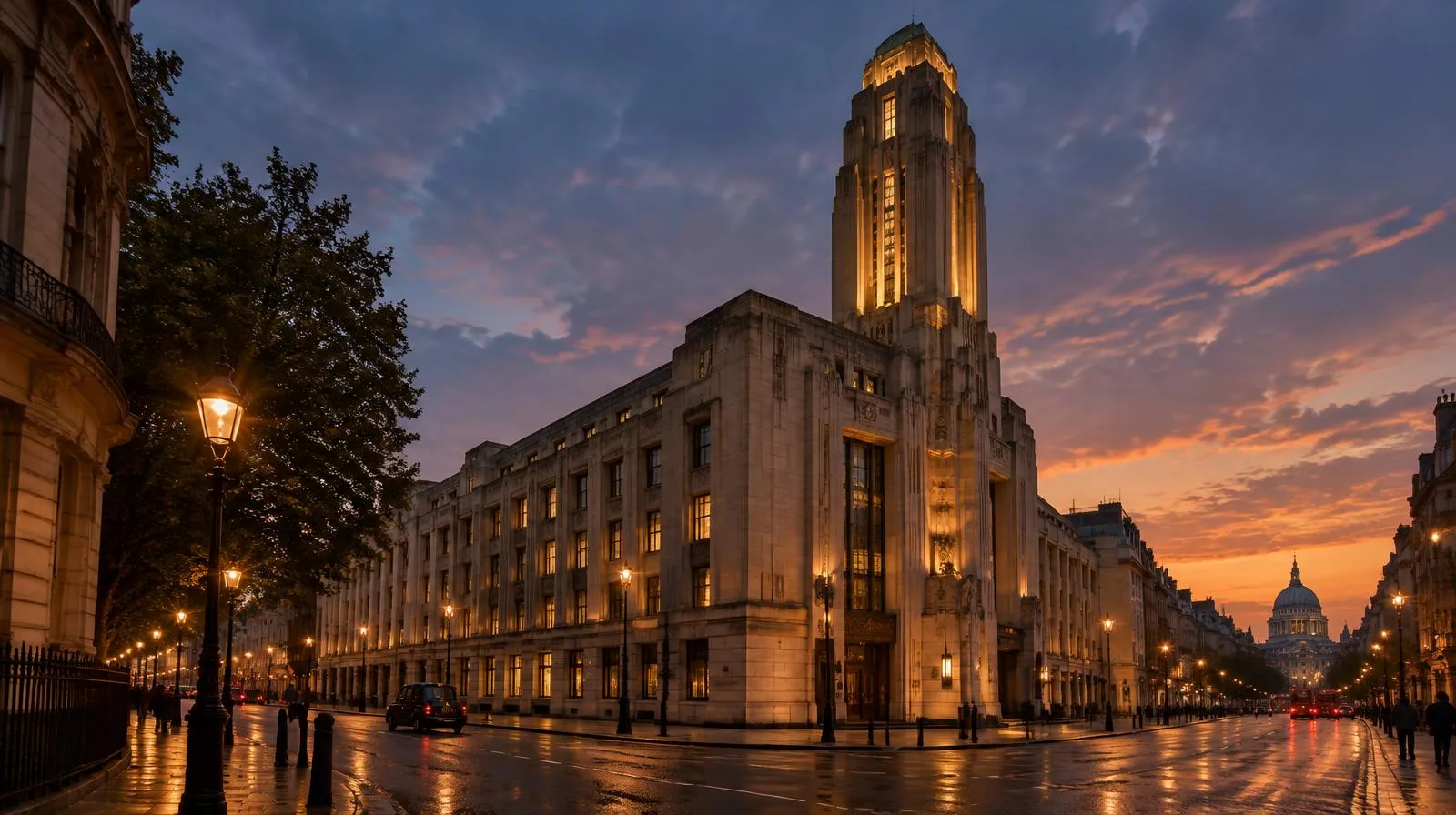
Turn off the bustling thoroughfare of Kingsway into Great Queen Street, and the mood of London changes. Between Covent Garden and Holborn stands the headquarters of the United Grand Lodge of England (UGLE), a monumental Art Deco building with an extraordinary story of remembrance. For the travelling Brother, crossing this threshold offers a connection with the institutional history of English Freemasonry; for the architecture lover and curious historian, Freemasons' Hall London offers an opportunity to explore a working Masonic headquarters. Its public museum and guided tours invite visitors to look beyond the imposing exterior and discover a building where craftsmanship, symbolism and the memory of the First World War meet.
The Heart of the Craft: A Century of History on Great Queen Street
While the present building dates from the interwar period, the site has been used for Masonic meetings since 1775. According to UGLE’s historical timeline, the property was acquired in 1774. It comprised a tavern house facing Great Queen Street, a garden and a second house behind. Thomas Sandby won the architectural competition, designing a Grand Hall over the garden to link the two houses. The new Freemasons’ Hall was dedicated on 23 May 1776, providing a central venue for a fraternity whose international development we explore in how Freemasonry conquered the world.
The early hall was not exclusively a Masonic setting. UGLE records its use for concerts, balls, literary evenings and meetings of learned and charitable societies. Following the union of the rival English Grand Lodges in 1813, the headquarters continued to evolve. Sir John Soane became Grand Superintendent of Works in 1814 and undertook extensive remodelling in the 1820s. Between 1862 and 1869, Frederick Pepys Cockerell’s designs greatly extended Sandby’s hall to the east. Part of Cockerell’s façade survives at the Connaught Rooms. For another perspective on the relationship between the Craft and its meeting places, consider our guide to the Grand Lodge of Ireland on Molesworth Street.
The current edifice, the third Masonic hall on the site, grew from a desire to commemorate those lost in the First World War. At a special Grand Lodge meeting in July 1919, an address delivered on behalf of the Grand Master, Arthur, Duke of Connaught, requested a new memorial hall. The Masonic Million Memorial Fund supported the project through contributions from members and lodges. Designed by Henry Victor Ashley and F. Winton Newman, the building was constructed between 1927 and 1933. Its foundation stone was laid on 14 June 1927, and its dedication took place on 19 July 1933. Known for many years as the Masonic Peace Memorial, it remains a place of work and assembly as well as remembrance.
Architectural Wonder: The Art Deco Monument to Peace
To view Freemasons' Hall London simply as an office or meeting venue is to overlook its architectural ambition. The Grade II* listed building is a compelling stop for readers exploring the 10 most Masonic cities in the world or assembling a Masonic travel bucket list. Its monumental Art Deco character makes an impression before any interior visit begins. Rather than rushing through the entrance, give the exterior a little time: the massing of the building and its prominent tower establish the solemn tone of a memorial conceived on an unusually generous scale.
The Imperial War Museums memorial register describes a five-storey hall in a classical style, with a tower and an irregular hollow pentagonal plan. Above the main entrance is a stone carving of an angel holding a model building, set before a wreath and a cross bearing the dates 1914 and 1918. This is a particularly useful detail for visitors to notice. The memorial purpose is not merely a historical footnote attached to the building; it is expressed at the entrance itself.
Inside, the ceremonial areas offer a different encounter with the same ambition. Guided tours can introduce visitors to spaces beyond the museum, although the route depends on availability. Approach the decoration as something to examine rather than a puzzle with a single hidden solution. Ask your guide which symbols belong to Masonic teaching, which recall the memorial’s founders and which draw on a wider classical vocabulary. This distinction helps preserve the pleasure of discovery without turning every decorative detail into evidence of an ancient secret.
The Grand Temple: Where Geometry Meets Reverence
At the ceremonial heart of Freemasons' Hall London lies the Grand Temple, which seats approximately 1,700 people. Its scale is impressive, but the decoration rewards attention just as much as the overall effect. Bronze doors lead into the room, while the ceiling and its surrounding mosaic cove bring together figures from biblical tradition, classical mythology and the history of geometry. These are symbolic references, not proof that modern Freemasonry descends directly from the people or events depicted.
A historical description preserved by the Worcestershire Masonic Library and Museum identifies an oblong, coffered ceiling culminating in a representation of the Celestial Canopy. The surrounding mosaic cove depicts Solomon and Hiram of Tyre in the east, St George and the Dragon with the Duke of Connaught’s coat of arms in the north, Apollo’s chariot in the south, and Euclid and Pythagoras in the west. The four cardinal virtues occupy the corners: Prudence, Temperance, Fortitude and Justice. A sky-blue background and golden sunbeams complete the scheme described in that record.
The Grand Temple also contains an organ built by Henry Willis & Sons in 1933. Harrison & Harrison carried out comprehensive restoration work in 2014-2015. The original pipework occupies two chambers on either side of the auditorium, and the later work added a central case to improve projection into the room. For readers interested in the relationship between ceremony and space, our guide to lodge room architecture and symbolism offers a useful companion. Here, however, let the actual room lead your interpretation, with the guide’s explanations providing context.
“The present building, the third Masonic Hall on the site, was constructed between 1927 and 1933 as a memorial to those who died in the First World War and was for many years known as the Masonic Peace Memorial.”
UGLE, History of Freemasons’ Hall
The Grand Temple is only part of a much larger working headquarters. UGLE’s current visitor information describes the building as comprising 22 lodge rooms, alongside board and committee rooms and administrative offices. Do not assume that a public visit includes access to these meeting spaces. Their working use is part of the building’s character, and a tour should be understood as an introduction to available areas rather than an unrestricted architectural inspection.
The Museum of Freemasonry and Library
One of the most welcoming aspects of the building is the Museum of Freemasonry, situated with the library on the first floor. The museum is open to everyone and admission is free. You do not need to be a Freemason, arrive with a member or possess specialist knowledge to enjoy it. Readers of our survey of the greatest Masonic libraries and museums will find a particularly rewarding destination here, with collections recognised by Arts Council England for their national and international importance.
Established in 1838, the museum has had a dedicated home at Freemasons’ Hall since 1933. Its collections illuminate roughly three centuries of Masonic history, but only a fraction of its holdings is displayed at any one time. Rather than arriving with a checklist of supposedly permanent star exhibits, allow the galleries to introduce the material currently available:
- Objects and Material Culture: The museum cares for a wide range of artefacts, many almost 300 years old. Use the labels to distinguish an object’s documented owner, date and purpose from broader interpretations of its symbolism.
- Institutional Records: The collections include records of UGLE, the Supreme Grand Chapter and various Masonic charities, offering routes into the administrative and charitable history of the organisation.
- Lodge and Personal Archives: Archives relating to individual Freemasons, lodges and chapters can help connect the larger institutional story with particular communities and lives.
- Family History Resources: A project with Ancestry made available names of more than 1.7 million members of English lodges from membership registers covering 1751-1921. The museum explains how registered readers with a booked research desk can access these records there without an Ancestry subscription.
The restored Art Deco library is itself worth appreciating, but research access needs planning. The museum states that the library is free to use and that readers must register to see books. Contact staff before travelling if you need particular records, manuscripts or research facilities. A focused enquiry, with names, approximate dates and any known lodge details, is a sensible starting point. The library and South Gallery have more restricted hours than the museum as a whole, so a Saturday museum visit should not be treated as a substitute for a weekday research appointment.
Attending a Lodge Meeting: Protocol for Visiting Brethren
For a travelling Master Mason, attending a meeting at Freemasons' Hall London can be a memorable part of a visit. It is, however, a separate undertaking from entering the public museum or booking an architectural tour. Public access does not confer admission to a lodge meeting, and a visitor should make arrangements before arriving rather than assume that a meeting will be available.
UGLE publishes a list of recognised foreign Grand Lodges and explains that recognition allows for intervisitation between their members and its own. If you hope to visit a lodge, use that official information as a starting point and seek guidance on the arrangements appropriate to your jurisdiction:
- Advance Arrangements: Ask your own lodge or Grand Secretary’s office how to obtain the appropriate introduction and arrange contact with a prospective host. Our guide to international Masonic visitation protocol provides background, but current instructions from the relevant Masonic authorities should take precedence.
- Credentials and Admission: Confirm what evidence of membership and standing the host requires, and what admission procedures will apply. Do not assume that a particular document, such as a dues card, is a universal requirement or sufficient by itself.
- Dress Code: Ask the host lodge for its instructions and follow the summons. Requirements for a particular lodge meeting should not be confused with those issued for a formal meeting of Grand Lodge.
- Travelling with Regalia: Confirm which regalia you should bring and whether anything can be provided locally. Our advice on how to travel with Masonic regalia can help you plan packing, but the host should clarify what is appropriate for the meeting.
Keep the distinction between public interpretation and private Masonic business clear. A guided tour is designed to introduce the building and its history; it is not admission to a ritual ceremony. Companions who are not attending a meeting can instead plan a museum visit or book a suitable public tour during the advertised visiting hours.
Planning Your Visit to Freemasons' Hall
Whether you are arriving for research, architecture or a fraternal visit, a little preparation makes the experience more rewarding. Decide first whether your priority is the museum, the Grand Temple or the library. Each involves different access considerations, and combining them successfully means checking more than the building’s general opening hours.
Location and Transit: The address is Freemasons’ Hall, 60 Great Queen Street, London WC2B 5AZ. UGLE and the museum identify Holborn and Covent Garden as the closest Underground stations. Use a current journey planner rather than relying on an exact walking-time promise. The museum has no on-site visitor car parking and recommends public transport as generally the easier option. UGLE’s accessibility information lists automatic entrance doors, an accessible lift, accessible toilets and wheelchairs. Contact the venue in advance if your visit depends on a particular access arrangement.
Public Tours: Choose the tour carefully. UGLE advertises both Grand Temple tours and museum-focused tours, and these should not be treated as interchangeable. The museum’s tour page states that tours are operated by UGLE Trading Company Ltd, not by the Museum of Freemasonry. It also warns that the building is in active use, routes can change at short notice and particular spaces cannot be guaranteed in advance. Check the official booking page for the current itinerary, price, times and availability. Free museum admission does not mean that a guided building tour is free.
The Café and Shop: UGLE’s visitor information lists a shop, but check current retail and refreshment arrangements before building your day around them. Do not assume that a café will be open whenever the museum is accessible, or that a particular menu or range of merchandise will be available. For a longer visit, leaving some flexibility for a break is wiser than relying on an unconfirmed facility.
The dedicated UGLE visitor page and the museum’s visitor information advertise public opening Tuesday to Saturday, 10am to 5pm. A separate UGLE contact page gives different general opening hours, so use the dedicated visitor pages and confirm any uncertainty before travelling. The museum lists additional holiday closures, while the library and South Gallery close from 1pm to 2pm daily and all day Saturday. Check dated closure notices as well as the weekly timetable.
Frequently Asked Questions About Freemasons' Hall London
Is Freemasons' Hall open to the general public?
Yes. Members of the public are welcome, and admission to the Museum of Freemasonry is free. The dedicated visitor information advertises Tuesday to Saturday, 10am to 5pm, subject to closures. Access does not extend automatically to every room, and the library has separate restrictions. Check current opening information before travelling, and consult the booking page for guided-tour charges and availability.
Can non-Masons see the Grand Temple?
Yes. UGLE advertises public guided tours that include the Grand Temple and ceremonial areas. Select the appropriate tour when booking, since a museum-focused tour is a different offering. Freemasons’ Hall is a working building, and the official tour information warns that routes can change and particular rooms cannot be guaranteed in advance.
Can I take photographs inside Freemasons' Hall London?
The museum explicitly welcomes photographs of its galleries and exhibits, but asks visitors not to photograph or film its staff. That policy should not be assumed to cover every other part of Freemasons’ Hall. Ask your guide about photography in the ceremonial areas and follow any instructions given on the day. For publication, commercial use or professional filming, consult the museum’s image-use guidance and contact the relevant organisation.
How do I arrange a research visit to the library?
Contact the Museum of Freemasonry before your visit and explain what you want to consult. The library is free to use, but registration is required to see books. The museum also specifies registration and a booked research desk for free on-site access to its Ancestry resources. Confirm arrangements for archival material directly with staff, and remember that the library and South Gallery close from 1pm to 2pm daily and all day Saturday.
Sources
- UGLE: History of Freemasons’ Hall
- Imperial War Museums: Freemasons’ Hall War Memorial Register entry
- Worcestershire Masonic Library and Museum: Grand Temple ceiling description
- UGLE: Museum collections and family history resources
- Museum of Freemasonry: Directions, opening times and closures
- Museum of Freemasonry: Public tours, operator and access conditions
- UGLE: Recognised foreign Grand Lodges and intervisitation
- Museum of Freemasonry: Filming and photography policy