Cross the threshold of a Masonic temple, whether a modest meeting room or the monumental Grand Temple at Freemasons' Hall in London, and you may recognize a familiar symbolic landscape. Yet familiarity is not uniformity. The furniture, decoration and arrangement vary between jurisdictions, ritual traditions and individual buildings. A traditional masonic lodge room layout is more than an interior design choice: it provides a setting for moral instruction through architectural symbols. To read that setting well, a traveller must distinguish the language of Masonic tradition from the documented history of the room itself.
The Oblong Square: Orienting the Masonic Universe
To understand the masonic lodge room layout, begin with its traditional symbolic footprint: the "oblong square," or rectangle. Masonic lectures describe its length as extending from East to West and its breadth from North to South. In this symbolic geography, the lodge represents a world in which members are called to live and labour. This is an allegorical description, not a requirement that every meeting room possess identical proportions.
Masonic writers have offered different explanations for this orientation. The Encyclopedia Masonica connects it with the architectural tradition of orienting churches eastward, while acknowledging that actual lodge buildings follow an east-west direction only when circumstances permit. The East also carries the symbolic associations of sunrise, light and instruction. These ideas do not establish an uninterrupted architectural lineage from ancient Egyptian temples or Solomon's Temple to modern Freemasonry.
For the visitor, the essential distinction is between symbolic East and geographical east. The Master's station identifies the lodge's ritual East, even where the building's orientation does not match the compass. Whether exploring Kilwinning and Mary's Chapel in Scotland or visiting a lodge elsewhere, ask how the room is arranged rather than assuming that its doorway and principal chair follow a universal physical axis.
The East, West, and South: Stations of the Principal Officers
In a widely used arrangement, the three principal officers occupy the symbolic East, West and South. Their stations are explained through the daily course of the sun. This arrangement is familiar in many Craft lodges, but it should not be projected onto every jurisdiction or every period of Masonic history. UGLE's educational paper on lodge furnishings describes earlier arrangements that differ substantially from the familiar modern pattern.
In the East sits the Worshipful Master, who presides over the lodge. Traditional explanations compare the Master's role in opening and governing the lodge with the rising sun opening the day. A raised platform or an elaborate chair can make this station visually prominent, but neither a particular number of steps nor a specific decorative emblem should be treated as a universal requirement.
In the familiar arrangement, the Senior Warden sits in the West and the Junior Warden in the South. Traditional lectures associate the West with the close of labour and the South with the sun at its meridian. The Junior Warden is also commonly associated with the transition between labour and refreshment. Local ritual determines the precise wording and duties, while the architecture gives these offices a visible relationship.
In the traditional solar analogy, the East opens the day, the South marks its meridian, and the West brings its close. This is a symbolic reading of the stations, not a universal building specification.
The North is traditionally called a "place of darkness," but that does not mean its wall must be empty or that no officer may sit there. Nor is it accurate to say that sunlight never comes from the northern part of the sky anywhere in the northern hemisphere. The traditional explanation concerns the sun's southerly position at noon at latitudes north of the tropics. Treat it as ritual symbolism, not a complete account of astronomy or proof that the northern side of Solomon's Temple lacked light.
The Mosaic Pavement: Walking the Landscape of Mortal Life
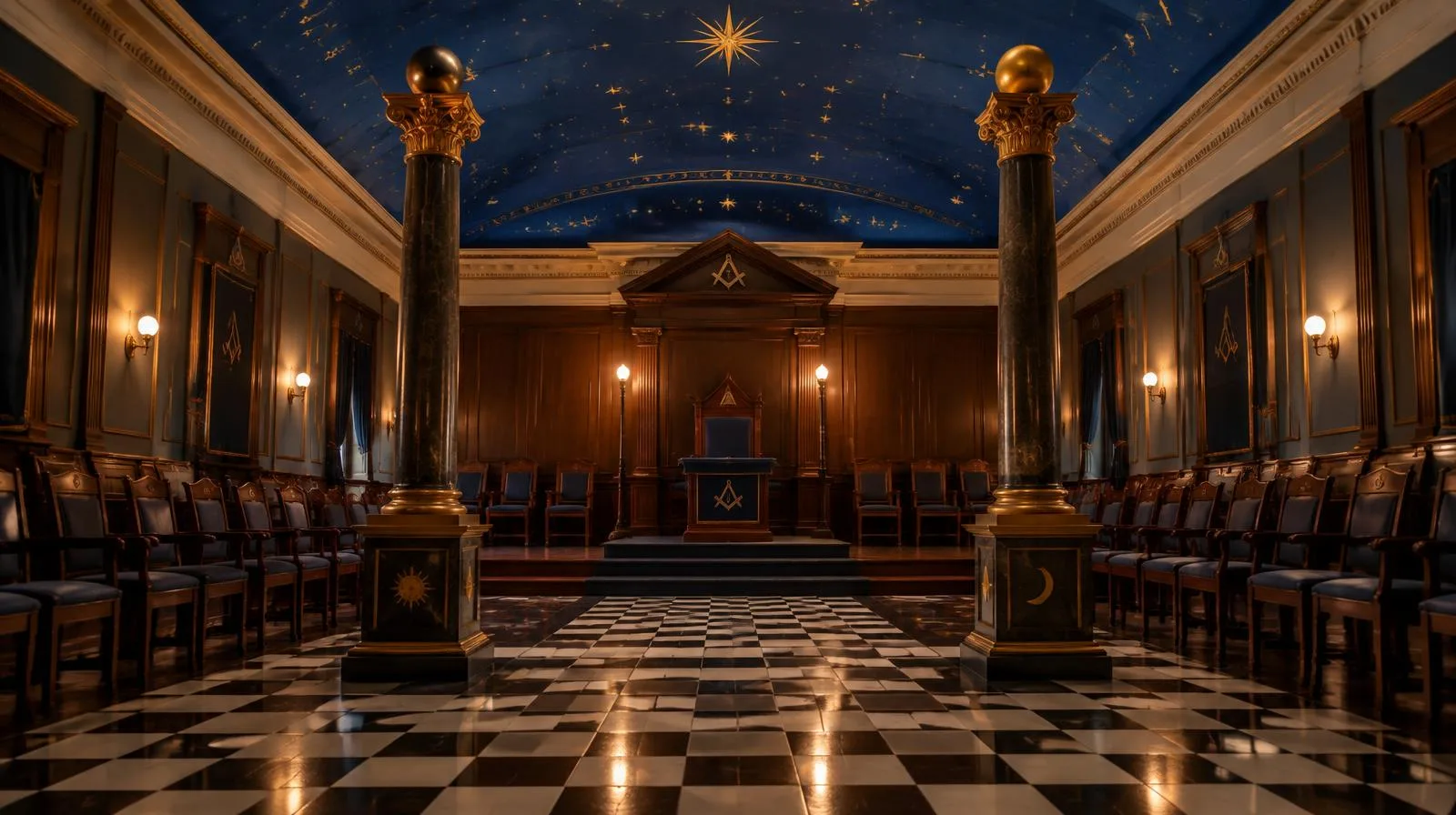
Look for the alternating black and white squares known as the Mosaic Pavement. This is a familiar Masonic symbol, but do not expect every lodge room to have a permanent checkerboard floor. The pavement may be represented within the room's furnishings or imagery rather than covering the entire walking surface. Traditional accounts associate it with an indented or tessellated border and a blazing star, although the physical presentation varies.
Its moral interpretation is both simple and searching. Daniel Sickels's nineteenth-century General Ahiman Rezon describes the pavement as emblematic of human life, checkered with good and evil. Prosperity and adversity, security and uncertainty, provide further ways of contemplating that contrast. The lesson invites humility in good fortune and compassion toward those who suffer, rather than confidence that any person's circumstances will remain unchanged.
Some Masonic lectures describe the pavement as representing the ground floor of King Solomon's Temple. That is a ritual association, not an archaeologically established description of the Temple's flooring. Shawn Eyer's historical study traces references to the pavement to early speculative Freemasonry, including the published exposure Masonry Dissected of 1730. Such documentary evidence is more useful than unsupported claims of an unchanged floor design inherited from antiquity.
When exploring the Philadelphia Masonic Temple or another historic building, distinguish what you can actually see from what a symbolic lecture describes. Ask your guide about the materials, date and intended use of a particular floor. A striking surface deserves attention, but its symbolism does not establish its material, origin or age.
The Altar and the Pedestal: Transatlantic Differences in Layout
A traveller comparing lodge rooms will notice differences in the placement of the Volume of the Sacred Law, Square and Compasses, traditionally called the Three Great Lights. A freestanding altar is prominent in many American Craft lodge rooms. In many English lodge arrangements, these objects are instead placed on the Master's pedestal in the East. These are useful tendencies to recognize, not a rigid division between two continents.
The educational guide The Layout of the Lodge and the Symbolism of the Furniture explicitly allows for variation: some lodges have an altar, some place it centrally, and others use the Master's pedestal. The presence of a central altar can change the visual balance of the room, while a pedestal in the East draws attention toward the Master's station. The position used for obligations and other ceremonial movements depends on the working followed by the lodge.
Do not explain this difference simply as America preserving an ancient "Antient" arrangement while England adopted a new standard after the 1813 Union. Coil's Masonic Encyclopedia states that the date and circumstances of the altar's introduction into American lodges are difficult to establish, and that early eighteenth-century lodges had no altars. The surviving evidence does not support the neat origin story.
Likewise, a Scottish Rite setting such as the House of the Temple in Washington, D.C. should not be used as a universal model for Craft lodge rooms. Compare like with like where possible, and ask which Masonic body uses the space. Differences in ritual purpose matter as much as differences in national architecture.
The Two Pillars: Gateway Between the Profane and the Sacred
Boaz and Jachin refer to the two pillars described in the biblical account of Solomon's Temple. They are familiar subjects in Masonic furnishings and imagery, but their size, placement and representation differ. A lodge need not possess two monumental columns at its entrance, and it is misleading to claim that every initiate physically passes between such structures.
According to the biblical narrative, the Temple's bronze work was made by a craftsman named Hiram. Masonic traditions develop the figure of Hiram Abiff within their own ritual narrative. Those traditions should be identified as such, rather than presented as independently verified accounts of the Temple's construction. Scholarship also records debate about the pillars' original function and the interpretation of their names.
In Masonic interpretation, Boaz is commonly associated with strength and Jachin with establishment or stability. Terrestrial and celestial globes appear on pillars in some Masonic representations. These should not be mistaken for a straightforward reproduction of the biblical description, which includes decorated capitals, network, pomegranates and lily-work.
Read symbolically, the paired pillars can suggest a threshold between ordinary affairs and a space devoted to instruction and reflection. Here, "profane" means outside the sacred setting, not necessarily offensive or immoral. To explore changing representations, consult the collections described in the world's greatest Masonic libraries and museums. An illustrated board, a model column and a full-sized architectural feature can express related ideas without sharing a single design or date.
The Celestial Canopy and the Two Ashlars
Cast your gaze upward. Masonic lectures describe the lodge's covering as a clouded canopy or starry heaven, an image that extends its symbolic dimensions beyond the room's walls. Some buildings give that image decorative form. The Grand Lodge of Ireland, for example, describes the ceiling of its Grand Lodge Room in Dublin as adorned with gold stars. A plain ceiling, however, does not prevent a lodge from using the same celestial symbolism.
Among the lodge's symbolic objects are two stones known as the Ashlars. Their precise locations are not universal. Masonic writer Don Falconer notes differences in placement and explains that the classification of the lodge's movable and immovable jewels also differs between English and American systems. Avoid using a stone's position alone to infer a rule applying throughout Freemasonry.
- The Rough Ashlar: A rough or undressed stone, traditionally used to represent a person in need of education and moral development. It is not accurately described as an "unquarried" block: the image concerns a building stone that has not yet been properly worked.
- The Perfect Ashlar: A worked and squared stone, traditionally associated with improvement through instruction, discipline and virtuous conduct. Its symbolic contrast with the rough stone matters more than a supposedly mandatory position beside a particular officer.
Together with the lodge's historic Masonic tracing boards, these objects create opportunities for reflection on personal improvement. Tracing boards illustrate symbols used in Masonic teaching, but they should not be read as measured architectural plans. A painted temple, staircase or celestial canopy belongs first to the board's instructional language.
Planning Your Visit: Experiencing Historic Lodge Rooms Firsthand
Whether you are a Master Mason planning a visit abroad or an architecture enthusiast seeking a public tour, distinguish admission to a meeting from admission to a building. The arrangements are different, and neither should be assumed from the appearance of an open door.
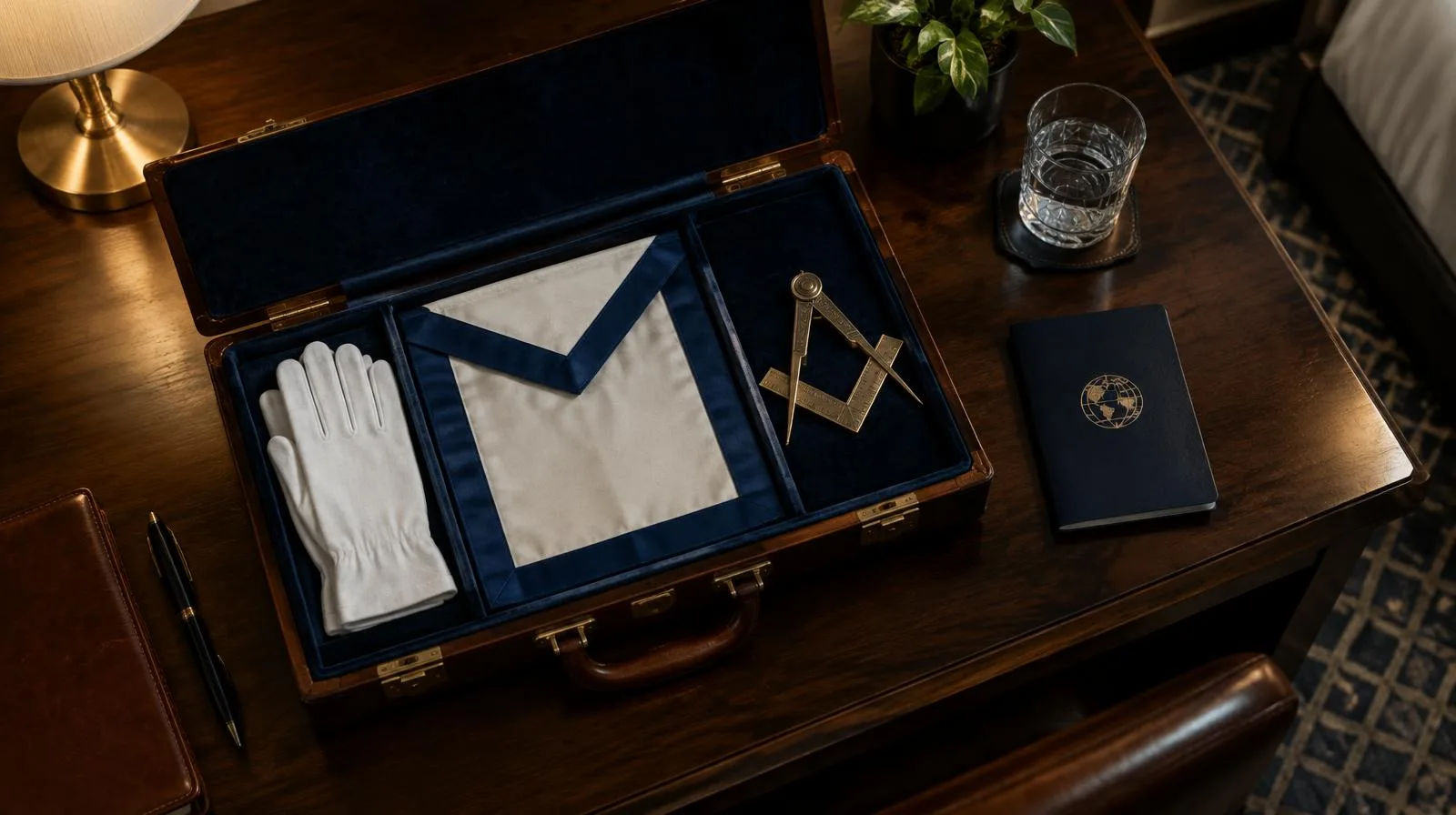
For Freemasons: Before attending a tiled, or closed, meeting, ask your own lodge secretary or Grand Lodge about recognition, eligibility and the required documents. There is no universal package consisting of a dues card, letter of good standing and Grand Lodge certificate. Maine's guidance requires a current dues card for visitors; New Zealand's overseas guidance describes a travel certificate used with a Master Mason's certificate. These examples demonstrate why local instructions matter.
Official communication between jurisdictions may be required to pass through Grand Secretaries rather than merely being encouraged to do so. Follow your own jurisdiction's procedures before contacting a foreign lodge or Grand Lodge. Establish recognition first, then confirm admission requirements, examination or vouching procedures, dress and regalia. Review the international Masonic visitation protocol as preparation, but treat current instructions from the relevant Grand Lodges as authoritative.
For Non-Masons and Architecture Enthusiasts: Membership is not required for advertised public tours. Freemasons' Hall on Molesworth Street in Dublin, Freemasons' Hall in London and the George Washington Masonic National Memorial in Virginia all advertise public visits or tours. Their schedules, booking arrangements and accessible spaces differ, so do not assume that each offers the same experience throughout the week.
The Museum of Freemasonry warns that London's tour route can change at short notice because Freemasons' Hall is a working building. Ireland's Grand Lodge likewise advises that events can prevent tours from running. Before making a special journey, check the venue's official website for current opening days, reservations, admission charges, identification requirements and closures. If seeing a particular room is your main reason for travelling, ask whether access can be confirmed.
Frequently Asked Questions About Masonic Lodge Room Layouts
Why is every Masonic lodge oriented toward the East?
Not every lodge room faces geographical east. In a familiar symbolic arrangement, the Master's station is called the East and is associated with sunrise, light and instruction. Masonic tradition also describes the lodge as extending from East to West. Actual buildings may not follow that compass orientation, and the symbolism does not prove a continuous architectural descent from ancient temples.
Why do American lodges have an altar in the center, while British lodges keep it in the East?
This describes a common contrast, not a universal rule. Many American Craft lodges use a central altar, while many English lodges place the Volume of the Sacred Law on the Master's pedestal. Practice varies, and "British" should not be treated as synonymous with "English." The evidence does not establish a simple explanation based on the Antients, Moderns or the 1813 Union. Coil's encyclopedia specifically acknowledges uncertainty about the introduction of American lodge altars.
Can non-Masons go inside a Masonic lodge room?
Yes, where public tours, open days or other authorized visits are offered. Admission to a public tour is different from admission to a closed lodge meeting, which is governed by Masonic eligibility and visitation rules. Check the venue's official information, and remember that a building tour may not include every ceremonial room.
What does the empty North wall represent in a lodge room layout?
The North wall is not necessarily empty. Masonic tradition calls the North a "place of darkness," contrasting it with the solar associations of East, South and West. This is symbolic language, not a prohibition on northern seating, windows or furnishings. It should not be explained by claiming that the sun never appears in the northern sky or that the northern side of Solomon's Temple was necessarily unlit.
Sources
- The Layout of the Lodge and the Symbolism of the Furniture
- Shawn Eyer: The Mystery of the Mosaic Pavement
- Coil's Masonic Encyclopedia: Altar
- Jewish Bible Quarterly: The Pillars of the Temple
- Don Falconer: The Jewels of the Lodge
- Freemasons New Zealand: Visiting Lodges Overseas
- Grand Lodge of Ireland: Public Tours
- Museum of Freemasonry: Tours of Freemasons' Hall London