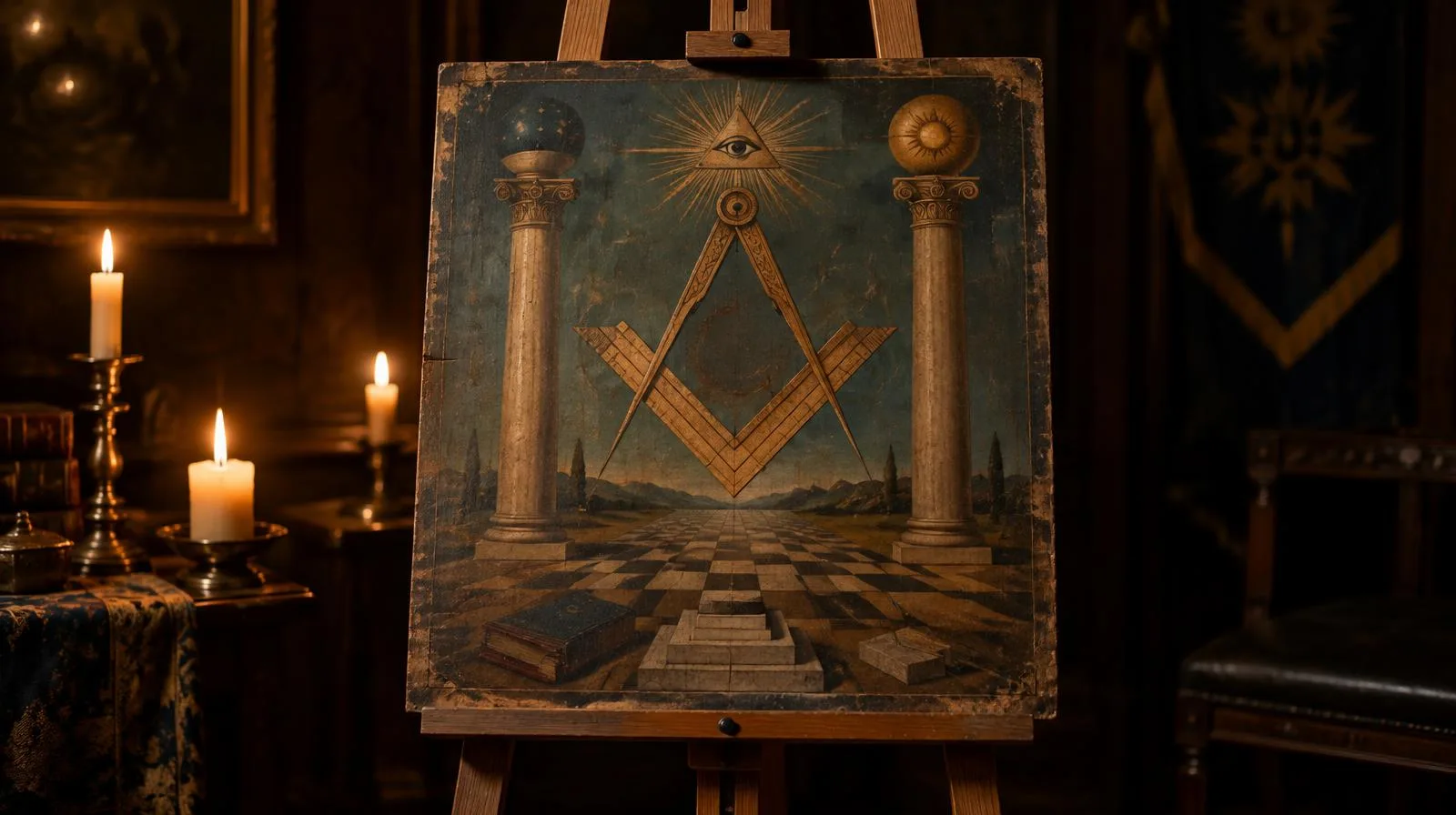
Step inside an English lodge room, and among its furnishings you may encounter a particularly intriguing kind of visual textbook: Masonic tracing boards. Painted or printed, these illustrations bring together the emblems used to explain the lessons of Freemasonry. Some offer architectural landscapes; others arrange tools, stones and celestial symbols into a compact field of images. For the travelling brother and the curious cultural historian alike, studying historic boards offers a rewarding way into Masonic heritage. The pleasure lies not simply in finding an old painting, but in discovering how an object was made, used and understood.
From Chalk on the Floor to Painted Masterpieces: The Evolution of Tracing Boards
Before tracing boards became familiar lodge furnishings, Masonic teaching employed temporary diagrams. In the eighteenth century, lodges often met in private rooms above taverns, where designs could be chalked onto a table or the floor. The Tyler or Worshipful Master commonly prepared them. A simple boundary might enclose geometric figures and other symbols, with physical objects sometimes taking the place of drawings. At the end of the meeting, a new member was often required to erase the design with a mop, demonstrating his obligation of secrecy. This was a recorded practice, not a procedure that should be assumed for every early lodge.
Repeatedly drawing and removing these designs took time. Removable painted floorcloths provided an alternative: the symbols could be brought out when needed and rolled away afterwards. Surviving objects show that the transition to more permanent displays was not confined to Britain. The Scottish Rite Masonic Museum & Library documents a tracing board belonging to Union Lodge in Dorchester, Massachusetts, which appears in lodge inventories from 1796 through 1820. Probably in the early nineteenth century, members attached it to a wooden panel so that it could hang on the wall.
Such examples suggest a varied development rather than a single invention or an inevitable march from floorcloth to easel. Cloth, wood and paper offered different possibilities for storage, display and teaching. By the early nineteenth century, sets of three boards were becoming an established format in English practice. Their relationship with lodge room architecture and symbolism is especially rewarding to explore: a painted pillar or pavement can echo the furnishings around it, bringing the lesson and the room into conversation.
Decoding the Degrees: The Symbolism of the Three Boards
To examine a set of Masonic tracing boards is to follow a visual companion to the three Craft degrees. There is no single design or explanation binding on every Masonic jurisdiction. The following readings describe familiar features of English-style boards and common Masonic interpretations, rather than a universal symbolic dictionary. Their Temple settings belong to biblical narrative and Masonic allegory. They should not be mistaken for archaeological reconstructions of Solomon’s Temple or evidence that modern lodge ceremonies were practised there.
The First Degree Board: The Ground Floor and the Moral Foundation
The First Degree board commonly gathers the symbolic furnishings of a lodge into an imaginative architectural setting. The chequered pavement can be read, in Masonic teaching, as an image of the contrasting experiences of human life. Jacob’s Ladder connects the earthly scene with the heavens. Faith, Hope and Charity are associated with its ascent in familiar English interpretations. These are the three theological virtues, not the cardinal virtues. Their appearance belongs to the board’s moral and religious imagery, rather than to a literal description of a building.
Three classical pillars commonly represent Wisdom, Strength and Beauty. Familiar English arrangements associate these respectively with the Ionic, Doric and Corinthian orders, although historic designs show variation in their treatment and labelling. Nearby, the rough and perfected ashlars offer a particularly accessible lesson. The Museum of Freemasonry explains the contrast as a symbolic journey of personal improvement, drawing on the transformation of a rough building stone into a properly shaped one. Here the traveller needs no specialist knowledge of ritual to recognise the educational force of a craftsman’s tools.
The Second Degree Board: The Winding Staircase and the Sciences
The Second Degree board often shifts attention towards an architectural journey, with the pillars called Boaz and Jachin and a winding staircase among its familiar features. The pillar names come from the biblical account of Solomon’s Temple. Their use in Masonic teaching adds a further layer of interpretation. Ornament such as pomegranates and lily-work may appear, but its arrangement and explanation should be checked against the particular design and ritual tradition rather than treated as a fixed international code.
In familiar Masonic lectures, the staircase provides a framework for lessons that can include the senses and the seven liberal arts and sciences: grammar, rhetoric, logic, arithmetic, geometry, music and astronomy. Groupings of three, five and seven steps occur in this tradition, although the way an artist renders a staircase need not be a literal diagram of every spoken explanation. The letter G also appears in many designs. Its Masonic associations include Geometry and God, with emphasis depending on the working concerned. For the visitor, the important point is the relationship between image and lecture.
The Third Degree Board: The Grave, the Temple, and Eternity
The Third Degree board turns towards mortality and remembrance. Coffin or grave imagery, working tools and other emblems can give it the atmosphere of a painted meditation on death. The narrative associated with Hiram Abiff belongs to Masonic ritual legend, not established history concerning the death of an identifiable architect of Solomon’s Temple. Reading the scene as allegory preserves its significance without confusing the fraternity’s teaching story with a documented ancient event.
Acacia is commonly interpreted in Masonic tradition as an emblem of immortality. Lettering and other details vary between boards, as do the working tools associated with the degree in different jurisdictions. A documented British Third Degree board by Josiah Bowring, dated 1819, includes the compass, pencil and skirret. Such particulars reward close looking. Rather than assuming that every dark scene promises the same theological outcome, ask how the individual board presents memory, fidelity and the limits of human life.
The Masters of the Craft: John Harris and the Golden Age of Masonic Painters
Several artists and publishers helped shape the visual language of tracing boards. John Cole, Josiah Bowring and John Harris are important names, but their work should not obscure the variety of designs that circulated. Nor does the survival of a familiar pattern mean that every lodge adopted it. A board’s maker, date and provenance are more reliable guides than its resemblance to a popular reproduction.
Documented engraved boards printed by John Cole date to 1801, with the engraving credited to F. Curtis. Josiah Bowring (1757-1832) produced hand-painted boards on wood, including examples dated 1819. Art UK records First, Second and Third Degree boards by Bowring in the Museum of Freemasonry’s collection. John Harris (1791-1873), an artist and engraver particularly associated with pen-and-ink facsimile work, became a Freemason in London in 1818. By 1820 he was selling portable miniature tracing-board designs.
The crucial competition of 1845 was organised by the Emulation Lodge of Improvement, not by the United Grand Lodge of England as a universal standardisation exercise. A contemporary announcement in The Freemasons’ Quarterly Review records that artists were invited to submit designs illustrating the three Craft degrees and that Harris’s were selected. His designs became influential in Emulation practice and remain associated with it. Their success does not establish that all English, Scottish or overseas lodges adopted an officially mandated set.
Where to See Historic Tracing Boards: Top Global Collections
A rewarding itinerary should distinguish a documented tracing-board collection from a broader Masonic heritage destination. Ownership also does not guarantee display. The places below offer different kinds of encounters with Masonic visual culture, so contact the institution before travelling for one particular object.
1. The Museum of Freemasonry at Freemasons’ Hall (London, England)
London offers a strong starting point. The Museum of Freemasonry holds historic tracing boards, including works by Bowring. Its own account describes a large board made for Silurian Lodge in Ludlow, later owned by the Lodge of the Marches and purchased by the museum in 2021. Combining imagery from all three Craft degrees, it is a useful reminder that not every board belongs to a three-picture set. The museum reported placing it in the South Gallery, but visitors should confirm its current display status.
Use the museum’s online catalogue to identify objects and enquire about research access. Our guide to visiting Freemasons’ Hall London can help frame the wider visit. Do not assume that a particular Harris original, floorcloth or archival item will be available simply because the museum has relevant holdings.
2. The Masonic Temple of Philadelphia (Pennsylvania, USA)
The museum at Philadelphia's Masonic Temple provides a broader encounter with American Masonic material culture. Its official collections information identifies documents, prints, folk art, aprons, ceramics and other artefacts. The institution also identifies folk art from the early to mid-nineteenth century. These collections offer useful context for studying how Masonic symbols moved between different objects and media.
They do not, on the evidence available here, establish a display of rare hand-painted tracing-board scrolls. Ask specifically about charts or boards before making a special journey. For a securely documented American tracing board, also explore the Scottish Rite Masonic Museum & Library’s online exhibition entry for the Union Lodge example from Dorchester. Confirm physical viewing arrangements separately.
3. Freemasons’ Hall on Molesworth Street (Dublin, Ireland)
Dublin’s Freemasons’ Hall offers a museum, library, archive and richly decorated ceremonial rooms. The Grand Lodge of Ireland describes museum displays of regalia and historic documents, while its hall gallery explains the contrasting architectural character of the principal rooms. The Grand Lodge Room has Corinthian pillars; the Royal Arch Room draws on Egyptian and Middle Eastern styles. These are documented reasons to visit, without promising a particular eighteenth-century tracing-board collection.
There is evidence of historic Irish floorcloths: a Grand Lodge of British Columbia and Yukon illustration index records a Lurgan Lodge example dated 1764. That reference does not establish its present location in Dublin or public availability. Consult our guide to Freemasons' Hall Dublin, then ask the museum directly about relevant objects and current tours.
4. Historic Lodges of Scotland and York
Scotland and York invite a wider exploration of lodge history, but neither should be advertised here as a guaranteed destination for particular early tracing boards. Use our week-long Masonic history tour of Scotland as an itinerary to investigate, not as proof that local guild artisans produced surviving boards before English designs became influential. Ask each host what is documented and available to view.
Likewise, following the Masonic history of York can lead towards historic halls and archival heritage. Published accounts discuss York’s Masonic manuscripts and records, but these do not substantiate the claim that early eighteenth-century painted boards hang in private anterooms. Beyond Britain and Ireland, our index of the greatest Masonic libraries and museums in the world offers starting points for further enquiries. Check individual catalogues rather than assuming that every continental collection contains a particular symbolic tradition.
Painted Canvases Across the Atlantic: The American Chart vs. The British Board
The contrast between an American chart and a British tracing board is useful, provided it is not made absolute. The Union Lodge object from Massachusetts demonstrates that painted tracing boards formed part of American lodge furnishing too. Different formats could serve related purposes: helping a lecturer explain an emblem and helping a member remember the lesson.
Jeremy Ladd Cross’s The True Masonic Chart, or, Hieroglyphic Monitor was published in 1819. The Huntington’s catalogue identifies Cross as its creator and associates the volume with Amos Doolittle, the engraver of its emblem plates. Cross should not be described as a master painter responsible for those engravings. The book is a documented example of Masonic instruction presented through printed text and images, rather than a large painted lodge-room board.
Wall charts and projected slides also belong to the history of Masonic visual instruction. A magic lantern could project images from slides, offering a different way to present symbols to a group. Nevertheless, these developments should not be turned into a simple story in which one nation uniformly abandoned boards for screens. Practices differed, and the evidence here does not establish either present-day American dominance by a single medium or a widespread revival of Harris-board commissions.
Planning Your Journey: Visiting Historic Boards Around the World
A little preparation makes the difference between an enjoyable museum visit and a disappointing search for an object in storage. Distinguish public admission, access to a collection item and attendance at a lodge meeting. They are separate arrangements, even when they concern the same building.
- Public Museums: Masonic museums can welcome visitors who are not Freemasons. Dublin’s Grand Lodge explicitly offers public museum access and tours, while London and Philadelphia also provide opportunities to explore Masonic heritage. Check each official website for current admission arrangements, opening times, closures and bookings. Ask whether a particular tracing board is on display. A catalogue record is not a guarantee of access.
- Active Lodge Rooms: A board in a working lodge may be accessible only by appointment or during a public event. Enquire about heritage visits rather than arriving unannounced. If you hope to photograph an object, request permission and check any restrictions. Record the label or catalogue reference as carefully as the image: a secure attribution matters more than an appealing story about its age.
- Visiting as a Freemason: Ask your lodge secretary about the correct arrangements for an overseas visit, including recognition between the relevant Grand Lodges and any required credentials. Requirements vary by jurisdiction. Under English rules, visitors must be appropriately vouched for or examined and may be required to produce a Grand Lodge certificate and proof of good standing. Review our international Masonic visitation protocol, but obtain current instructions from the responsible Masonic authorities.
Frequently Asked Questions About Masonic Tracing Boards
What is the primary purpose of a Masonic tracing board?
A tracing board is a visual teaching aid depicting Masonic symbols and emblems. It can accompany a degree lecture and help experienced members recall earlier instruction. The relationship between image, spoken explanation and ceremony depends on the ritual being worked. It is not necessarily an independent picture that can be decoded without reference to its lodge context.
Can non-Masons view authentic Masonic tracing boards?
Yes. Museums hold authentic historic examples, and some publish images and explanations online. The Museum of Freemasonry documents boards in its collection, while the Scottish Rite Masonic Museum & Library provides an online account of the historic Union Lodge board. Check current displays and research arrangements before travelling. Public access to a museum does not imply access to every object it owns or to private lodge meetings.
Why do tracing board designs differ between countries?
Designs reflect differences in ritual, artistic choices, publishing and local practice. Variation also occurs within a country and across time. Harris’s successful 1845 designs are particularly associated with Emulation, not a worldwide requirement. Comparing a painted board with a printed chart can reveal shared emblems without proving that their lectures or interpretations were identical.
Are tracing boards still used in modern lodge meetings?
Yes. They remain in use as teaching aids, including in English Emulation practice. Their place in a meeting, the designs selected and the way they are presented depend on local ritual and custom. It is safer to ask a host lodge about its practice than to assume that every lodge in a country displays, turns or unveils boards in the same way.
Sources
- Museum of Freemasonry: What are Masonic tracing boards?
- Grand Lodge of British Columbia and Yukon: Historic tracing-board illustration index
- Grand Lodge of British Columbia and Yukon: John Harris and Josiah Bowring boards
- The Freemasons’ Quarterly Review: New Craft Tracing Boards, June 1845
- Scottish Rite Masonic Museum & Library: Union Lodge tracing board
- Masonic Temple, Library & Museum of Pennsylvania: Museum collections
- Grand Lodge of Ireland: Museum, Library & Archive
- The Huntington: The True Masonic Chart, 1819