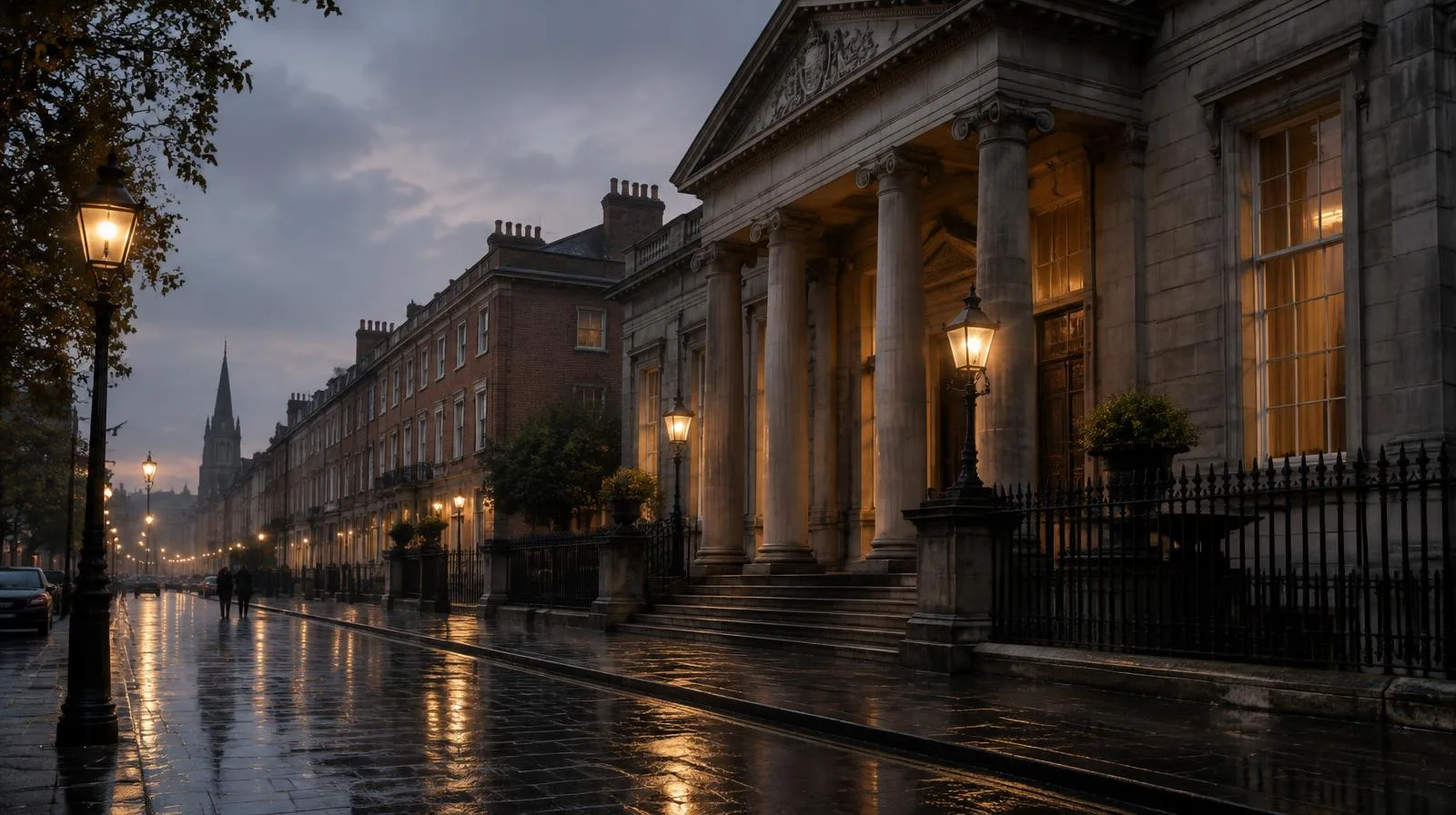
Turn down Molesworth Street in central Dublin and you might easily mistake Number 17 for an understated Victorian gentleman's club. Behind its classical facade, however, lies Freemasons' Hall, the headquarters of the Grand Lodge of Ireland. For the curious traveller and the travelling Mason alike, its appeal is the contrast between a dignified street frontage and an imaginative sequence of ceremonial interiors. Here, neoclassical pillars, Egyptian-inspired decoration and a room resembling a medieval chapel offer different ways into the history of Irish Freemasonry. This is not simply a monument to a vanished fraternity: the hall remains the headquarters of an organisation whose history reaches back to the early eighteenth century.
The Ancient Pedigree of Irish Freemasonry
The Grand Lodge of Ireland describes itself as the second most senior Grand Lodge in the world. It was in existence by 1725, but that year should not be mistaken for a precisely documented foundation date. Its first recorded communication took place on 24 June 1725, and a contemporary newspaper report described the installation of Richard Parsons, 1st Earl of Rosse, as Grand Master. The distinction matters: a surviving record establishes that the institution was operating, not necessarily the moment when it began. The Grand Lodge celebrated its tercentenary in 2025, using that first recorded communication as its anniversary landmark.
Among Ireland's significant contributions to the spread of Freemasonry were travelling military warrants. The first military warrant was granted by the Grand Lodge of Ireland to the First Battalion, Royal Scots, on 7 November 1732. Such warrants allowed lodges to accompany their regiments rather than remain tied to a single meeting place. Irish, Scottish, English and other military lodges subsequently helped carry Freemasonry overseas. Migration and trade also played important parts in that expansion, so the story is broader than any one army or jurisdiction. If you are exploring how the brotherhood dispersed across continents, a journey we explore in our guide to 10 Most Masonic Cities in the World, Dublin deserves a place among its important centres.
Victorian Ambition on Molesworth Street
Freemasons' Hall was the Grand Lodge of Ireland's first permanent home. By the 1860s, plans for a purpose-built headquarters had taken architectural form, with a competition attracting several designers. The surviving competition records offer a firmer starting point than picturesque but insufficiently supported accounts of every earlier meeting place. They also help explain the building's ambition: this was to be more than an office or an ordinary assembly room. Its programme brought together ceremonial spaces, libraries and supporting accommodation under one roof.
Edward Holmes of Birmingham won the architectural competition in 1866, and the hall opened in 1869. The contemporary architectural description reproduced by Archiseek identifies the frontage material as Ancaster stone, rather than limestone, and describes three classical orders arranged in successive stages: Doric below, Ionic in the centre and Corinthian above. The pediment bears the Masonic square and compasses. These details reward a pause before entering. Much like the experience of touring Freemasons' Hall London, a visit invites you to look beyond the headquarters' public face and consider how architecture gives a fraternity a visible identity.
A Walk Through the Themed Lodge Rooms
The hall's most memorable feature is its sequence of rooms associated with different Masonic bodies. Rather than presenting one decorative language throughout, the interiors move between classical, Egyptian and Middle Eastern references, medieval chapel imagery and elaborate ceremonial decoration. The effect can feel theatrical, but these are meeting spaces, not evidence that Freemasonry descends directly from every culture represented on their walls. Read the rooms as interpretations of history and symbolism. Their variety makes a guided visit particularly valuable, since an explanation of who uses each room can be as revealing as the ornament itself.
The Grand Lodge Room
The Grand Lodge Room is the building's principal meeting room. The Grand Lodge's own account describes its neoclassical design, Corinthian pillars and ceiling adorned with gold stars. A large pipe organ adds to the room's imposing character. The portraits deserve a closer look, but they should not be mistaken for an uninterrupted visual record stretching back to 1725. Most were commissioned specifically for this room and depict Grand Masters, Deputy Grand Masters and other senior officers from approximately 1870 to the 1920s. Together, the architecture and portraiture convey a distinctly institutional grandeur: this is a place in which the fraternity presents its leadership and continuity.
The Egyptian Room (Royal Arch Chapter)
The Royal Arch Room, often called the Egyptian Room, offers a striking change of atmosphere. The official description identifies a mixture of Egyptian and Middle Eastern styles, reflecting the nineteenth-century popularity of Egyptology. It is therefore more accurate to see the chamber as a Victorian interpretation than as a faithful reconstruction of a pharaonic temple. The Royal Arch room opened in 1871, after the hall itself had begun operating. For students of lodge room architecture and symbolism, its appeal lies in the way historical references become a setting for ceremony. Enjoy the visual richness, while asking your guide to distinguish decorative motifs from the meanings attached to them in this particular Masonic context.
The Knight Templar Chapel
The Knight Templar Room recreates the appearance of a medieval church or chapel. According to the Grand Lodge, that design reflects the Christian and chivalric aspects of medieval orders of knighthood. The distinction between evocation and survival is essential: visitors are entering a Masonic ceremonial room, not a surviving medieval Templar chapel. Nor does its appearance establish an unbroken institutional descent from the medieval Knights Templar. For those who include Dublin on their personal Masonic travel bucket list, this is an opportunity to consider how historical imagery can shape the experience of a room without being a literal record of its origins.
The Prince Masons Chapter Room
The Prince Masons Chapter Room is another highly decorated interior, associated with the Ancient and Accepted Rite. The Grand Lodge explicitly connects its elaborate appearance with the branch of Freemasonry that meets there. Rather than assigning a fixed interpretation to every colour, emblem or furnishing without a reliable explanation, let the guide introduce the room on its own terms. Its place in the sequence is part of the pleasure: after the Grand Lodge Room's classical order and the contrasting historical references of the other chambers, it provides another expression of ceremonial identity within the same headquarters.
Treasures of the Museum and Library
Beyond the ceremonial rooms, Freemasons' Hall houses a museum, library and archive. The museum displays Masonic regalia, jewellery, tools and other artefacts, offering a more intimate encounter with the fraternity's material culture. These objects provide a useful counterpoint to the grand interiors: a piece of regalia or a symbolic tool asks for a different kind of attention from a ceiling or a row of columns. Any itinerary devoted to the subject, such as our curated Masonic history tour of Dublin, can use the museum as a starting point for further questions. Researchers should contact the Library and Museum about holdings and access rather than assume that archival material is available during an ordinary tour.
One of Irish Freemasonry's most enduring stories concerns Elizabeth Aldworth, born Elizabeth St Leger, remembered as the Lady Freemason. According to the tradition recounted by the Provincial Grand Lodge of Munster, she accidentally observed a lodge meeting at Doneraile Court in County Cork through an opening in a wall during building work. After her presence was discovered, the brethren decided to initiate her. That account belongs to Masonic tradition, and the precise date and circumstances should not be presented as securely established contemporary history. The story remains a fascinating part of Irish fraternal memory, but it does not justify promising visitors that her personal apron, portrait and regalia are currently displayed in Dublin.
The library also offers a reason to look beyond decorative splendour and towards the printed foundations of the Craft. For readers exploring the greatest Masonic libraries and museums, a useful historical distinction concerns the constitutions themselves. Laurence Dermott's Ahiman Rezon was written for the Antients Grand Lodge in England, not as the Irish Book of Constitutions. The Museum of Freemasonry identifies John Pennel's 1730 publication as the first Irish edition of Anderson's Constitutions. These are important strands of Masonic publishing history, but they should not be confused with a verified inventory of the Dublin library. Ask staff about particular editions before arranging a research visit.
Irish Working: What Visiting Brethren Should Expect
For Masons travelling from abroad, an Irish lodge meeting can offer a valuable encounter with another jurisdiction's practice. It is tempting to describe that experience through sweeping claims about antiquity, simplicity or national character. A more careful approach recognises both shared foundations and locally valued differences. Historian Ric Berman, discussing early Irish and English Freemasonry, cautions against exaggerating the distance between them:
“the differences in ritual that distinguished Irish from English Freemasonry were relatively modest. But they were prized nonetheless and provided a sense of distinction.”
That historical observation is a useful antidote to claims that every Irish ceremony preserves unchanged eighteenth-century wording or is inherently less formal than ceremonies elsewhere. Approach a visit with curiosity rather than a checklist of supposed national traits. Before packing, ask your host what clothing and regalia are appropriate for the particular meeting. Our recommendations on traveling with Masonic regalia can help with the practical side of the journey, but local instructions should guide what you bring and wear.
A public tour and admission to a private lodge meeting are separate matters. If you hope to attend a meeting, begin with your own lodge secretary and seek guidance on the appropriate introduction to Ireland. Confirm recognition between the relevant Grand Lodges, your eligibility for the meeting and the evidence of membership the host requires. Ask whether certificates, other documents or an examination will be needed rather than assuming that a particular overseas dues card is sufficient. Reviewing international Masonic visitation protocol can help you prepare, but admission arrangements should be confirmed through the responsible Masonic authorities.
Planning Your Visit to Freemasons' Hall
Whether you are seeking a public architectural tour or making enquiries about a lodge visit, a little preparation will help. The official public-tour page is the best starting point for ordinary visitor arrangements. Because the headquarters remains in use, even a published schedule is not a guarantee that a tour will run on a particular day.
- Location: The visitor address published by the Grand Lodge is 17 Molesworth Street, Dublin, D02 HK50. The National Library of Ireland and the National Museum of Ireland's Archaeology museum are nearby. Allow time for your chosen walking route rather than relying on a universal three-minute estimate.
- Public Tours: The Grand Lodge's public-tour page lists tours at 3 p.m. each weekday, with no booking required and a contribution of €5 per person. It warns that major events can cause cancellations at short notice. Tours outside these times can be arranged for groups of 12 or more. The same page lists museum opening hours as Monday to Friday, 9 a.m. to 5 p.m., year-round. Confirm current arrangements with the Library and Museum before making a special trip.
- Attending Lodge Meetings: Arrange this separately from sightseeing. Seek an introduction through your own lodge and confirm the host lodge's requirements in advance. Do not treat a public-tour booking or museum visit as permission to attend a private communication.
- Dress Code: Ask the hall about any requirements for your tour or event. For a lodge meeting, obtain the host's specific instructions on dress and regalia rather than assuming that one business-suit rule applies to every occasion.
- Accessibility: Open House Dublin's 2026 listing describes an entrance reached by 11 steps, a lift serving the upper floors and four steps to negotiate on the first floor. A lift therefore does not, by itself, establish a fully step-free visitor route. Contact staff about your requirements, the route available for your visit and whether the lift is operating.
Frequently Asked Questions
Can non-Masons tour Freemasons' Hall Dublin?
Yes. The Grand Lodge advertises public guided tours and public access to its museum. Its official tour page lists weekday tours at 3 p.m., without advance booking, for a €5 contribution, and museum hours of 9 a.m. to 5 p.m., Monday to Friday. Major events can interrupt tours, sometimes at short notice, so check before travelling. Do not assume that public museum admission includes unrestricted access to the library, archives or every ceremonial room. Ask staff what is included and whether separate research arrangements are necessary.
How can a visiting Mason attend a lodge meeting in Dublin?
Start with your own lodge secretary and arrange the appropriate contact before your journey. Confirm that the relevant Grand Lodges recognise one another, that you are eligible to attend the particular meeting and that the host can receive you. Ask which documents are required and how your membership and qualifications will be verified. The requirements should come from the host and the relevant Grand Lodge authorities, not from a generic travel checklist. Also confirm the meeting time, dress and regalia before setting out.
What makes the Irish ritual working unique compared to English or Scottish practice?
Irish Freemasonry has its own jurisdictional traditions, but broad comparisons can easily become misleading. Ric Berman's research describes the historical ritual differences between Irish and English Freemasonry as relatively modest, although important to those who valued them. That is not a claim that all present-day workings are identical, nor does it provide a detailed comparison with Scottish practice. Visitors should avoid assuming that Irish ritual is unchanged from the early eighteenth century or uniquely informal. Let the host lodge explain the practices relevant to the meeting you attend.
Where is Freemasons' Hall located, and what else is nearby?
The hall's published visitor address is 17 Molesworth Street, Dublin, D02 HK50. Molesworth Street runs between Dawson Street and Kildare Street, placing the hall conveniently near the National Library of Ireland, the National Museum of Ireland's Archaeology museum and Leinster House. Trinity College and St Stephen's Green can also be incorporated into a wider central Dublin walk. Walking times depend on your destination and route, while neighbouring attractions have their own admission arrangements. Plan those visits separately rather than assuming that everything is within a fixed five-minute radius or accessible without booking.
Sources
- Grand Lodge of Ireland: institutional history and the hall's opening
- Grand Lodge of Ireland: official descriptions of the ceremonial rooms
- Grand Lodge of Ireland: public tours, museum hours and visitor arrangements
- Archiseek: Edward Holmes's design and contemporary architectural descriptions
- 1723 Constitutions: military warrants and the international spread of Freemasonry
- Ric Berman: The Second Grand Lodge, abridged Prestonian Lecture
- Provincial Grand Lodge of Munster: the tradition of Elizabeth Aldworth
- Museum of Freemasonry: Anderson's Constitutions and John Pennel's Irish edition