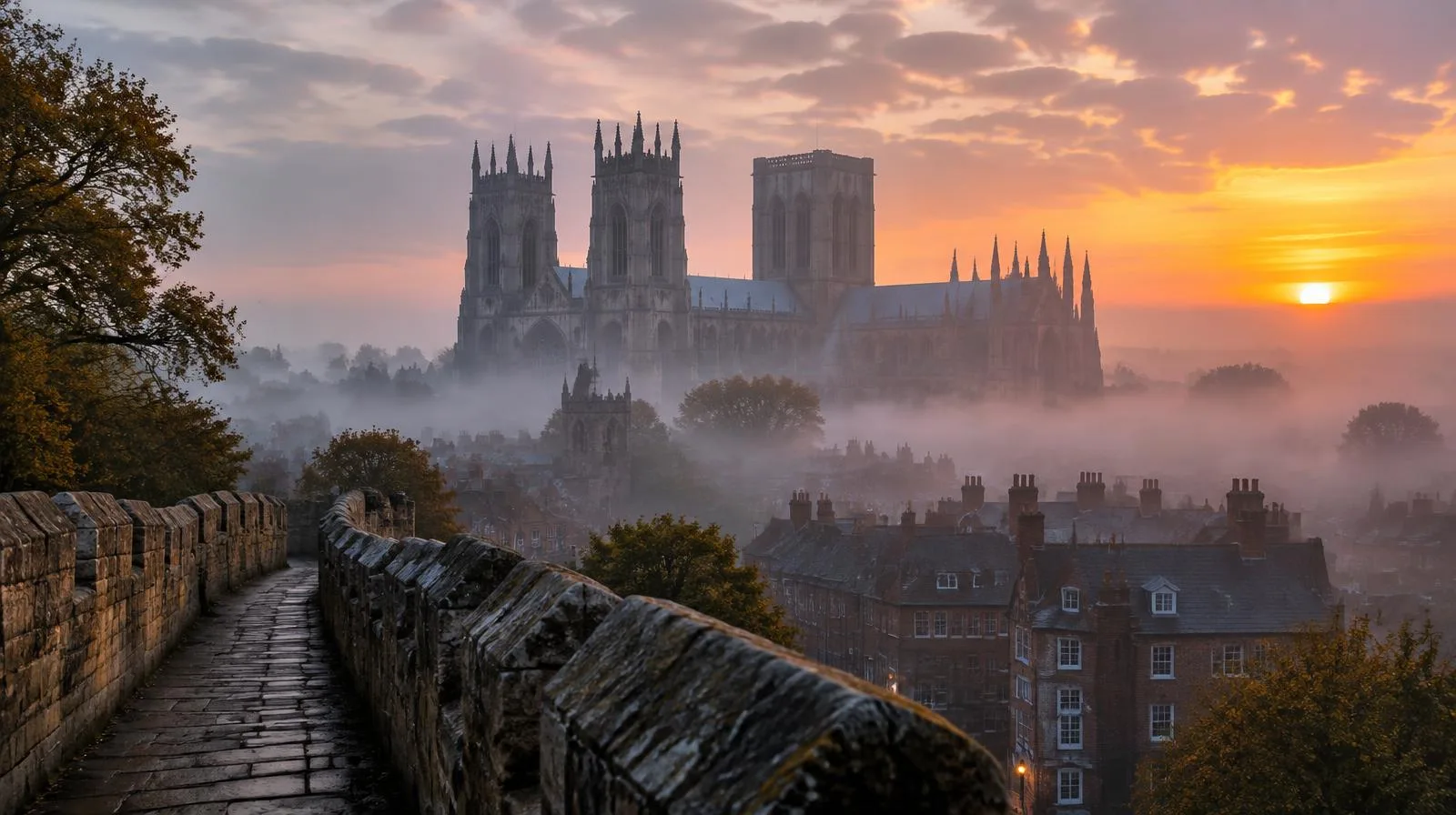
When the northern mist rolls off the River Ouse and clings to the limestone ribs of York Minster, this ancient walled city feels like a portal into the medieval past. For a travelling Freemason, its appeal lies partly in an enduring narrative: the famous York Legend. Walking these narrow streets, you encounter medieval stonecraft, eighteenth-century Masonic history, and the architecture of a later fraternity. These are connected subjects, but not an unbroken institutional thread. The pleasure of exploring York is learning to distinguish the legend from the surviving evidence, while allowing each its own place in the journey.
The Legend of 926 AD: King Athelstan, Prince Edwin, and the Craft
To understand York’s place in Masonic lore, begin with the Old Charges, manuscript texts that combine accounts of the craft’s origins with duties and regulations for masons. The Regius and Cooke manuscripts belong to this early tradition, but the familiar York story did not emerge fully formed in every version. The Regius account associates an assembly with King Athelstan; later manuscripts elaborate the narrative. By the Elizabethan period, versions located the assembly at York in 926. It is therefore misleading to treat all the Old Charges as independent witnesses to the same tenth-century event.
In the developed legend, Prince Edwin obtains royal support for the masons, summons an assembly at York, and gathers earlier writings from which rules for the craft are compiled. His relationship to Athelstan varies in the retelling. This is Masonic tradition, not a verified account of a royal charter or national assembly. The purported York Constitutions associated with 926 do not supply a surviving original tenth-century manuscript. Their story belongs to the history of Masonic claims about antiquity, rather than proving those claims.
That distinction need not diminish York’s place on a Masonic travel bucket list. The legend offers a symbolic language of royal protection, shared obligations, and orderly assembly. York itself, known in Roman times as Eboracum and in its Scandinavian past as Jorvik, provides a compelling setting for such institutional memory. Stand before the Minster’s west front and consider two different questions: what happened here, and what later generations believed had happened here. Both reward investigation, but they require different kinds of evidence.
Operative Foundations: The Mason Fabric Rolls of York Minster
Walk around York Minster and the audacity of medieval operative masonry becomes strikingly apparent. Construction of the present Gothic cathedral began around 1220 and continued through successive building campaigns to 1472. Its architecture brings together Early English, Decorated, and Perpendicular work. Rather than relying on a disputed superlative about its size, let the scale speak for itself. The building is an extraordinary place to consider the skill, organization, and resources required to turn a sustained architectural ambition into stone.
The fabric records and associated ordinances provide firmer ground than the assembly legend. The York ordinances of 1370 describe a working lodge beside the cathedral and regulate the masons’ working day. They were imposed by the cathedral Chapter, not evidence of an autonomous speculative lodge. A record reproduced with the ordinances names Master Robert de Patrington and twelve other masons who undertook to observe the rules. The provisions concerning daylight, work, and meal breaks bring the practical conditions of the medieval building site into focus.
The Minster’s limestone came from the Tadcaster area. For visitors interested in reading stonemasons' marks, its fabric invites close attention, although individual marks should be interpreted with appropriate guidance. They are not, by themselves, proof of modern Masonic degrees or an uninterrupted lodge succession. Likewise, comparison with Kilwinning and Mary's Chapel in Scotland should respect the differences between cathedral employment records, lodge minutes, and later ritual traditions. Similar vocabulary does not make these sources interchangeable.
Do not rush your visit. The Undercroft offers a way to explore the site’s earlier history, including Roman remains and evidence of the Norman cathedral. Above ground, pause over the relationship between individual carved stones and the larger structure. For a Freemason, the working tools may carry moral meanings; for the builders, measurement and geometry were practical necessities. That comparison can be illuminating without turning every carving into an encoded Masonic message or claiming a direct institutional descent that the evidence does not establish.
The Punch Bowl and the Grand Lodge of All England
York’s documented eighteenth-century Masonic story is substantial enough without assigning it an unsupported founding scene. The Ancient Society of Freemasons in the City of York existed by at least 1705. In the mid-1720s it adopted the title Grand Lodge of All England meeting at York. Accounts differ over the precise dating of the declaration. The evidence does not securely establish the article’s former claim that this happened at the Punch Bowl on a particular winter feast day in 1725.
The northern body appealed to York’s legendary antiquity, but it should not be imagined simply as a large regulatory organization equivalent to a modern grand lodge. For much of its existence it functioned chiefly as a lodge that made Freemasons, although it also enabled or supported dependent lodges. Its activity was intermittent: it became inactive in the 1730s and revived in 1761. It eventually ceased functioning again late in the eighteenth century. This was not a continuous jurisdiction subsequently absorbed wholesale during the nineteenth-century English unifications.
Stonegate nevertheless belongs on the walk. Published transcriptions of early York minutes record meetings at premises there in the 1720s, alongside meetings elsewhere in the city. If you pause at the Punch Bowl, treat it as an atmospheric stop rather than a verified birthplace of the York Grand Lodge. The distinction matters: a street can have a documented Masonic connection without every appealing building on it inheriting that history. The later York Rite also invokes the city’s legendary prestige, but its name does not establish organizational descent from a particular York tavern meeting.
The Jewel of Duncombe Place: York Masonic Hall
Near the Minster stands Duncombe Place Masonic Hall, a Grade II listed building constructed in 1862-63 and altered in 1866. York Lodge No. 236 identifies its architect as John Edwin Oates, a lodge member, and credits J. Barton-Wilson with the lodge-room interior. The architectural records differ in the spelling of the first architect’s surname, so the lodge’s own account is the basis for the name used here. The hall offers a documented Victorian chapter in York’s Masonic story, distinct from both the medieval workshop and the eighteenth-century York Grand Lodge.
Its exterior is not Gothic. The architectural description records a stone-faced front with pilasters, an entablature, round-headed upper windows, and a Doric entrance porch. These classical features provide a useful contrast with the cathedral nearby. The inscription Audi Vide Tace appears across the front. According to the lodge’s building history, the foundation stone was laid on 8 September 1862, and the completed hall was opened and consecrated on 2 June 1863. In 1866 the front was rebuilt farther forward to enlarge the accommodation.
Should an interior visit be available, it offers an opportunity to consider lodge room architecture and symbolism in a purpose-built Victorian setting. Do not, however, arrive expecting a guaranteed display of particular banners, tracing boards, furnishings, or manuscripts. Historic collections and visitor arrangements should be confirmed with the lodge. An attractive account of a museum is no substitute for a current description of what visitors can actually see.
York Lodge No. 236 dates its warrant to 7 July 1777, issued by the Provincial Grand Lodge of Yorkshire. It now works under the United Grand Lodge of England, whose headquarters are at Freemasons' Hall in Covent Garden. Its warrant should not be confused with a documented institutional descent from the Grand Lodge of All England. The United Grand Lodge of England resulted from the union of the English Antients and Moderns in 1813, not from the absorption of a still-functioning York Grand Lodge. York’s heritage is richer when these separate histories remain visible.
A Self-Guided Walking Route: In the Footsteps of the York Brethren
Set aside a morning for an introductory walk, or longer if you intend to enter the principal attractions. This route brings together sites of direct Masonic interest and places that illuminate York’s wider architectural and civic history. Not every stop is a documented Masonic meeting place. Check access before setting out and adapt the route to weather, mobility, and the time available:
- 1. York Minster and Undercroft: Begin at the West Front, then explore the cathedral and Undercroft if admission arrangements permit. Roman remains beneath the Minster and surviving evidence of the Norman church reveal successive layers of the site’s history. Constantine was proclaimed emperor at York in 306, but that does not identify a particular accessible room beneath the cathedral as the proven location of the proclamation.
- 2. Duncombe Place: Make your way to the Masonic Hall and study its classical exterior. This is an active lodge venue, not an attraction whose interior can be assumed to be open. Arrange any visit beforehand, and distinguish a public architectural tour from attendance at a lodge meeting.
- 3. Stonegate: Continue along Stonegate, remembering the early eighteenth-century meetings recorded at premises on this street. A pause at the Punch Bowl can provide atmosphere, but the pub should not be presented as the established location of the Grand Lodge’s declaration. Let the surviving minutes, rather than an appealing itinerary, determine the historical claim.
- 4. St. Helen's Square and the Mansion House: Walk toward St. Helen’s Square and the Mansion House, York’s lord mayoral residence. Include this as a civic-history stop rather than evidence of a specific Masonic ceremony. The setting invites reflection on the different institutions that have shaped the city, without assuming that civic and lodge histories are identical.
- 5. The Merchant Adventurers’ Hall: Continue toward Fossgate to visit the hall, whose principal medieval construction took place in 1357-1361. Its history encompasses a merchants’ religious fraternity, trade, and charitable provision. These themes make it an illuminating comparison with other associations, but the hall is not evidence that this merchants’ fraternity directly founded Freemasonry.
- 6. The City Walls and Monk Bar: Finish with a suitable accessible section of the walls and, if your route allows, Monk Bar. Check current access and conditions before climbing onto the walls. Views toward the Minster offer a fitting conclusion to a journey through one of the great Masonic cities of the world, a description to enjoy as a travel theme rather than a historical ranking.
Planning Your Visit to Historic York
York has direct rail connections with London King’s Cross and Edinburgh Waverley. Journey times vary by service, so consult the current timetable rather than planning around a fixed duration. The central sites on this itinerary lend themselves to exploration on foot, but historic streets, steps, and wall walks are not equally suitable for every visitor. Check accessibility information for each building and consider a shorter street-level route if necessary.
Before packing your bags, review essential travel planning tips for Freemasons. If you hope to attend York Lodge No. 236 or another lodge in the Province of Yorkshire, North and East Ridings, begin with your home lodge secretary. Recognition between Grand Lodges matters, as do the host lodge’s admission procedures. Ask what introductions, evidence of membership, and other arrangements are required, following the appropriate international Masonic visitation protocols. Avoid assuming either that arrival guarantees admission or that one universal clearance procedure applies to every visitor.
For York Minster and the Merchant Adventurers’ Hall, check official websites for current admission charges, opening times, accessibility, and booking requirements. For the Masonic Hall, make a separate enquiry about any available tour. Public visits have been arranged in the past, but a past event is not a standing invitation. Build flexibility into the itinerary, especially if attending worship, joining a guided visit, or arranging a lodge meeting is central to your trip.
Frequently Asked Questions
Did the Grand Assembly of 926 AD actually take place?
It is not established as a historical event. The assembly belongs to Masonic legend, and its familiar details developed through later retellings. The Old Charges are important evidence for what masons recorded about their duties and origins, but they are not contemporary tenth-century records of an assembly at York. Enjoy the story as a constitutional tradition without presenting Edwin’s meeting or a royal charter of 926 as proven fact.
Can visiting Freemasons tour Duncombe Place Masonic Hall?
Contact the lodge to ask about current opportunities. Organized public visits have taken place, including a Yorkshire Philosophical Society visit in 2015, but this does not establish daily opening or annual participation in Heritage Open Days. Check current event listings rather than assuming a recurring programme. Attendance at a lodge meeting is a separate matter, requiring the appropriate arrangements and satisfaction of the host’s admission requirements.
What is the relationship between York, England, and the American York Rite?
The name invokes the Masonic legend that places an early assembly of masons at York. In American usage, the York Rite commonly groups Royal Arch Chapters, Cryptic Councils, and Knights Templar Commanderies, each with its own governing arrangements. It is not a single worldwide organization directed from York. The legendary association does not prove that the American bodies descend institutionally from either the supposed assembly of 926 or the eighteenth-century Grand Lodge of All England.
How much time is needed to explore York's Masonic and medieval sites?
A morning can provide an introduction to the streets and building exteriors. For a more leisurely visit including the Minster, Undercroft, Merchant Adventurers’ Hall, and sections of the walls, consider allowing two days. That is a planning suggestion, not a minimum requirement. Any arranged Masonic Hall tour or lodge meeting will influence the schedule, and opening arrangements may determine which stops fit comfortably into your visit.
Sources
- Grand Lodge of All England: institutional history and development of the York Legend
- York Cathedral Ordinances of 1370: translated working regulations
- Getty Cultural Objects Names Authority: York Minster
- York Lodge No. 236: history of the Duncombe Place building
- York Lodge No. 236: warrant, affiliation, and enquiries
- Merchant Adventurers’ Hall: official historical timeline
- United Grand Lodge of England: recognition of foreign Grand Lodges
- York Rite: name, constituent bodies, and organization