
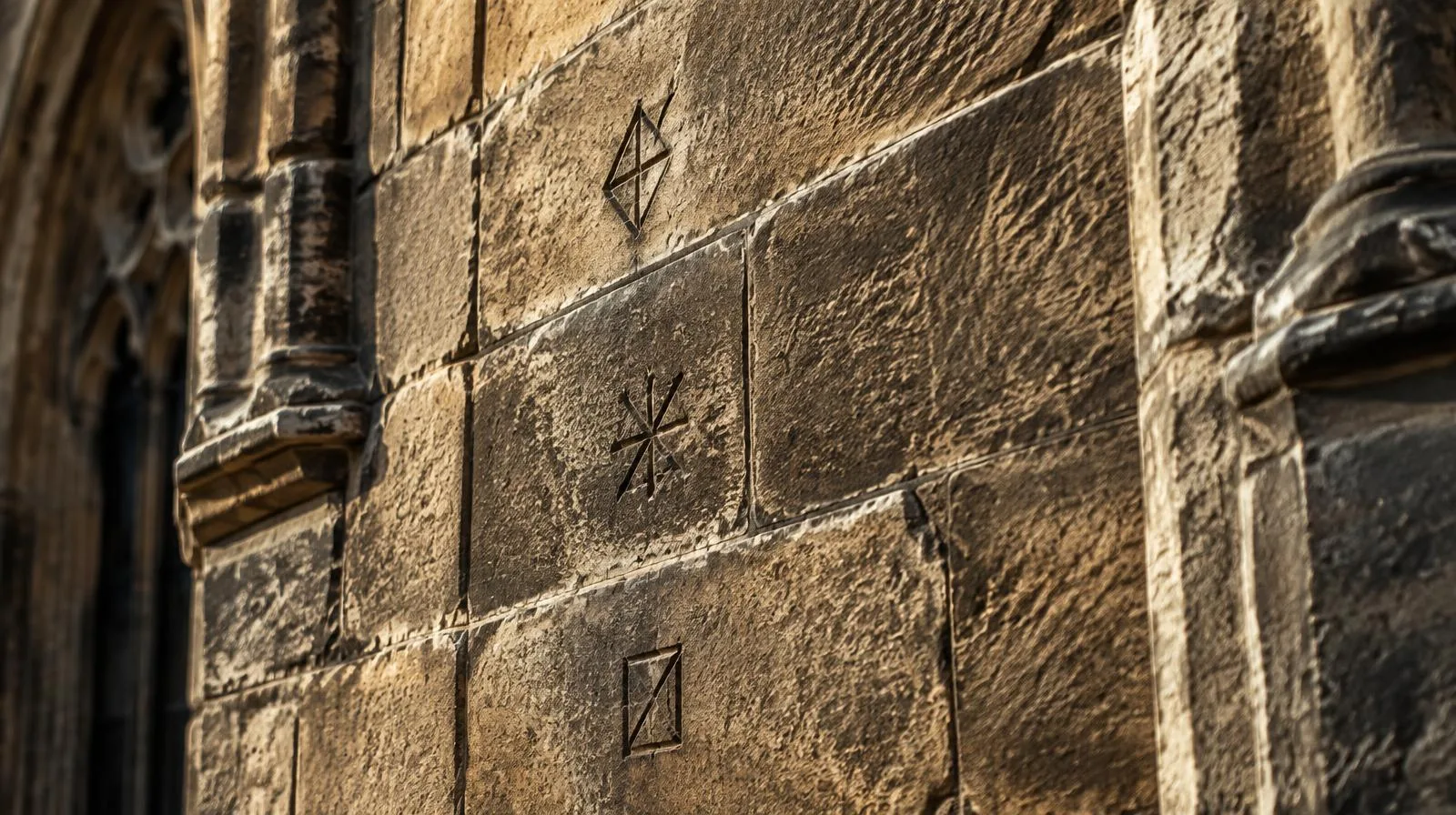
Look closely at the dressed stone of a medieval cathedral pillar, without touching its surface, and you might notice an angular incision that seems quite deliberate. Look again nearby: does the same shape appear on another block? You may have found a stonemason’s mark. These small signs can offer clues to the people and working practices behind Europe’s great churches. They are not all personal autographs, and not every scratch belongs to a builder. For the travelling Freemason and architectural pilgrim, learning to observe them carefully transforms a cathedral visit into an encounter with the practical world of the operative craft.
What Are Stonemason Marks? The Anatomy of an Operative Stamp
Stonemasons’ marks are signs made on stone as part of its preparation and construction. They occur on walling blocks and on shaped architectural elements, including arches and windows. Some identified a worker’s output; others helped builders assemble components. Their interpretation depends on their position, repetition and relationship to the surrounding fabric. As architectural historian Jennifer S. Alexander cautions, medieval walls also carry marks made by visitors and other users of the building. A striking shape alone is not enough to establish its origin.
For a traveller, three useful distinctions are:
- Banker Marks (Identity Signatures): These are associated with the mason who worked a stone. The banker is the mason’s workbench. Such marks could help identify output for payment or supervision, but calling every example a personal signature is misleading. Their meaning and administrative use must be considered within the particular building and period.
- Position and Assembly Marks: These identify components that belong together in complex work, such as arches and tracery. Vienna’s cathedral workshop describes examples consisting of letters, numbers and simple geometric forms, often placed on surfaces concealed after assembly.
- Quarry Marks: Marks associated with the supply of stone should be distinguished from those identifying its later dressing or assembly. Do not assume that a particular incision records a quarry bed, stone quality or intended structural use without supporting evidence.
A mark might acquire professional significance, but there was no single documented ceremony of allocation shared by all medieval masons. Alexander’s research emphasizes how little evidence survives for the allocation and registration of marks through much of the medieval period. Traditions about a master ceremonially granting a lifelong sign to every newly qualified journeyman should therefore be presented as craft traditions, not universal historical practice.
The Geometry of the Chisel: How Medieval Masons Designed Their Marks
The geometry of marks is part of their fascination. Intersecting lines and repeated shapes invite comparison, sketching and speculation. Yet the claim that medieval workshops everywhere generated their marks from strict geometric “mother-keys” goes beyond the evidence. Geometric interpretations associated with writers such as Franz Ržiha belong to the history of studying these signs; they do not, by themselves, establish how a medieval mason designed a particular mark.
It is useful to separate three questions: what shape can we see, how might that shape be constructed, and what evidence explains its original use? A modern drawing can fit a mark into a grid without proving that its maker used that grid. Nor does resemblance to a square, triangle or compass construction demonstrate a shared ritual system linking different workshops. Record the form first, and leave its meaning open where the documentation is silent.
A useful field principle: describe what the stone shows before deciding what the sign means.
For your notebook, count the strokes, note intersections and preserve the orientation in which you found the mark. Do not rotate every example into a preferred symbolic arrangement. The published survey of Regensburg Cathedral recorded marks upright, inverted and oblique, indicating that they were cut without regard to the blocks’ eventual orientation. Freemasons may find these forms evocative of lodge room architecture and symbolism today, but that modern association should not be mistaken for evidence of a medieval symbolic intention.
From Operative Chisels to Speculative Degrees
For modern Freemasons, marks offer a compelling point of contact with operative craftsmanship. Scotland provides important documentary evidence, but the chronology matters. The requirement to enter an admitted master or fellow craft’s name and mark in the lodge book belongs to the First Schaw Statutes of 1598, not the Second Statutes of 1599. William Schaw was Master of Works to James VI of Scotland. These regulations illuminate the organization of the craft, rather than proving that later speculative ceremonies already existed.
When planning a masonic history tour of Scotland, distinguish surviving records from lodge tradition. Mother Kilwinning’s own history associates its origins with the building of Kilwinning Abbey in 1140, but that is a traditional origin claim, not a foundation date established by contemporary lodge minutes. Its known minute books begin in 1642. Our guide to Kilwinning No. 0 and Mary’s Chapel No. 1 provides a starting point for exploring these institutions. Do not assume that original registers are available for casual inspection; ask about access or published reproductions.
Operative lodges and speculative Masonic lodges must also be distinguished. Archaeologist Moira Greig notes their historical connection while warning against treating them as the same institution. The Mark Master degree draws moral and symbolic meaning from the craftsman’s identifying mark, but its precise origins remain debated. A tangible later example survives at the Scottish Rite Masonic Museum & Library: the mark book of King Hiram Royal Arch Chapter, Massachusetts, dated 1815-1835. Its members chose symbols recorded within keystone outlines. That is evidence of speculative practice in its own period, not a template for interpreting every medieval incision.
The Best European Cathedrals for Hunting Stonemason Marks
Marks are not confined to cathedrals, and a rewarding itinerary need not depend on a league table of the largest collections. Scottish archaeological research discusses them across castles, churches and other historic buildings. You can bring the same observational approach to the architecture explored in our guide to Tomar’s Convent of Christ, without assuming that every site contains accessible or securely identified examples. For your masonic travel bucket list, the destinations below offer different ways to consider stonework, its makers and its interpretation.
1. York Minster, England
York offers both historic fabric and a continuing stonemasonry tradition. The Minster’s own account reports marks on stones in parts of the cathedral dating to 1154. A study of the east end undertaken in 2022 also considered marks as evidence for construction processes, including working groups and building phases. There is no need to embellish that interest with an unsupported total of two thousand marks or a claim that York is Northern Europe’s finest repository.
Ask a guide where examples can currently be viewed rather than relying on a promised cluster in the crypt or undercroft. Those following our Masonic history guide of York should also remember that not every marked stone is medieval. Masons interviewed for the 2022 study described modern personal marking as voluntary, with identifying numbers and time sheets performing administrative functions. A living workshop can preserve aspects of a tradition while changing how it works.
2. Strasbourg Cathedral, France
Strasbourg’s sandstone cathedral offers a setting for exploring the organization of the German-speaking stonemasons’ craft. The regulations commonly called the Strasbourg Constitutions have a more complicated history than their name suggests. The account accompanying the supplied translation describes an initial meeting at Regensburg in 1459, followed by adoption and promulgation at Strasbourg, with subsequent additions and revisions. It is more accurate to describe this developing regulatory tradition than to suggest one document instantly unified every workshop in the Holy Roman Empire.
When examining marks here, resist turning a matching shape elsewhere into a named craftsman’s travel itinerary. Alexander’s research describes a methodological shift away from antiquarian attempts to trace itinerant workers through collections of similar signs, toward recording marks within the context of individual buildings. Compare examples, certainly, but look for independent documentary and architectural evidence before concluding that one person worked at both sites.
3. St. Vitus Cathedral, Prague, Czech Republic
St. Vitus Cathedral stands within Prague Castle, and Peter Parler was a major figure in its fourteenth-century construction. It is an evocative destination for a traveller interested in medieval building. However, the evidence supplied here does not establish a publicly accessible route to particular marks, or justify identifying repeated angled signs as Parler’s personal or family signature.
Use our Master Mason’s guide to Prague as an itinerary companion, then ask the cathedral’s visitor staff about current access and specialist interpretation. Treat a named attribution as a question to investigate, not a conclusion to impose on the stone. A useful visit may involve studying architectural forms and learning about the building workshop even when no securely identified mark is available at eye level.
4. Melrose and Elgin Abbeys, Scotland
A necessary distinction for this pairing: Melrose is an abbey, while Elgin is a cathedral, not an abbey. At Melrose, the inscription naming John Morow offers a particularly personal encounter with the building craft. It states that he was born in Paris and had responsibility for masonry at St Andrews, Glasgow, Melrose, Paisley, Nithsdale and Galloway. An inscription naming a builder is not, however, the same thing as an independently identified banker mark.
Morow’s career requires care in dating. An 1858 study in the Proceedings of the Society of Antiquaries of Scotland placed his work at Melrose in the fifteenth century; later discussion considers him within the architectural revival beginning in the 1390s. Avoid presenting him simply as a securely dated late-fourteenth-century mason whose individual mark visitors can identify in specified doorways.
Elgin lies in Moray. Historic Environment Scotland highlights its thirteenth-century west front, octagonal chapter house and rich surviving stone carving. These provide sound reasons to visit, but they do not establish a particular concentration of accessible masons’ marks. Check current access arrangements at both sites, and let the surviving fabric, rather than an expectation of guaranteed discoveries, guide your visit.
The Art of Spotting Marks: Field Techniques for Travellers
Looking for marks requires a shift in attention. Rather than staring only upward at vaults and windows, spend time observing accessible stone surfaces at a comfortable height. The most useful record combines a close view with enough surrounding architecture to relocate it. Try this cautious, non-contact approach:
- Seek Raking Light: Light falling obliquely across a surface can make shallow incisions easier to see. There is no universal best visiting hour, since orientation, windows and artificial lighting differ. Compare the surface from several permitted viewpoints.
- Carry an Angled Pocket Torch: If staff permit it, try a small torch directed across the stone rather than straight at it. Keep equipment away from the surface and avoid disturbing worshippers or other visitors. Special specifications are not necessary for a first observational visit.
- Check Spiral Stairwells and Tower Passages: Consider these only where visitor access is authorized. Do not assume they contain more marks than the nave. The Regensburg survey records difficulties caused by darkness, whitewash and inaccessible wall surfaces, reminders that visibility is not a reliable measure of abundance.
- Examine Window Sills and Column Bases: Accessible lower stonework can be convenient to study, but low position does not guarantee good preservation. Look for repeated signs on neighboring blocks, distinguish incisions from general tool dressing, and photograph the wider setting if photography is allowed.
In your notes, separate observation from interpretation. “Three intersecting lines, repeated on four nearby stones” is more useful than “secret lodge symbol.” Record the location, the apparent orientation and any uncertainty. A clear description can remain valuable even when the mark’s maker and purpose are unknown.
Planning Your Architectural Pilgrimage
Living workshops add another dimension to a journey focused on historic stone. York Minster describes the continued use of hand carving with mallets and chisels, alongside mechanical developments in lifting and sawing. This is continuity with adaptation, not the unchanged use of identical medieval techniques. Modern conservation work also means that a freshly visible mark may belong to a replacement stone rather than an original building phase.
Check official websites for current opening times, admission charges, worship arrangements, conservation closures and accessibility. York’s Hidden Minster programme includes tours involving the Chapter House roof and old Mason’s Loft, or spaces behind the present crypt. These are opportunities to explore building history, not guarantees of seeing the densest concentrations of untouched marks. Confirm availability, physical requirements and booking conditions for your intended date.
If you plan to combine architectural exploration with Masonic visits, review our travel planning tips for Freemasons. Requirements depend on the jurisdictions and bodies involved. UGLE explains that recognition governs which foreign Grand Lodges its members may intervisit. Consult your own lodge secretary or Grand Lodge about recognition, introductions and necessary credentials before arranging a meeting visit. Our guide to international Masonic visitation protocol can help frame those questions, but no single certificate should be presented as a universal European admission requirement.
Frequently Asked Questions
Are stonemason marks secret esoteric codes?
They should not be presumed to be. Documented functions include identifying a worker’s output and organizing the assembly of components. Later speculative Masonry gives marks symbolic and moral significance, but that does not establish an occult meaning for medieval examples. Nor is every incision a mason’s mark: visitor graffiti and other signs also occur on church walls. Context and repetition are better starting points than a resemblance to a familiar symbol.
Is it permissible to touch stonemason marks on cathedral walls?
Follow the site’s instructions and adopt a non-contact approach unless staff explicitly permit otherwise. Do not scrape, clean, wet, chalk or retrace a mark. Photography and sketches made without contacting the stone are preferable to rubbings. Historic Scotland’s carved-stone guidance treats rubbing as an activity requiring careful consideration, not an automatic visitor entitlement. Ask the responsible site staff about any proposed recording technique; permission from a particular named officer should not be assumed sufficient everywhere.
Why are marks found on some stones but completely absent on others?
There is no single explanation. Assembly marks may lie on concealed surfaces. Weathering can erase incisions, while coatings and poor lighting can obscure them, as the Regensburg survey documents. Marking practices and administrative needs also varied. An apparently unmarked area therefore does not prove that different craftsmen worked there, or that its masons were paid by the day. Payment arrangements require supporting evidence rather than inference from absence alone.
Can two different medieval masons share the same mark?
Yes. A matching shape is not a globally unique identifier. Vienna’s cathedral workshop describes personal marks as distinguishing workers within their workshop context, but such local identification should not be converted into a universal rule covering every region and century. Likewise, claims that sons invariably inherited a father’s mark with an extra stroke need evidence for the particular tradition. Compare the date, location, stonework and documentary record before attributing matching signs to one individual.
Sources
- Jennifer S. Alexander: The Introduction and Use of Masons’ Marks in Romanesque Buildings in England
- Jennifer S. Alexander: Marks to Identify Work and Output
- Vienna Cathedral Workshop: Stonemasons’ Marks and Their Functions
- Schaw Statutes of 1598 and 1599: Transcription and Edition
- Scottish Rite Masonic Museum & Library: The Mark Book
- York Minster: Centuries of Expert Craftsmanship
- Society of Antiquaries of Scotland: Notes on Melrose Abbey and John Morow
- Historic Environment Scotland: Elgin Cathedral