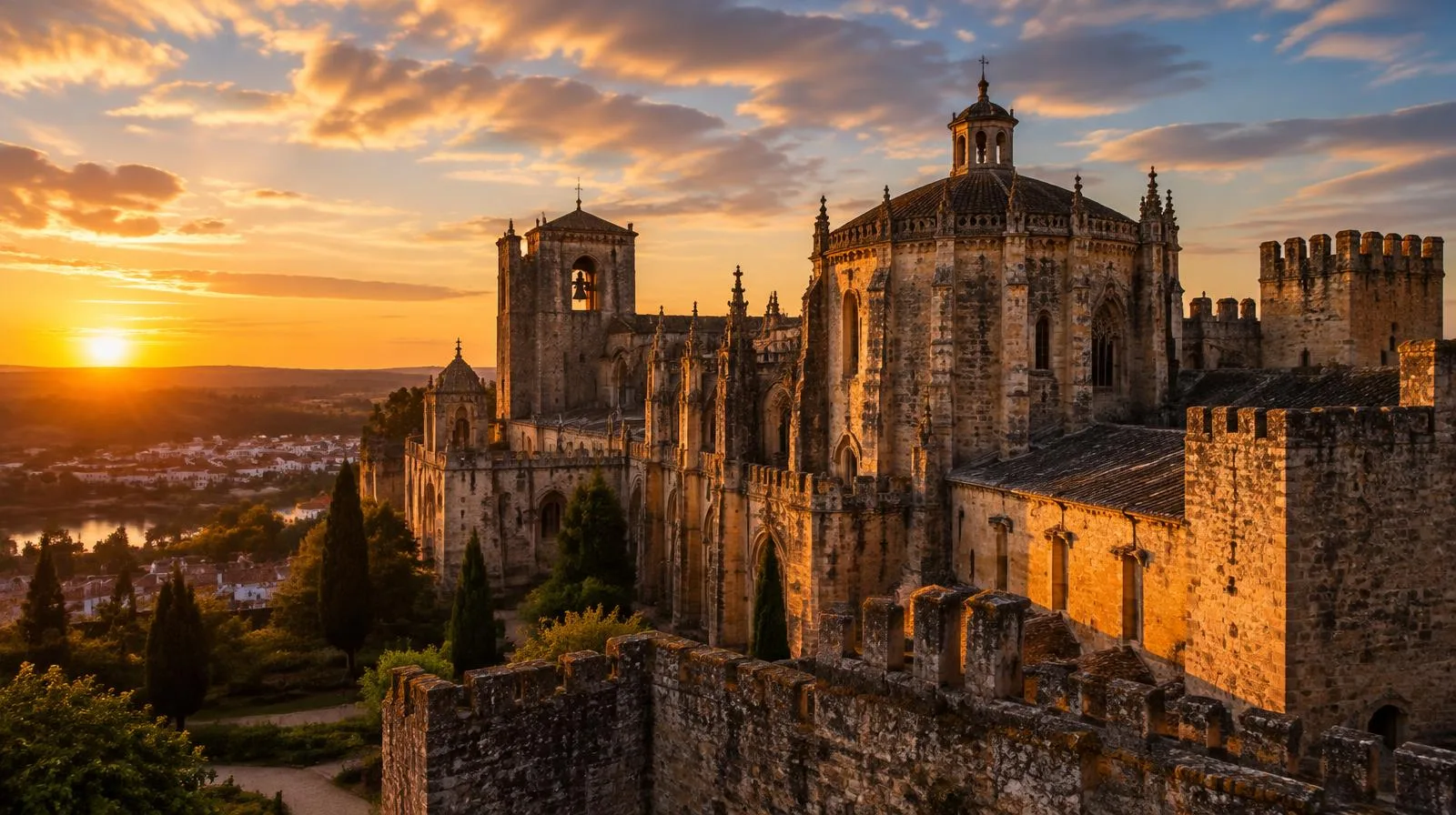
High above the Nabão River in central Portugal stands an astonishing fortress-sanctuary that defies simple architectural categorization. The Convent of Christ in Tomar is not merely a monastic curiosity; for the travelling Freemason and the lover of chivalric history, it offers a meeting place between documented history and enduring myth. Here, the Knights Templar built a Portuguese headquarters whose buildings later passed to the Order of Christ. That inheritance was real, but it was not simply a change of name that allowed an abolished order to survive untouched. For anyone assembling a masonic travel bucket list, this hilltop complex invites a rewarding exercise: admire the romance while keeping the boundary between evidence and imagination clearly in view.
The Fortress on the Hill: Gualdim Pais and the Templar Bastion
To understand the Convent of Christ, one must journey back to the twelfth century. Construction of Tomar Castle began on March 1, 1160, under Gualdim Pais, Master of the Knights Templar in Portugal. An inscription on the fortification records the date. The castle was intended both to establish the order's headquarters in Portugal and to complement the defensive line between Coimbra and Santarém. Its position above the town makes that combination of military command and territorial presence immediately legible.
Pais had served in the Holy Land before returning to Portugal. Tomar's military architecture included a keep and sloping masonry at the base of its walls, features that strengthened its defenses. Those defenses were tested in 1190, when forces of the Almohad caliph Abu Yusuf Ya'qub al-Mansur attacked Tomar. The Templars under Pais successfully resisted. The Rota dos Templários account describes a six-day siege, although published accounts differ over its precise chronology. According to local legend, fighting at the Almedina entrance was so fierce that it became known as the Blood Door. The memorable name belongs to the site's traditional storytelling, not to a securely established account of every detail of the battle.
For speculative Masons who appreciate the relationship between practical building and symbolic reflection, the stonework offers ample inspiration. Much like the close observation encouraged in our guide to stonemasons' marks on European cathedrals, a visit rewards attention to walls, openings and the demands imposed by terrain. Such craftsmanship does not establish a connection with later Masonic ritual. It does offer a powerful setting in which to consider skill, endurance and the responsibilities of those who build.
The Sacred Hexadecagon: Inside the Charola
At the architectural heart of Tomar sits the Charola, the Templar rotunda whose construction began in the second half of the twelfth century and continued in subsequent campaigns. Official heritage descriptions identify Jerusalem's Holy Sepulchre as an inspiration. Architectural scholarship also places the building in conversation with other centrally planned sacred structures, including the Dome of the Rock and Charlemagne's palatine chapel at Aachen. These comparisons are richer than the notion of a simple, exact copy of one eastern monument.
From outside, the Charola presents sixteen faces; inside, an octagonal central structure is surrounded by an ambulatory. That interplay of eight and sixteen supplies its extraordinary spatial character. Yet the interior visible today is not an untouched medieval time capsule. Under Manuel I, the Charola received an elaborate decorative program involving painting, gilding, sculpture and other ornament. Conservation research dates the sculptures of its central drum to 1511-1514, not the seventeenth century. Their colour and craftsmanship belong to a later chapter in the building's devotional life.
For a visitor drawn to geometry, the repeated forms and changing perspectives can be intoxicating. A Freemason may find personal resonances with lodge room architecture and temple symbolism, but those resonances should remain an interpretation rather than a claim of historical transmission. The Charola does not demonstrate that medieval Templars handed a system of sacred geometry to modern lodges. Its documented achievement is impressive enough: a centrally planned Christian oratory, subsequently transformed by generations of patrons and craftsmen. Take time to distinguish its structural framework from its later decoration, rather than reading every visible feature as part of a single original design.
The Papal Suppression and the Birth of the Order of Christ
On October 13, 1307, Philip IV of France ordered the arrest of the Templars in his kingdom, including their master, Jacques de Molay. The ensuing proceedings included confessions obtained under torture. On March 22, 1312, Pope Clement V issued Vox in excelso, formally suppressing the Order of the Temple. Much Templar property was assigned to the Knights Hospitaller, although its disposition differed between territories. Readers interested in that separate order's later setting can turn to our guide to Malta's historic temples and lodges.
In Portugal, King Denis pursued arrangements that ultimately led to the creation of the Order of Christ. Pope John XXII's foundation bull, dated March 14, 1319, assigned the new order the Portuguese Templars' property, privileges and rights. The Portuguese archival record also specifies Castro Marim as its initial residence. This was a new military-religious institution inheriting an earlier order's patrimony, not merely the Templars continuing at Tomar without interruption.
The road to that settlement was more complicated than a royal rescue story suggests. Historian Giulia Rossi Vairo describes negotiations and conflicts involving the monarchy, the papacy, former Templars and other participants. Tomar became the new order's headquarters later in the fourteenth century. Sources differ over the precise date: UNESCO gives 1344, while the Portuguese presidency's history gives 1356. What matters here is the distinction between the foundation of the order and its later establishment at Tomar. Property and institutional memory could endure without proving that every knight, custom or supposed esoteric teaching passed unchanged into the successor body.
From Cloisters to Carvels: The Maritime Cross and the New World
In the fifteenth century, Tomar entered another important chapter under Prince Henry the Navigator, appointed governor and administrator of the Order of Christ in 1420. The order's resources supported Portuguese maritime exploration. Its history thus connects the world of medieval military-religious foundations with the expanding ambitions of the Portuguese monarchy, although that connection should not turn the convent itself into an imaginary navigation academy.
The red cross of the Order of Christ appeared on Portuguese ships' sails and became a familiar emblem of maritime expansion. Later voyages by Vasco da Gama to India and Pedro Álvares Cabral to Brazil belong to that wider history, not to evidence that their expeditions were directed from Tomar. For readers following the story across the Atlantic, our Masonic guide to Brazil explores a different and much later dimension of cultural history. Keeping those periods separate makes their connections more meaningful, not less.
Henry's patronage also left an architectural legacy at the convent. Official heritage accounts associate his expansion with the Gothic Washing and Cemetery cloisters. These are the appropriate places to consider his role, rather than picturing undocumented teams of geographers drawing maps in the cloisters. Further campaigns under Manuel I and João III transformed the complex again. The resulting layers offer a fascinating counterpoint to later networks, including how Freemasonry expanded globally. Such a comparison concerns different institutions moving through changing worlds, not an unbroken organization operating across the centuries.
The Manueline Chapterhouse Window: A Symphony of Stone
No journey through Tomar feels complete without seeking out the celebrated Chapterhouse Window, built between 1510 and 1513. It belongs to the Manueline church campaign associated with Diogo de Arruda, although scholarship has revisited the window's precise authorship. Its familiar name also deserves a little care: the official monument account explains that the lower room was a sacristy that became known as the Chapter Room, with the church choir above it. The window's fame need not flatten the building's more complicated history.
On the western facade, elaborate ropes, coral-like forms and vegetal ornament mingle with the symbols of Manuel I and the Order of Christ. These are characteristic elements of the Manueline architectural language, whose exuberance can make stone appear almost organic. Rather than insisting on an exact identification for every carved form, allow time for close looking. The window's appeal lies partly in the way familiar emblems emerge from an extraordinary density of ornament.
To a Masonic visitor, the composition may suggest a stone tracing board. Just as brethren consider the relationship between image and moral reflection in our guide to Masonic tracing boards and symbolism, a traveller can approach this facade as an invitation to interpret. That is a modern analogy, however, not evidence of Masonic authorship or an alchemical program. Royal and religious symbolism provides a firmer historical starting point. The delight is in looking carefully without treating every rope or branching shape as a cipher whose meaning has already been proved.
The Templar Mythos and the Masonic Imagination
Why might Tomar exert such a pull on the Masonic imagination? Later Freemasonry developed chivalric degrees and traditions that drew upon the memory of the crusading orders. Eighteenth-century Templar rites are part of Masonic history, but their existence does not establish descent from the medieval Knights Templar. Stories of hidden survival, guarded Solomonic secrets or refugees carrying an intact institution into later lodges must be identified as traditions or speculative narratives, not accepted as documentary history.
The origins of Freemasonry are themselves more nuanced than a single, universally agreed story. David Stevenson's influential study emphasizes Scottish stonemasons' lodges around 1600 and their interaction with wider intellectual and cultural currents. Other scholarship discusses distinct Scottish and English forms and their subsequent influence on one another. These debates concern evidence from early modern Britain. They do not supply a documented institutional bridge from the Templars at Tomar to speculative Freemasonry.
What survived at Tomar was nevertheless remarkable: buildings, inherited property and a continuing place within Portuguese religious and political history. That is different from saying the medieval Templars survived intact. For brethren visiting today, the thrill need not depend on proving a literal lineage. It can come from standing among works that invite reflection on duty, craftsmanship, memory and change. The distinction between history and legend does not empty the place of romance. It allows the romance to rest on an honest foundation.
Planning Your Visit to Tomar
Tomar lies northeast of Lisbon and can be approached as a day trip or an overnight retreat. An overnight stay is worth considering if you prefer to explore the town and hilltop monument without compressing everything into a single outing. Treat the following suggestions as planning guidance, not guarantees about services or access on your travel date.
- Getting There: Rail services connect Lisbon and Tomar, with options from Santa Apolónia and Oriente. A journey of around two hours is a useful planning estimate, but check Comboios de Portugal's current timetable for departures, connections and service notices. Drivers should consult an up-to-date route planner rather than assume that a motorway exit delivers them directly to the monument.
- Visiting the Convent: The complex occupies a hill above the town. Allow for an uphill approach if walking, and check the current entrance arrangements before setting out. The adjoining Mata dos Sete Montes is an additional landscape to explore, not a guaranteed direct route through to the castle gates. If steep walking is difficult, ask the monument about accessible approaches and drop-off arrangements before your visit.
- Hours and Ticketing: Consult the official Museus e Monumentos de Portugal page and its ticketing service for current hours, admission prices and access notices. The supplied ticketing information warns that conservation works can restrict parts of the monument, so check what will be open. Set aside several hours if you enjoy architecture and close observation, allowing time for the Charola, church and cloisters rather than planning around a fixed cloister count.
- Local Sights: Consider the Igreja de São João Baptista in the town's central square and the Church of Santa Maria do Olival across the river. Santa Maria do Olival is a standing church, not a ruin. Associated with Templar burials and the tomb of Gualdim Pais, its present fabric largely reflects a thirteenth-century Gothic rebuilding. Check visiting arrangements separately from those of the convent.
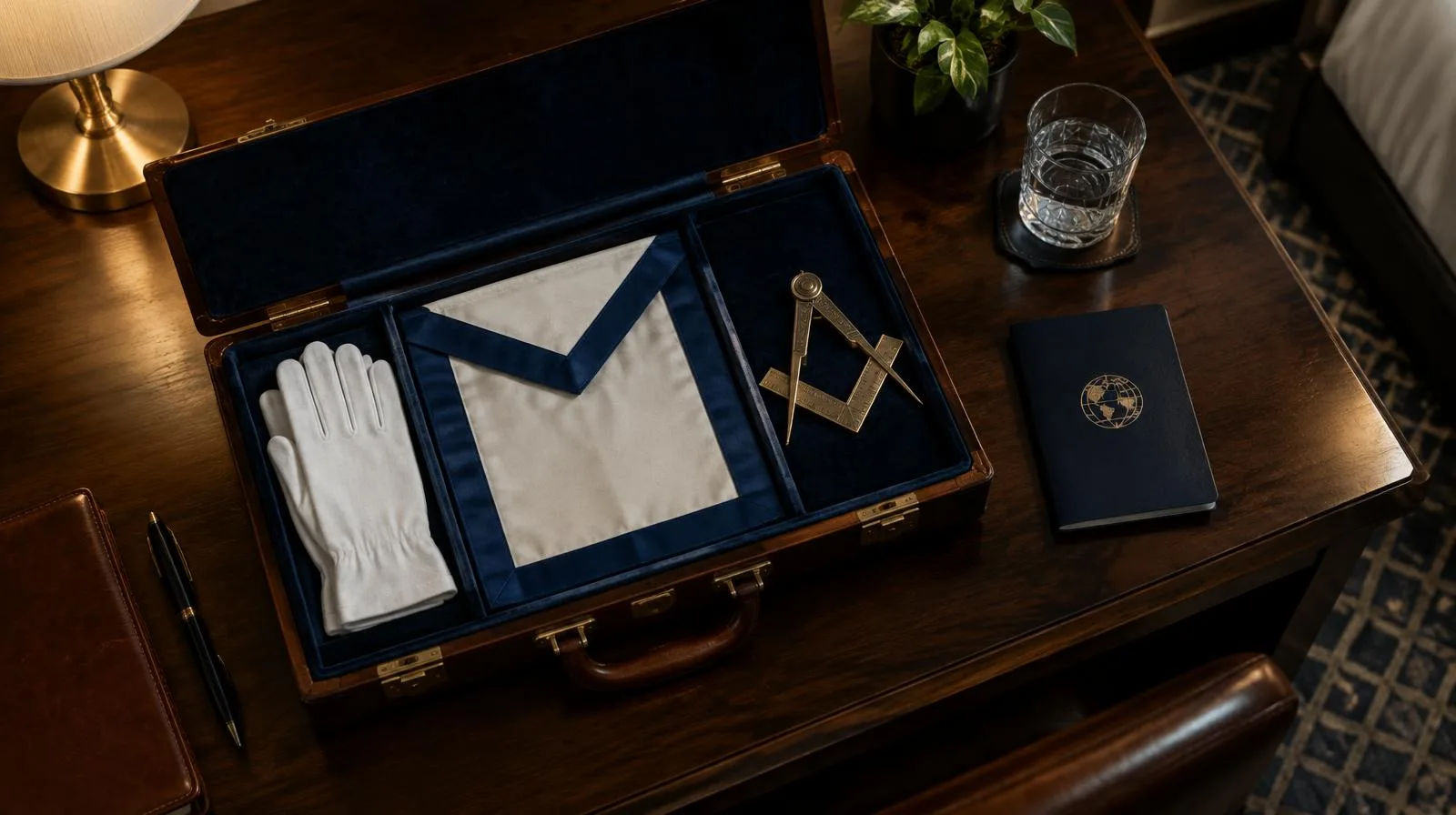
- Masonic Etiquette: Visiting this UNESCO World Heritage monument is distinct from attending a lodge meeting. If seeking a visit under the Grande Loja Legal de Portugal / Grande Loja Regular de Portugal, first consult your own Grand Secretary about recognition, eligibility and required credentials. The Portuguese Grand Lodge's published protocol directs members of other obediences to make initial contact through their own Grand Secretariat or Grand Chancellery, rather than approaching it directly beforehand. Our guide to international Masonic visitation protocol provides further context. Admission to a meeting remains subject to the relevant jurisdiction's rules.
Frequently Asked Questions
Did the Knights Templar actually become Freemasons at Tomar?
No documented evidence establishes that transition. The Order of Christ, founded by papal bull in 1319, inherited the Portuguese Templars' property and privileges and initially had its headquarters at Castro Marim. Its later presence at Tomar should not be confused with the origins of Freemasonry in early modern Britain. Later Masonic traditions adopted Templar imagery and chivalric themes, but symbolic identification is not proof of institutional descent.
What is the most architecturally significant feature of the convent?
The Charola and the Manueline Chapterhouse Window are two outstanding highlights, although choosing one as the most significant is a matter of emphasis. The Charola combines a medieval centrally planned structure with important later decoration. The window, dated 1510-1513, brings together elaborate organic and rope-like forms with royal and religious emblems. Seeing both allows you to appreciate distinct phases of the complex rather than treating it as the product of a single period.
Is Tomar easily visited alongside other historical sites in Portugal?
Yes, Tomar can be combined with the monasteries of Batalha and Alcobaça, both also UNESCO World Heritage sites. They make a rewarding architectural itinerary, but the ease of combining them depends on your transport and available time. A two-day trip is one possible plan, not a guarantee of an unhurried visit to every monument. Check travel connections and opening arrangements before deciding how much to include.
Sources
- UNESCO World Heritage Centre: Convent of Christ in Tomar
- Portuguese Archives Portal: King Denis's charter implementing the foundation of the Order of Christ
- Giulia Rossi Vairo: The dissolution of the Order of the Temple and creation of the Order of Christ
- Universidade NOVA de Lisboa: Conservation research on the Charola sculptures
- Património Cultural: Architectural history of the Convent of Christ
- Cambridge University Press: David Stevenson, The Origins of Freemasonry
- Museus e Monumentos de Portugal: Official Convent of Christ visitor information
- Grande Loja Legal de Portugal / GLRP: Published Masonic contact protocol