
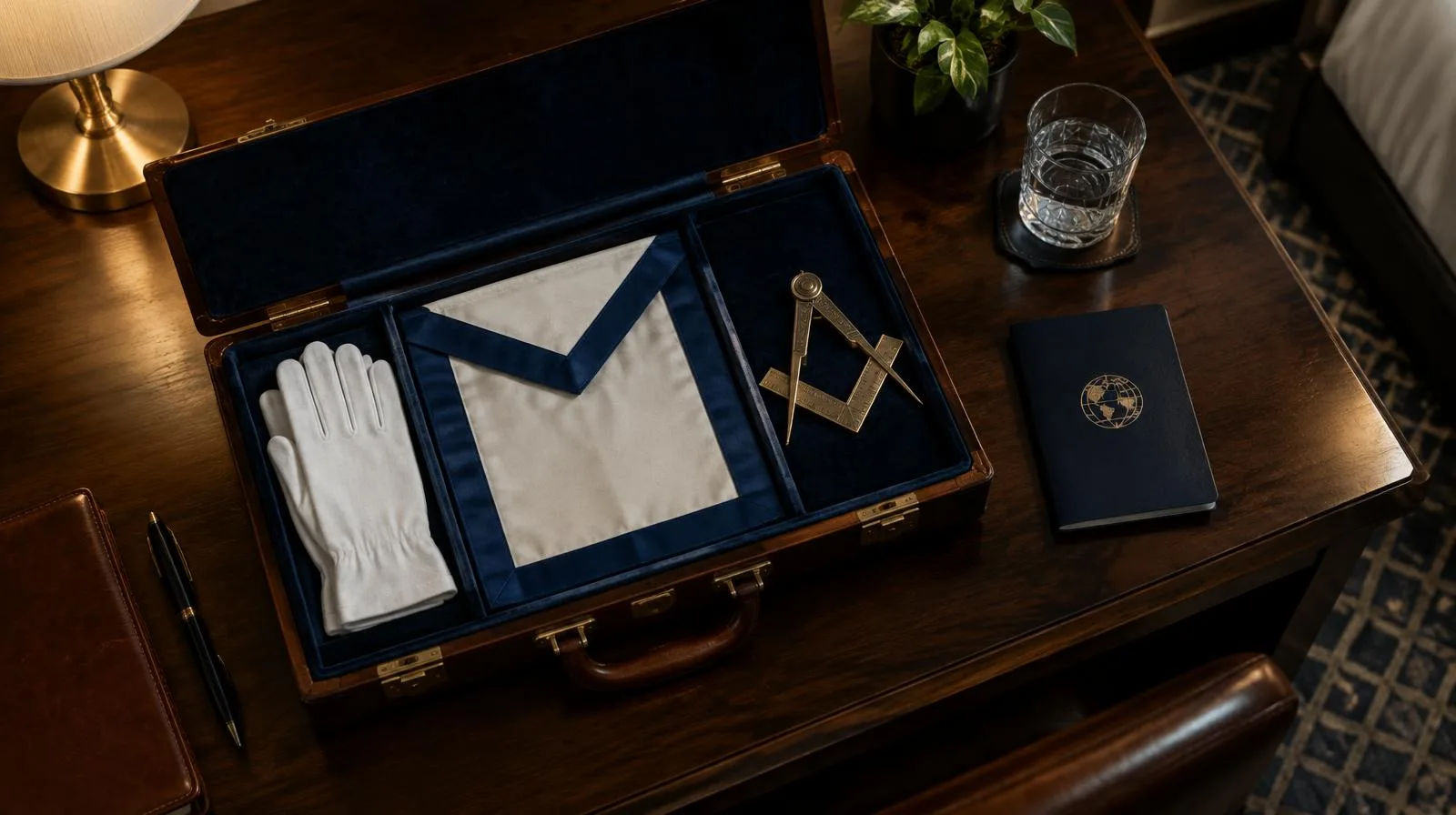
Few imagined moments in global voyaging test a Brother’s composure quite like an airport security officer opening a carry-on case to reveal an embroidered apron and an unfamiliar ceremonial jewel. When you choose to travel with masonic regalia, you may be transporting more than ceremonial attire: perhaps an inherited apron, a presentation medal, or a piece with deep personal significance. Whether you are heading to a lodge celebration or arranging a visit during a holiday, careful preparation can help protect your belongings and prevent avoidable misunderstandings. The aim is not to promise a seamless passage through every checkpoint. It is to arrive prepared, with suitable packing, accurate explanations, and the permissions and credentials your visit requires.
The Anatomy of the Masonic Travelling Kit
Before packing a single suitcase, consider the construction and condition of the items you intend to carry. Regalia can combine textiles, leather, embroidery, and metal fittings, so a packing method suitable for one piece may be unsuitable for another. Look for loose attachments, exposed pins, weakened ribbons, and decorations that could catch on neighbouring objects. If an heirloom appears fragile, consider leaving it at home and asking whether suitable alternative regalia can be worn or borrowed.
Every thoughtful traveller develops a sense of what is essential, and preparing to visit lodges abroad calls for the same foresight. Rather than treating the following as a universal required kit, use these three categories to build a checklist approved for your particular visit:
- Vesting garments: The apron, gloves, collar, or sash appropriate to the meeting and permitted by the host jurisdiction.
- Jewels and metalwork: Only the jewels and accessories you need and are entitled to wear. Ask separately about any ceremonial implement.
- Administrative credentials: The certificate, dues card, proof of good standing, identification, or introduction required by your own and the host Grand Lodge.
Think of these as separate packing problems rather than one bundle. A heavy jewel should not press against delicate embroidery, and a credential should remain accessible without unpacking the entire case. Museum conservation guidance provides a useful starting point for supporting textiles and minimising folds, but it is not a guarantee that a particular leather-and-textile apron is fit to travel. For valuable or deteriorating pieces, seek advice from a qualified conservator.
Packing the Apron: Preserving Silk, Leather, and Bullion
Resist the temptation to fold an apron simply because it fits the suitcase more neatly that way. The Canadian Conservation Institute recommends flat storage for most textiles because it supports the whole object and advises keeping folding to a minimum. Although storage guidance is not a complete transport specification, those principles offer a sensible starting point: provide support, avoid unnecessary bending, and protect vulnerable decoration from pressure.
A suitably sized, supportive apron case can be a practical option. Place the apron flat without forcing it into a compartment that is too small. Use suitable conservation-quality tissue where appropriate to separate surfaces, and avoid tightening retaining straps across raised embroidery or fragile fittings. Pack jewels separately in padded compartments or individual protective enclosures, with pins secured. Check that nothing can shift onto the apron when the case is lifted or turned upright.
What if your luggage constraints preclude a full-sized case? If you are travelling light or embarking on solo journeys to distant destinations, do not assume that rolling is a safe substitute. A composite apron with leather, stiff backing, and attached metalwork needs an assessment of its own construction. Avoid improvising with an ordinary shipping tube or rolled garment. Ask the manufacturer about a sound modern apron, or a conservator about an antique, before adopting a different packing method.
Pack only when the item and its enclosure are dry, and plan protection against accidental spills. Do not treat either a fabric dust bag or a plastic covering as a complete conservation solution. The more fragile the piece, the stronger the case for arranging a less vulnerable alternative. Before closing the luggage, take photographs of the apron and its fittings as a record of condition.
Navigating Airport Security and the X-Ray Screener
The checkpoint is where the decision to travel with masonic regalia meets practical security requirements. There is no need to assume that every collar or jewel will cause an alarm. However, the Transportation Security Administration states that even generally permitted items may receive additional screening or be refused if they trigger an alarm or raise security concerns. Its officers make the final decision at the checkpoint.
For ordinary aprons, permitted jewels, and documents, consider carry-on baggage when your airline’s size, weight, and item allowances permit it. This keeps them accessible and avoids entrusting those particular belongings to the checked-baggage system. It is a preference, not an exemption from security rules or a guarantee against damage. Measure the packed case and check whether it counts as your cabin bag or an additional item.
If an officer asks about the contents, give a calm and accurate explanation. You do not need to discuss ritual. A description such as the following can help, provided it matches what you actually carry:
“This case contains ceremonial regalia for a fraternal organisation: an apron and a medal. Some parts are delicate. Please let me know how I can help you inspect them safely.”
Ask politely about protecting fragile surfaces, but allow the officer to direct the inspection. Do not reach into the case without permission or assume that a preferred handling method must be accepted. Leave enough time for questions, and pack so the contents can be inspected without dismantling several tightly wrapped layers.
A vital caveat regarding blades and gavels: A ceremonial purpose does not override baggage restrictions. For US screening, TSA explicitly prohibits swords in carry-on baggage and permits them in checked baggage, with sharp objects sheathed or securely wrapped to protect handlers and inspectors. This is not a worldwide rule allowing every blade in the hold. Check the airline, departure and transit security authorities, and destination laws before transporting a sword or other implement.
Heavy gavels, mauls, and unusual metal tools also deserve an individual enquiry rather than an assumption based on their Masonic use. The UK Civil Aviation Authority warns that airports may reject items considered dangerous and that airlines and other countries may impose further restrictions. Where possible, ask the host to provide ceremonial implements instead of carrying them yourself.
Customs Declarations and Border Crossings
Airport security and customs answer different questions. Permission to carry an item aboard an aircraft does not establish permission to import it or prove that no duty is payable. Before travelling, consult the customs authority for your destination and the authority governing your return home. Explain whether the regalia is already yours, newly purchased, borrowed, intended as a gift, or being carried for an organisation.
Do not rely on a worldwide exemption for “personal ceremonial regalia”. The treatment of a particular item depends on the applicable rules and circumstances. Nor does calling something a medal automatically secure a special exemption. For example, UK relief for imported decorations and awards has specific conditions concerning the awarding organisation, recipient, and purpose, and excludes long-service awards, prizes, and gifts from that particular relief.
To prepare for customs enquiries:
- Carry useful ownership records: For valuable pieces, consider photographs, receipts, and appraisals. Ask your home customs authority whether any pre-departure documentation would help establish prior ownership on return. A photograph alone should not be treated as a guarantee of duty-free entry.
- Follow declaration requirements: Read the actual questions on the declaration and comply with them, rather than waiting to be asked in person. Describe the items and their intended use truthfully. If their classification or declaration status is unclear, seek guidance from customs.
- Research local requirements: Check current official travel advice, relevant import restrictions, and your Grand Lodge’s guidance before taking regalia abroad. Do not use broad regional assumptions about acceptance of Freemasonry as a substitute for destination-specific advice.
If you are carrying several sets for other Brethren, make that clear when seeking guidance. Goods intended for gifts or sale should not simply be described as your own travel wardrobe. Equally, do not assume that every gift is commercial merchandise. Establish the correct treatment under the destination’s passenger-baggage rules, and distinguish those rules from rules for goods sent by post or freight.
To Pack or to Borrow: Navigating Local Lodge Etiquette
Before taking your full kit across continents, pause to ask an essential question: is bringing your own regalia required, permitted, or unnecessary? The safest answer comes from the rules and arrangements for the particular meeting, not from a generalisation about an entire country or continent. A courteous enquiry can save both luggage space and an awkward conversation at the lodge door.
Whether your itinerary includes Freemasons' Hall in London or the Grand Lodge of Ireland on Molesworth Street in Dublin, confirm what visitors should wear through the appropriate Masonic channels. Ask specifically about your home-jurisdiction apron, collars, and jewels. The significance of an item to you does not by itself establish that it is appropriate for the meeting you hope to attend.
There are documented examples of flexibility. Pennsylvania’s official visitation guidance says that courtesy aprons are provided for members and visitors, while visitors are also welcome to wear their traditional Masonic dress. That is useful guidance for Pennsylvania, not evidence that every lodge worldwide keeps spare aprons or accepts every form of regalia.
Avoid assuming that Continental European or Latin American lodges all follow one clothing custom. Instead, obtain a clear answer about the apron, gloves, ordinary clothing, and any permitted decorations. Follow your jurisdiction’s correspondence rules when arranging this enquiry. If borrowing is confirmed, leaving a prized heirloom at home may be the most comfortable choice. Ask whether any advance arrangements are needed rather than relying on an unconfirmed spare.
Planning Your Visit: Documentation and Protocol
Transporting your regalia is only one part of preparation. A beautifully packed apron does not establish eligibility to enter a lodge. Plan your international visitation protocol alongside your flights and accommodation, using current guidance from your own Grand Lodge and the host jurisdiction.
- Establish mutual recognition: Ask your own Grand Lodge whether the intended visit is permitted. UGLE publishes a list of the foreign Grand Lodges it recognises, but that list describes UGLE’s relationships, not necessarily those of your jurisdiction. Confirm the relevant relationship and any additional visitation conditions before making arrangements.
- Work through your Grand Secretary: Begin with your lodge secretary or the office designated by your jurisdiction. Freemasons New Zealand’s overseas-visitation guidance, for example, directs members to its National Office and explains that communication between Grand Lodges is conducted by Grand Secretaries. Do not assume that you should write directly to a foreign Grand Secretary or that every jurisdiction uses an identical introduction process.
- Carry essential documents: Obtain the documents required for your visit and confirm the accepted format. New Zealand’s guidance describes a Travel Certificate used with a Master Mason’s Certificate. Pennsylvania requests a current dues card or receipt, a Travel Certificate, or other proof of membership and current good standing. Do not assume either that a smartphone image will suffice or that every jurisdiction universally rejects digital credentials.
- Check current schedules online: Consult official lodge and Grand Lodge information, then confirm the meeting, eligibility, dress requirements, and arrival arrangements through permitted channels. Leave time for your credentials to be reviewed. A historic hall appearing on an itinerary does not mean that a suitable lodge meeting will be available during your stay.
- Prepare for examination: Ask your own lodge how to prepare for the host’s process of examination or avouchment. Pennsylvania explains that, if no member can vouch for a visitor, the Tyler arranges a committee to verify the visitor’s credentials and claims. Establish the relevant procedure before a visit involving the Philadelphia Masonic Temple or another hall on your Masonic travel bucket list.
Keep your expectations gracious as well as practical. Recognition, documentation, clothing, and the arrangements for a particular meeting all need attention. Treat advance confirmation as preparation for a visit, not as a promise that possession of an apron or certificate alone secures admission.
Frequently Asked Questions About Travelling With Regalia
Can I carry a Masonic sword or Tyler's implement on an airplane?
A sword cannot pass through a US TSA checkpoint in carry-on baggage. TSA lists swords as permitted in checked baggage and requires sharp objects to be sheathed or securely wrapped. That does not settle airline acceptance, overseas security restrictions, or import and weapons laws. Check every relevant authority before travelling. For a gavel, maul, or other implement, request item-specific guidance rather than assuming all ceremonial objects receive the same treatment. Borrowing from the host may be simpler.
Should I pack my Masonic apron in carry-on or checked baggage?
Prefer carry-on for an apron and permitted personal jewels when the airline’s allowances and security requirements make that practical. Use supportive packing and keep metalwork separate from delicate surfaces. Do not assume an apron case fits beneath every seat or within every cabin-baggage allowance. Measure it before departure and consider what you would do if cabin space were unavailable. For a particularly fragile heirloom, borrowing suitable regalia may be safer than transporting it at all.
Do I have to pay customs duty on Masonic regalia when entering a foreign country?
There is no universal answer. Check the destination’s rules for your circumstances, including whether the items are personal belongings that will leave with you, new purchases, gifts, or goods carried for others. Special relief for medals or awards has its own conditions and should not be assumed to cover a Masonic jewel. Follow declaration requirements and ask customs for advice before departure if the value, material, or intended use creates uncertainty.
What should I do if my regalia is lost or damaged during a trip?
Report a baggage problem promptly to the carrier and retain the reference number, photographs, receipts, and other relevant records. Check any insurance reporting requirements. Contact your host through the agreed channel and ask whether suitable regalia can be borrowed. Pennsylvania explicitly offers courtesy aprons, but spare clothing is not a universal guarantee, nor does lost luggage override admission requirements. If an heirloom is damaged, avoid improvised repairs and seek conservation advice. Fellowship is the purpose of the journey, but practical arrangements still deserve care.
Sources
- Canadian Conservation Institute: Flat Storage for Textiles
- Transportation Security Administration: Swords
- Transportation Security Administration: Sharp Objects and Screening Discretion
- UK Civil Aviation Authority: Restricted Baggage Items
- HM Revenue & Customs: Import Relief for Decorations and Awards
- United Grand Lodge of England: Recognised Foreign Grand Lodges
- Freemasons New Zealand: Visiting Lodges Overseas
- Grand Lodge of Pennsylvania: Lodge Visitation, Credentials, and Courtesy Aprons