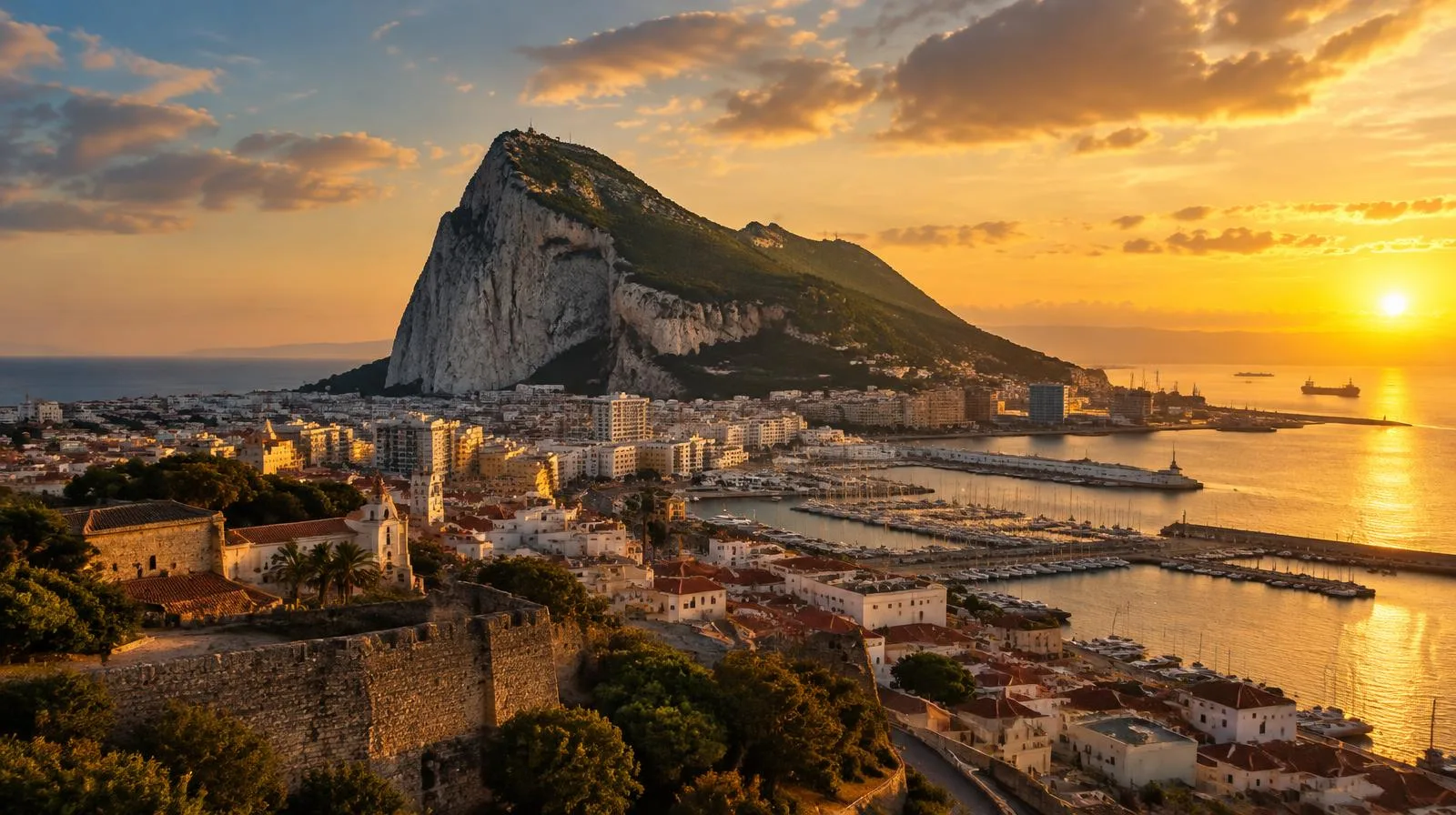
Stand upon the Upper Rock and look across the Strait toward the mountains of Morocco. Gibraltar's limestone mass gives this meeting place of sea routes a dramatic backdrop. Traditionally identified as the northern Pillar of Hercules, the Rock carries a legendary association as well as a documented military history. For the travelling Freemason, there is another story to explore: the relationship between a British garrison, its civilian neighbours and the lodges they established. To understand freemasonry in gibraltar is to follow a local chapter in the wider movement of the craft through military postings, maritime connections and settled communities. The surviving records are compelling enough without adding imagined ceremonies beneath the guns.
The Pillar of Hercules: Where Military Might Met Brotherhood
Gibraltar was captured by Anglo-Dutch forces in 1704 during the War of the Spanish Succession and ceded to Great Britain under the Treaty of Utrecht in 1713. Its development as a British fortress was a continuing process, not an overnight transformation. Barracks, batteries and defensive works shaped the lives of those stationed here. The Ministry for Heritage dates the construction of South Barracks to 1730-1735, a tangible reminder of the infrastructure required to sustain the garrison.
Freemasonry took root in this military setting during the 1720s. Accounts differ over the precise dating of its earliest establishment and recognition. The Ministry for Heritage describes the first lodge, St. John of Jerusalem No. 51, as founded in 1726 or 1727, while the UNED virtual museum places the beginnings and recognition of the early Gibraltar and Madrid lodges within 1727-1729. Rather than assign a precise warrant date that these accounts do not consistently establish, it is safer to describe Gibraltar's Masonic beginnings as belonging to the late 1720s.
A particularly useful example of military mobility is the ancestor of today's Lodge of St John No. 115. Its District Grand Lodge history records that it was warranted at Perth in 1767 as a travelling lodge in the 2nd Battalion, Royal Artillery. It subsequently moved to Mahon, Minorca, and reached Gibraltar with the battalion in 1772. This is a documented route through which a lodge travelled with military personnel, rather than evidence that Gibraltar was the single launching point for Mediterranean Freemasonry. It gives local substance to the wider story explored in how Freemasonry conquered the world.
The civilian story matters too. The District's history identifies an earlier Inhabitants Lodge No. 285 as Gibraltar's first civilian lodge, serving the British mercantile community. That lodge should not simply be equated with today's No. 153 on the strength of a shared name. Lodge names, numbers, warrants and institutional relationships require careful tracing. Garrison Freemasonry was never only a story of soldiers passing through.
A Tri-Jurisdictional Haven: English, Irish, and Scottish Masonry
One of the most engaging dimensions of contemporary freemasonry in gibraltar is the presence of the three Home constitutions. The local District Grand Lodge explains that English, Irish and Scottish Freemasons meet under one roof, and that many Gibraltarian members belong to more than one constitution. This shared setting is a distinctive feature of local Masonic life, although coexistence between constitutions is not unique to Gibraltar.
The three traditions should be distinguished accurately:
- The United Grand Lodge of England (UGLE): Its District Grand Lodge of Gibraltar lists nine Craft lodges. These include Lodge of St John No. 115, Inhabitants' Lodge No. 153 and Royal Lodge of Friendship No. 278. Lane's Masonic Records dates the warrant of the present Inhabitants' Lodge to 18 November 1777.
- The Grand Lodge of Ireland: Irish Freemasonry is represented in Gibraltar, with directory information identifying a Grand Inspectorate rather than the Provincial Grand Lodge described in some accounts. Calpe Lodge No. 325 is an Irish lodge, and its own website states that it was constituted in 1826. Consult current Irish official information for administrative contacts.
- The Grand Lodge of Scotland: Scottish Freemasonry is represented through a District Grand Lodge. Published listings include St Thomas No. 576, Al Moghreb al Aksa No. 670, Coronation No. 934 and St Bernard Lodge of Research No. 1817. Older directories should not be treated as current meeting calendars.
Much like the fraternal landscape encountered in a Master Mason's guide to Malta, Gibraltar invites visitors to look beyond a single administrative tradition. Shared premises and overlapping membership offer a more grounded picture of fraternity than picturesque claims about exchanging regalia at meetings. Differences of constitution still matter, particularly when arranging a visit and checking recognition.
The three Home constitutions are not the whole local picture. The District's explanatory material also records Gibraltar Lodge No. 47 for women, consecrated in 1989. Its presence is a useful reminder that a survey of Gibraltar's Freemasonry should distinguish the bodies being discussed rather than imply that all local Masonic activity falls within the three men's constitutions.
Inside Prince's Street: The Gibraltar Masonic Hall
First, a correction to the location suggested by this heading: the current official address is the Gibraltar Masonic Institute, 47a Prince Edward's Road, not Prince's Street. Use that address when arranging a visit. The District's contact page identifies the Institute as its address, and its account of local Freemasonry describes the English, Irish and Scottish constitutions meeting together under one roof.
The significance of the Institute lies in its living purpose as much as its historical associations. The District describes members meeting in their individual lodges, practising ceremonial traditions and gathering socially at festive boards. For a travelling Brother, this is an opportunity to encounter a working fraternity, not simply to inspect a historical interior. Any visit should respect the distinction between a lodge meeting, a social invitation and a public heritage tour.
It would be misleading to promise particular mahogany furnishings, celestial ceiling decoration, memorials or archival treasures without reliable documentation. If you are admitted on an organised visit, ask your host which features can be identified and dated. Our guide to lodge room architecture and symbolism offers a framework for looking carefully, but a general explanation of Masonic symbolism cannot establish the history of a particular chair, portrait or room.
The records also caution against imagining one permanent home across the centuries. Lane's entry for Inhabitants' Lodge lists numerous meeting places, including the Crown and Anchor in 1815, the Garrison Library in 1869 and a Masonic Hall in the Armstrong Buildings in 1877. These changing addresses reveal a fraternity embedded in the town's evolving spaces. They do not establish the age or contents of the present Institute.
Brethren Under Fire: The Great Siege and Wartime Endurance
The Great Siege of Gibraltar lasted from 1779 to 1783. Spain and France sought to take the fortress from Britain during the American Revolutionary War. The Gibraltar National Museum describes blockade, bombardment, shortages of fresh food and outbreaks of scurvy and other sickness. Relief convoys brought supplies and reinforcements, while the garrison continued to strengthen its defences. That documented experience is severe enough without treating every day of the siege as an identical episode of bombardment.
The Masonic story most often associated with these years belongs to the lodge now known as St John No. 115. According to the lodge history published by the District Grand Lodge, its artillery brethren were meeting when a cannonade began. They were called from labour to refreshment so that they could man the guns, and the meeting was not formally resumed and closed until early in 1783. The account adds that bread, cheese and beer followed.
This should be presented as a lodge account, not as independently verified proof of every detail. It also differs fundamentally from the image of uninterrupted underground meetings throughout the siege. The supplied evidence does not establish candlelit ceremonies on powder kegs, cannonballs striking the ceilings above assembled brethren or regular meetings in bombproof vaults. Such scenes may be evocative, but they should not be substituted for records.
Inhabitants' Lodge received its warrant in 1777, before the siege began. Its continued existence today does not demonstrate uninterrupted work in every intervening year. Indeed, the District's own history records a revival in 1858 after a period of dormancy, with assistance from Robert Freke Gould. Endurance can include interruption and renewal. For a historical journal, that is a more meaningful account of resilience than an unbroken flame asserted without evidence.
Later wartime experiences are also recorded. The District's history of Royal Lodge of Friendship describes collections during the First World War for brethren interned as prisoners of war in Germany, alongside ceremonies cancelled because candidates were absent. These less theatrical details show how conflict affected ordinary lodge business and charitable responsibilities. They bring the human scale of wartime fraternity into focus.
A Walk Through Stone and Memory: Masonic Echoes Across the Rock
Gibraltar rewards a walk that connects military history with carefully identified Masonic evidence. The pleasure lies partly in learning where those subjects intersect and where they do not. As with the places explored in hidden Masonic sites, an intriguing symbol or familiar surname should be the beginning of an inquiry, not its conclusion.
Begin at the Trafalgar Cemetery, by the Southport Gates, occupying ground in the former defensive ditch. Despite its name, only two graves are identified as belonging to victims of the Battle of Trafalgar. Many other burials relate to different naval engagements or to the yellow fever epidemics that struck Gibraltar between 1804 and 1814. The cemetery therefore speaks to a broader history of disease, service and loss than its famous name alone suggests.
Read the inscriptions closely, but resist assigning Masonic membership or rank from funerary ornament alone. Urns and broken columns are not exclusively Masonic symbols. Even an apparently Masonic emblem needs to be interpreted alongside the inscription and supporting records. The evidence supplied here does not establish the original article's claim that numerous graves display carvings identifying their occupants' Masonic rank.
Next, visit the Great Siege Tunnels. Gibraltar's official tourism account credits Sergeant Major Ince with proposing the tunnelling solution and states that work began on 25 May 1782 under Lieutenant J. Evelegh's direction. The tunnellers used sledgehammers, crowbars and gunpowder. This was military engineering undertaken during the siege, not evidence of a Masonic construction project. The analogy between practical craftsmanship and speculative Masonry can enrich a visitor's reflections, provided it remains an analogy.
Conclude along Main Street, allowing time to take in the town rather than hunting for supposedly Masonic cornerstones at every turn. Claims that particular hospitals, schools or administrative buildings were founded with Masonic ceremonies require building-specific evidence. If a plaque or guide mentions such a ceremony, look for the date, participants and documentary source. That approach turns an attractive walk into a responsible historical investigation.
Planning Your Visit to Gibraltar's Lodges
A fraternal journey benefits from preparation, especially when a lodge meeting is the centrepiece of the itinerary. Check current entry requirements and transport arrangements with the relevant official authorities before travelling. Our travel planning tips for Freemasons can help organise the practical questions, but local confirmation should determine the final plan.
The English District's published visiting guidance is straightforward: brethren in good standing are welcome, should contact the lodge secretary in advance and should bring their Grand Lodge Certificate. It does not state that every visitor must first obtain an official invitation through an exchange between Grand Secretaries. Nevertheless, your own constitution may prescribe a particular route for overseas inquiries. Follow its rules and consult international Masonic visitation protocol before making arrangements.
Recognition must be checked with the bodies concerned. Do not assume that recognition by one Grand Lodge automatically resolves every proposed visit under another constitution. Ask your own secretary for guidance and confirm your eligibility with the host. Admission can depend on your degree, the work being undertaken and the applicable rules. A blanket statement that all lodge meetings admit only Master Masons is too broad.
Before packing, ask which dress and regalia are appropriate, what supporting documents are required and whether examination or vouching will be necessary. Do not assume that a collar, gloves or a particular form of clearance certificate is universally mandatory. Advice on traveling with Masonic regalia can help protect what you need to carry, but the host lodge should settle the details.
For non-Masons and accompanying travellers, public access is a separate question. The Gibraltar Heritage Trust's events listings have included a tour of the Gibraltar Masonic Institute, demonstrating that organised heritage visits do occur. That is not a promise of daily access or an annually recurring open day. Check current announcements and any booking conditions before arriving.
Frequently Asked Questions
Can non-Masons tour the Masonic Hall in Gibraltar?
Organised public visits have been advertised by the Gibraltar Heritage Trust, including a tour of the Gibraltar Masonic Institute. The Institute is at 47a Prince Edward's Road, not Prince's Street. Check the Trust's current announcements or contact the Institute about access. Do not assume that an advertised event establishes regular museum opening hours.
Which Masonic constitutions work on the Rock?
English, Irish and Scottish lodges work in Gibraltar, and the English District's website describes the three constitutions meeting under one roof. English and Scottish Freemasonry have District Grand Lodge structures, while Irish directory information identifies a Grand Inspectorate. Women's Freemasonry is also represented by Gibraltar Lodge No. 47. Check the relevant body's current official information when seeking contacts or arranging a visit.
What is the protocol for an overseas Mason wishing to visit a lodge meeting?
Check recognition and your own Grand Lodge's overseas-visiting rules first. The English District of Gibraltar asks visitors to contact the lodge secretary in advance and bring their Grand Lodge Certificate. Confirm meeting details, eligibility, dress, regalia and any additional documentation or vouching requirements with the host. An advance inquiry is the appropriate starting point, not an unarranged arrival at the door.
When is the best time of year to visit Gibraltar for Masonic travel?
Choose your dates around a confirmed lodge meeting rather than a presumed territory-wide season. Royal Lodge of Friendship, for example, publishes meetings on the first Wednesday of February through June and October through December, with its installation in March. Other lodges have different schedules. The Institute's calendar advises visitors to consult its updated information and contact the relevant secretary. June should not automatically be dismissed as a recess month.
Sources
- Lane's Masonic Records: Inhabitants' Lodge No. 153
- District Grand Lodge of Gibraltar: Craft lodges
- District Grand Lodge: Understanding Gibraltar Freemasonry
- Gibraltar Masonic Institute: Official address and visiting guidance
- District Grand Lodge: History and siege account of Lodge of St John No. 115
- Royal Museums Greenwich: Trafalgar Cemetery
- Visit Gibraltar: History of the Great Siege Tunnels
- Gibraltar Heritage Trust: Heritage events and Institute tour listing