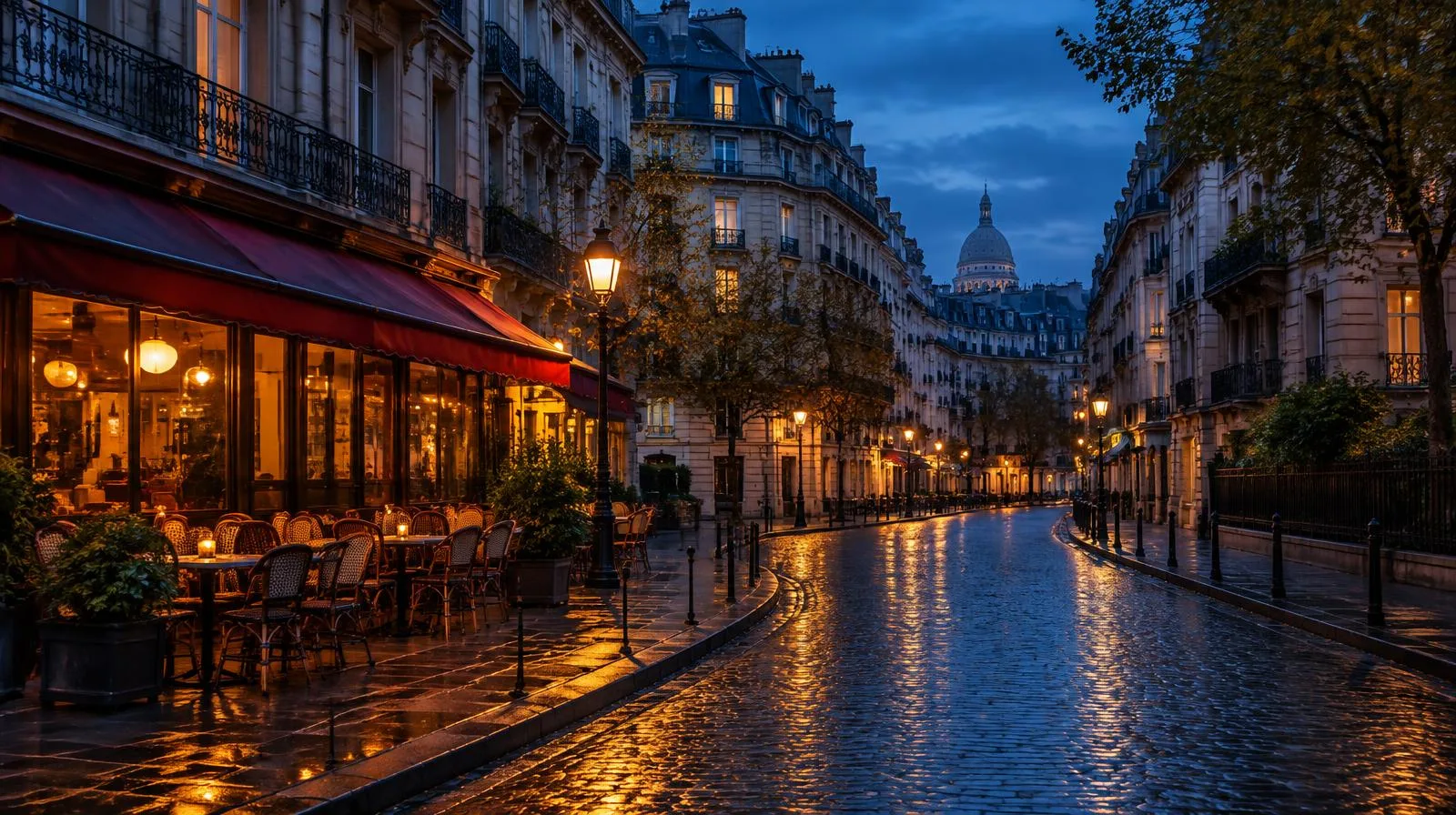
Tucked near the grands boulevards of the 9th Arrondissement, Rue Cadet offers an inviting starting point for a different kind of Parisian journey. Behind the doors of number 16 are the headquarters of the Grand Orient de France and the Musée de la Franc-Maçonnerie. For anyone fascinated by the global Craft, exploring freemasonry in paris is an exhilarating, occasionally bewildering encounter with traditions that do not fit neatly into a single Anglo-American frame.
Here in the City of Light, the square and compasses invite questions about fraternal fellowship, moral introspection, political upheaval, and philosophical experimentation. Paris deserves a place on any curious traveller's tour of Masonic cities. Whether you are an initiated Brother seeking to understand Continental obediences or a visitor exploring French intellectual history, Rue Cadet makes a rewarding beginning. The essential travelling companion is a willingness to distinguish documented history from symbolism, institutional identity from recognition, and public access from private lodge work.
Rue Cadet: The Epicenter of Continental Masonry
To understand an important part of French Freemasonry, begin at 16 Rue Cadet. This address has served as the headquarters of the Grand Orient de France (GODF) since 1853. The Grand Orient itself was constituted in 1773, emerging from an earlier French Grand Lodge. Its institutional history therefore reaches further back than its occupation of this particular building. The complex also houses the museum, making it both a working Masonic headquarters and a public destination for historical discovery.
Do not, however, mistake the museum entrance for unrestricted access to lodge premises. Public exhibitions, guided temple visits, and private meetings are different activities with different admission arrangements. The museum's ordinary admission ticket does not include access to the temples. Those are accessible to visitors through guided tours, subject to the museum's current arrangements.
The Grand Orient's own account of its purpose emphasizes initiation, symbols, freedom of conscience, and a commitment to republican ideals. It describes the lodge as a place of thought, questioning, and debate. That is a more useful introduction than imagining that every French lodge follows one political or philosophical script. Rue Cadet represents a major current of French Masonry, not the entirety of it.
Two Currents: Regularity, Secularism, and the French Rites
For visitors familiar with Anglo-American practice, exploring freemasonry in paris requires a deliberate shift in perspective. In the tradition represented by the United Grand Lodge of England (UGLE), belief in a Supreme Being is a condition of membership, and political and religious disputes are excluded from lodge proceedings. Readers familiar with Freemasons' Hall in London will recognize that framework. It should not, however, be treated as a system administered by a worldwide Masonic governing authority. Grand Lodges make their own recognition decisions.
In 1877, the Grand Orient removed the deistic requirement from its constitution and affirmed freedom of conscience. The change ended the constitutional obligation to believe in God and the immortality of the soul. The debate had been developing for years, and the reform helped deepen the divide between the GODF and the English recognition tradition. It did not mark a single simultaneous rupture with every American Grand Lodge, since some American recognition disputes predated it.
Freedom of conscience and laïcité are related but distinct ideas. The former concerns liberty of belief and conviction; the latter concerns secularism, particularly the relationship between religion and public institutions. The GODF emphasizes both. Its removal of a religious test should not be confused with a requirement that members be atheists.
Today, the French Masonic landscape resembles a philosophical mosaic rather than a single monolith:
- The Grand Orient de France (GODF): A major liberal obedience whose practices include the French Rite and the Ancient and Accepted Scottish Rite. Its public presentation emphasizes freedom of conscience and republican commitment.
- The Grande Loge de France (GLDF): A distinct obedience associated principally with the Ancient and Accepted Scottish Rite and a spiritual, symbolic approach invoking the Great Architect of the Universe. It should not be confused with the similarly named GLNF.
- The Grande Loge Nationale Française (GLNF): Founded in 1913, it maintains a requirement of belief in God. England, Ireland, and Scotland restored recognition to it in June 2014 after withdrawing recognition in 2012. Travellers should verify its current recognition status with their own Grand Lodge.
- Le Droit Humain & La Grande Loge Féminine de France: These represent, respectively, mixed-gender and women's Freemasonry, further illustrating why French Masonic life cannot be reduced to a division between two institutions.
Before planning to attend a tiled meeting, an initiated traveller must understand these jurisdictional boundaries. A shared rite or familiar symbolism does not itself establish permission to visit. Reviewing international Masonic visitation protocol is essential before packing your regalia for a trip across the Atlantic or the English Channel.
Inside the Musée de la Franc-Maçonnerie
Fortunately, the treasures of 16 Rue Cadet are not reserved for members. Open to the public, the Musée de la Franc-Maçonnerie belongs on the itinerary of anyone interested in greatest Masonic libraries and museums. Created in 1889, it has held the official designation Musée de France since 2003. Its exhibition traces three centuries of French lodge history and examines contributions to philosophy, politics, religion, literature, and the arts.
The museum's presentation lists approximately 10,000 objects in its collections, alongside a library of 23,000 volumes. These are collection and library figures, not a count of objects simultaneously on display. Among its published highlights are eighteenth-century French Masonic earthenware, embroidered or painted regalia, rare manuscripts, and a first edition of Anderson's Constitutions from 1723. Aprons, sashes, and collars offer particularly vivid ways to explore how symbols have been used across different degrees and traditions.
The museum also identifies aprons associated with Voltaire and Jérôme Bonaparte, together with Lafayette's Masonic sword. The Bibliothèque nationale de France dates the latter to around 1825 and describes it as a flamboyante, or flaming, Masonic sword. It should not be presented as a weapon Lafayette carried through the American or French Revolution.
Voltaire's initiation into the Parisian Lodge of the Nine Sisters, Les Neuf Sœurs, took place on 7 April 1778. The surviving account names the chevalier de Villars as the master of ceremonies who introduced him. Later Masonic retellings embellish aspects of the event, so picturesque details about his entrance should not displace the documentary record. The established initiation is fascinating enough without supplying an unsupported street address or presenting later storytelling as eyewitness testimony.
Take time to read the objects as historical evidence rather than simply as relics of famous men. The museum explains symbols, rites, and initiation alongside the lodges' place in French society. Its stated scope is broader than a roll call of celebrated members, and its scientific committee includes representatives of different components of French Freemasonry.
The Darkest Chapter: Vichy and the Anti-Masonic Exhibition
The history of Rue Cadet cannot be separated from the catastrophe of World War II. Under German occupation and the collaborating Vichy regime, French Freemasonry faced suppression, confiscation, and persecution. The law of 13 August 1940 prohibited secret associations and provided for the sequestration and liquidation of their property. The headquarters at Rue Cadet was looted during the Occupation, and the museum itself suffered losses.
The anti-Masonic exhibition at the Petit Palais took place from 12 October to 30 November 1940, not in 1941. An archival photographic catalogue records those dates and distinguishes the Paris exhibition from later presentations in other French cities. Surviving exhibition material also documents the antisemitic conspiracy propaganda associated with the campaign. This was not an exercise in neutral public education, but part of the persecution of organizations and people cast as enemies.
The archives had their own long wartime and postwar journey. German authorities confiscated Masonic records, some of which subsequently passed into Soviet custody. Historian Pierre Mollier records the restitution of archives to the Grand Orient on 23 December 2000. That precise history is more revealing than a generalized image of trainloads returning decades after the Cold War. Different collections followed different routes and restitution timetables.
The human consequences were profound. The departmental archives of the Aisne report that 64,000 Freemasons were registered in files, 3,000 public employees lost their jobs, and more than 1,000 Freemasons were murdered by the Germans. Many Masons participated in the Resistance, although individual responses to occupation were not uniform. These figures should not be converted into an unsupported claim that all victims were killed in concentration camps or persecuted for identical reasons.
For travelling Masons interested in the fraternity under totalitarianism, Paris offers a poignant connection with WWII Masonic sites. The museum reopened in 1973 and gradually rebuilt its collections. Its continued existence invites reflection not only on survival, but also on the difficult work of recovering objects, records, and historical understanding.
Walking the Masonic Stones of Paris
Beyond Rue Cadet, a thoughtful walk can connect Masonic biography with the city's monuments. The important distinction is between a documented personal connection and a claim that a monument or street plan conceals a Masonic program. Not every triangle is a lodge emblem, and not every symmetrical vista is evidence of esoteric intent.
Begin on the Île aux Cygnes, the artificial island in the Seine that carries a smaller version of the Statue of Liberty. The original statue's sculptor, Frédéric Auguste Bartholdi, was initiated into the Parisian lodge Alsace-Lorraine on 14 October 1875. That documented membership gives a Masonic traveller a genuine biographical connection to the work. It does not, by itself, establish that the Paris replica's dedication was an international Masonic ceremony.
Next, consider the Panthéon in the Latin Quarter, where Voltaire, Jean-Jacques Rousseau, and Victor Schœlcher are commemorated through their interment. Voltaire's initiation provides a direct connection to lodge history. Rousseau's presence offers an opportunity to reflect on the Enlightenment, but should not be used to imply that he was a Freemason. Schœlcher was a leading advocate of the abolition of slavery in the French colonies in 1848, an achievement that should not be reduced to the work of one man or one fraternity.
The boulevards reshaped under Baron Haussmann offer another tempting canvas for symbolic interpretation. Enjoy their perspectives, but do not treat urban geometry as proof of a hidden lodge-inspired plan. A comparison with lodge room architecture and symbolism can be an imaginative exercise, provided it is clearly identified as interpretation rather than established urban history. The most rewarding Masonic walk is one that sharpens observation without turning resemblance into evidence.
Culinary Brotherhood: The Tradition of the Parisian Table
No Parisian itinerary needs much encouragement to leave room for a meal. In French Masonic usage, agapes commonly refers to fraternal meals associated with lodge life. For an invited visitor, such a gathering can offer a less formal opportunity to continue conversation after the work of the lodge. It should not be assumed, however, that every meal follows the same ritual, menu, or degree of ceremony.
Ordinary fellowship over dinner and a formally organized table lodge are not automatically the same thing. Ask your hosts what is planned, whether a reservation or contribution is required, and whether dietary needs can be accommodated. There is no need to promise Bordeaux, Chablis, or a prescribed sequence of toasts to appreciate the appeal of shared hospitality.
Exploring Masonic festive board and table lodge traditions can enrich the experience, but local arrangements should lead the way. If your visit is confined to the museum, a meal nearby can still provide a welcome pause to discuss what you have seen. Public sightseeing and fraternal hospitality need not be confused for either to be worthwhile.
Planning Your Visit to Masonic Paris
Planning an itinerary centered on freemasonry in paris requires practical preparation and respect for the distinction between museum access and lodge admission. Keep these details in mind:
- Musée de la Franc-Maçonnerie: The address is 16 Rue Cadet, 75009 Paris. Nearby Métro options include Cadet on Line 7 and Grands Boulevards on Lines 8 and 9. The museum currently lists opening from Tuesday through Sunday, with a midday closure, and closure on Mondays and public holidays. Check its official practical-information page for current hours, prices, and exceptional closures. Temple access requires a guided tour rather than an ordinary museum ticket.
- Lodge Visitation Requirements: A public museum visit does not confer admission to a tiled meeting. Ask your own Grand Lodge to confirm recognition of the proposed host and the documents required. Depending on your jurisdiction, these may include a travel certificate, a Grand Lodge certificate, proof of current membership, or identification. Examination or avouchment may also be required. There is no single universal document checklist.
- Book in Advance: Begin arrangements well before departure. Follow your home jurisdiction's rules on communication, including any requirement that official correspondence pass through Grand Secretaries. Do not assume that a spontaneous arrival at a headquarters will produce an invitation to a meeting. For public guided tours, consult the museum's separate booking arrangements.
- Language Considerations: Ask about the language of the particular meeting or tour rather than assuming that every Parisian event is conducted in French. Learning terms such as Vénérable Maître for Worshipful Master and surveillants for Wardens can still be useful. Consult our travel planning tips for Freemasons before your trip, and confirm practical expectations with your authorized contact.
Frequently Asked Questions
Can Anglo-American Freemasons visit lodges at Rue Cadet?
Do not assume that you may attend a GODF tiled meeting. The Grand Orient is outside UGLE's recognition system, and members of other jurisdictions must follow their own Grand Lodge's rules. Obtain confirmation before arranging a Masonic visit. A museum visit is a different matter: the Musée de la Franc-Maçonnerie welcomes the public, including Freemasons from other obediences. Public guided temple tours are also distinct from participation in lodge work.
Do I need to be a Freemason to tour the Musée de la Franc-Maçonnerie?
No. The museum welcomes the general public and holds the official Musée de France designation. Its exhibitions explain Masonic history, symbols, and practices without requiring membership. Guided tours can include temples, but ordinary admission covers the museum's permanent and temporary exhibitions rather than temple access. Check the current tour schedule and booking conditions before visiting.
Which grand lodge in Paris is recognized by mainstream Grand Lodges?
The Grande Loge Nationale Française (GLNF) is the French Grand Lodge recognized by UGLE. England, Ireland, and Scotland formally restored recognition in June 2014 after the interruption that began in 2012. The GLNF's Paris address is 12 Rue Christine-de-Pisan, in the 17th Arrondissement. Recognition is jurisdiction-specific, so North American and other visitors should confirm current arrangements with their own Grand Lodge rather than relying on a claim of universal recognition.
What should I wear if invited to visit a recognized lodge in Paris?
Ask for the dress requirements of the particular lodge and meeting. Do not assume that a dark suit, dinner jacket, white gloves, or a particular apron is universally required. Confirm which regalia to bring and whether your own jurisdiction's regalia is appropriate. Following the host's instructions, alongside your home Grand Lodge's rules, is a better expression of courtesy than packing according to a generalized national dress code.
Sources
- Musée de la Franc-Maçonnerie: history, exhibitions, and collection highlights
- Musée de la Franc-Maçonnerie: institutional history and collection figures
- Musée de la Franc-Maçonnerie: practical information and guided tours
- André Combes: the Grand Orient's constitutional reform of 1877
- Home Grand Lodges: restoration of recognition to the GLNF in 2014
- Archives départementales de l'Aisne: Vichy laws and persecution of Freemasons
- Calames archival catalogue: dates of the anti-Masonic exhibitions
- Freemasons New Zealand: overseas visitation, documentation, and correspondence