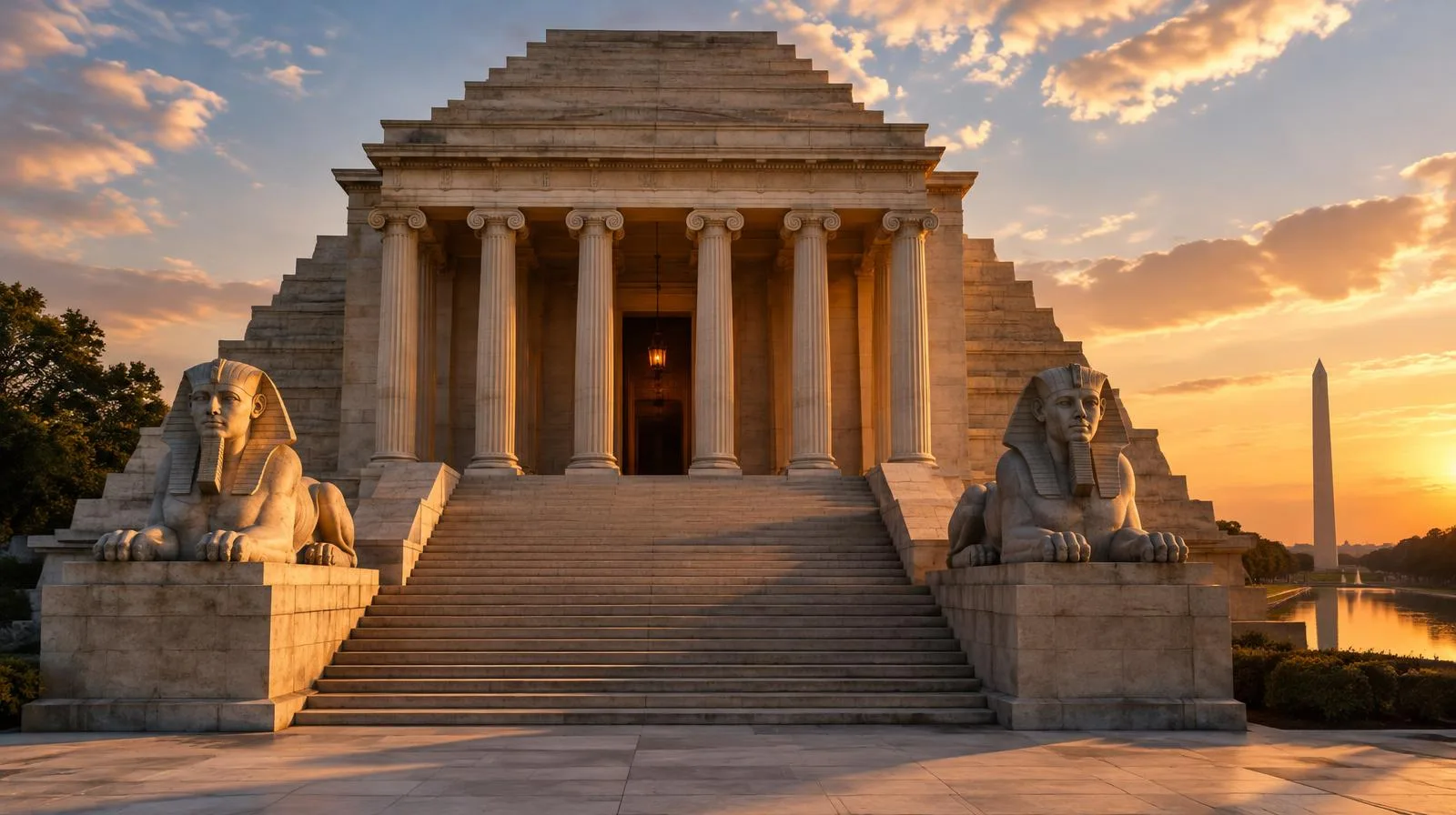
Stand near 16th and S Streets NW in Washington, D.C., and you might think you have wandered into an antique dream. In the Dupont Circle neighborhood, the house of the temple brings the silhouette of an ancient wonder into the modern capital. Flanked by monumental limestone sphinxes, it commands the streetscape with a quiet solemnity that feels far removed from the hurried political theater of Capitol Hill. For Freemasons and classical architecture lovers alike, this is a building worth approaching slowly, allowing its columns, sculpture and stepped roof to come into focus.
A Masterpiece of Classical Revival on 16th Street
Completed in 1915, the House of the Temple serves as the headquarters of the Supreme Council, 33°, Southern Jurisdiction of the Scottish Rite, also known as the Mother Council of the World. Its origins lie in a resolution adopted in October 1909, authorizing the enlargement or replacement of the existing headquarters. Grand Commander James D. Richardson received broad authority to acquire property and oversee the project. His ambition was not simply to provide more space, but to create a permanent home worthy of the organization.
The architect was John Russell Pope, whose other celebrated designs include the Jefferson Memorial, the National Archives and the West Building of the National Gallery of Art. Here, Pope drew inspiration from the tomb of Mausolus at Halicarnassus, in what is now Bodrum, Turkey. That ancient mausoleum was one of the Seven Wonders of the Ancient World. The Washington building is an interpretation of its monumental classical form, not a surviving ancient structure or an exact archaeological reconstruction.
Thirty-three Ionic columns, each thirty-three feet high, surround the upper chamber beneath a stepped pyramidal roof. The Scottish Rite identifies this repetition as an intentional reference to its thirty-three degrees. Each column is a monolith, carved from a single piece of stone. Look beyond the numerical symbolism, too: the Ionic capitals carry egg-and-dart ornament, a reminder that the building's effect depends on carefully worked details as well as imposing scale.
For those curating a thoughtful masonic travel bucket list, this building makes a compelling companion to treasures like the Philadelphia Masonic Temple. Granite clads the first floor, with limestone above. Rather than describing the exterior as unadorned, look for the contrast between broad stone surfaces and concentrated architectural ornament. Its power lies in that balance: a monumental outline, brought into sharper focus by sculpture and carving.
Crossing the Threshold: The Atrium and Guardian Sphinxes
The entrance terrace introduces the building's best-known guardians, two Egyptian-style sphinxes sculpted on-site by Adolph Alexander Weinman from solid blocks of Indiana limestone. According to the Scottish Rite's account, the original blocks weighed about seventy-six tons each. That figure describes the blocks from which the figures were carved, not a documented weight for each finished sculpture.
Their identities reward a closer look. On the north side is Power, with its eyes fully open. On the south side is Wisdom, with its eyes half-closed. The Scottish Rite interprets them as references to Boaz and Jachin, the pillars described in the biblical account of Solomon's Temple. This is Masonic symbolism drawing on a biblical tradition, not evidence that the Washington sculptures reproduce surviving objects from ancient Jerusalem. Their inscriptions and contrasting expressions invite reflection without requiring a visitor to mistake symbolism for archaeology.
Inside, the Atrium continues the conversation between ancient design and modern purpose. Pope used beige Tavernelle marble for its floor, inlaid with black marble from the Greek island of Tinos. A large marble table forms the room's focal point. According to the official virtual tour, it was modeled on a table found at Pompeii, but Pope replaced the original griffins with double-headed eagles and added Salve Frater, meaning "Welcome, brother."
The official tour describes the Atrium's Egyptian and Phoenician themes as design choices, rather than evidence of a historical link between those civilizations and the fraternity. Four ornate chandeliers each have thirty-three visible bulbs. Eight solid granite columns help support the Temple Room above, while Weinman's black-marble Egyptian figures flank the Grand Staircase. There is plenty to admire without assigning a hidden ritual meaning to every surface. Let the documented symbolism guide your attention, and allow the craftsmanship to speak for itself.
Inside the Temple Room: A Sanctuary of Light and Bronze
The Temple Room is the ceremonial heart of the building. Its position within the upper chamber, enclosed by the exterior colonnade, makes it central to Pope's architectural composition as well as to the building's purpose. After the entrance terrace and Atrium, the ascent toward this room offers a change of mood: the visitor moves from an urban street into a setting designed for formal assembly and reflection.
For readers interested in lodge room architecture and symbolism, the useful starting point is the relationship between the room and the institution it serves. This is the headquarters of a Supreme Council, not simply an enlarged version of every local lodge room. Ask your guide which features belong specifically to the Scottish Rite and which draw more broadly on classical design. That distinction can make the visit more rewarding than a search for supposedly universal secret codes.
"I would prefer to be criticized for building a Temple, considered by some, too fine and costly, rather than for a cheap or mediocre building."
Those words belong to Grand Commander James D. Richardson, as quoted in the Scottish Rite's history of the project. They offer a documented explanation for the building's ambition. Richardson wanted a permanent home that members could regard with pride, and Pope answered with an architectural composition that makes ceremony feel consequential. Whether you approach the room as a Mason, a student of architecture or a curious traveler, that intention is a useful lens through which to experience it.
Take time to look, rather than treating the chamber as a checklist of materials and measurements. Ask about the furnishings visible during your visit and their documented uses. The official virtual tour also provides a way to explore the building before or after an in-person visit, including some rooms that are not part of the live tour. Public access does not mean every office or ceremonial space is available on every occasion.
The Legacy of Albert Pike and the Scottish Rite Library
The house of the temple is not merely a ceremonial monument. Its library, archives and museum collections make it a place for historical inquiry. Albert Pike is central to that story. A lawyer, writer and Confederate general, he served as Sovereign Grand Commander of the Southern Jurisdiction from 1859 until his death in 1891. He extensively revised its rituals and wrote Morals and Dogma, published in 1871. His influence on the Southern Jurisdiction was profound, but it should not be confused with authorship of all Scottish Rite traditions everywhere.
Pike's remains were transferred from Oak Hill Cemetery in Georgetown to the House of the Temple in 1944. His burial within the building is a historical fact, not a lodge legend. It is best considered alongside the wider record of his life, including his Confederate service, rather than presented solely as a romantic feature of the architecture. Visitors interested in the memorial and related collections should ask staff what is accessible during their visit.
The Supreme Council Library deserves a place in any discussion of greatest masonic libraries and museums. Its beginnings are associated with Pike's collection of several thousand books. The Scottish Rite describes it as Washington's first free library open to the public, and DC Historic Sites similarly emphasizes its early public role. This description should not be confused with the history of the city's municipal public-library system or used to suggest that no other Washington library previously admitted readers.
The official library overview describes a collection of approximately 250,000 volumes, mostly focused on Freemasonry and fraternal organizations. Its holdings also include a major collection relating to Scottish poet and Freemason Robert Burns. Among the treasures identified in the official overview is Benjamin Franklin's 1734 printing of Anderson's Constitutions. These documented holdings are impressive enough without embellishing them with unsupported claims about Burns's personal lodge records or particular rare philosophical editions.
For a serious bibliophile, the attraction is not simply the number of books. It is the opportunity to encounter the fraternity through its publications, correspondence and preserved records. Plan research separately from sightseeing: contact library or archival staff about the materials you hope to consult, and ask about access arrangements before traveling. A public tour and a research appointment serve different purposes.
The Temple on Washington’s Symbolic Axis
The building stands at 1733 16th Street NW, roughly a mile north of the White House. That location makes it easy to place within the capital's geography, but it does not establish an exact meridian alignment, an uninterrupted view from the executive mansion or a hidden relationship between the two buildings. The streetscape is striking enough without turning approximate geography into a claim of mathematical precision.
Dan Brown's 2009 novel The Lost Symbol uses the House of the Temple as a setting, including in its opening scene. For some visitors, the novel supplies the first invitation to discover the real building. Enjoy that literary connection, but keep the categories clear: a thriller is fiction, not documentation of the Supreme Council's activities or the building's architectural history. Richardson's recorded statements provide firmer ground for understanding the project's ambitions than speculative stories about secret power.
Travelers exploring masonic symbols in Washington, D.C. can make this a particularly rewarding stop. It also pairs naturally with a visit across the Potomac to the George Washington Masonic National Memorial in Alexandria. Consider them complementary destinations, rather than evidence of a single concealed urban plan. If you are structuring an itinerary around a broader masonic history tour of Washington, D.C., allow room here for both the architecture and the collections. They tell related, but distinct, stories.
Planning Your Visit to the House of the Temple
Experiencing the house of the temple requires a little advance planning. The Scottish Rite states that the building has welcomed the public for guided tours since it opened in 1915. It remains a working headquarters as well as a visitor destination, so checking current arrangements is part of a successful pilgrimage.
- Public Access and Guided Tours: The official schedule lists free guided tours Monday through Thursday, with departures at 10 am, 11 am, 12:30 pm, 2 pm and 3:30 pm. These are scheduled tours, not a promise of unrestricted access throughout the working day. Check the official Hours & Tours page before visiting, because ceremonies, holidays, weather and other circumstances can change availability. Groups should consult the current booking requirements.
- Getting There: The address is 1733 16th Street NW, Washington, DC. The Scottish Rite estimates a 10-15 minute walk from either Dupont Circle or U Street Metro station. Its directions recommend the Q Street North exit at Dupont Circle. Check the current Metro journey planner for routes and service rather than relying on older line descriptions. If driving, investigate current parking arrangements before setting out.
- Photography: The published policy permits personal photographs provided they do not disrupt building operations or other visitors. Photography for any non-personal use, including nonprofit and commercial use, and any filming require advance written approval from the Grand Archivist and Grand Historian. Follow staff instructions during your visit, and ask about equipment or particular spaces rather than assuming a flash or tripod policy.
- Masonic Protocol: Public sightseeing and attendance at a Masonic ceremony are separate matters. Contact library or archival staff in advance for research requests. For any formal gathering, ask its organizers about invitations, registration, degree qualifications and credentials. Being a Master Mason does not automatically confer access to every Scottish Rite ceremony, and a public tour should not be treated as an opportunity to enter private proceedings.
Frequently Asked Questions About the House of the Temple
Can non-Masons tour the House of the Temple?
Yes. Public guided tours do not require Masonic membership. They provide an opportunity to explore the building's history, architecture and collections. Consult the official schedule for current times, closures and group arrangements. If a particular room or collection is important to your visit, ask about its availability beforehand.
Is Albert Pike actually buried inside the building?
Yes. Pike's remains were moved from Oak Hill Cemetery in Georgetown to the House of the Temple in 1944. Ask staff about access to the burial area during your visit. Claims that it is Washington's only private burial of its kind should not be repeated without a clearly defined and documented basis.
How does the House of the Temple connect to Dan Brown's The Lost Symbol?
The building appears in Brown's 2009 novel, including its opening scene. The connection offers an enjoyable literary angle on a visit, but the novel is a work of fiction. Use the Scottish Rite's historical material and museum interpretation, rather than the thriller's plot, to understand the building's actual history and function.
Can visiting Brethren attend lodge meetings inside the temple?
Do not assume that the House of the Temple operates as an ordinary blue lodge with meetings open to any visiting Master Mason. It is the Southern Jurisdiction Supreme Council's headquarters and hosts Scottish Rite ceremonial activities. Attendance requirements depend on the particular event. Contact the organizers directly about eligibility, invitations and documentation, and distinguish this address from other Masonic buildings in Washington.
Sources
- Scottish Rite: History of the Temple
- Scottish Rite: John Russell Pope and the House of the Temple
- Scottish Rite: The Temple's Monolithic Columns
- Scottish Rite: Symbolism of the Entrance Sphinxes
- House of the Temple: Official Virtual Tour
- Scott Scottish Rite: Main Library Collections
- House of the Temple: Hours and Tours
- House of the Temple Library: Visitor and Photography Policies