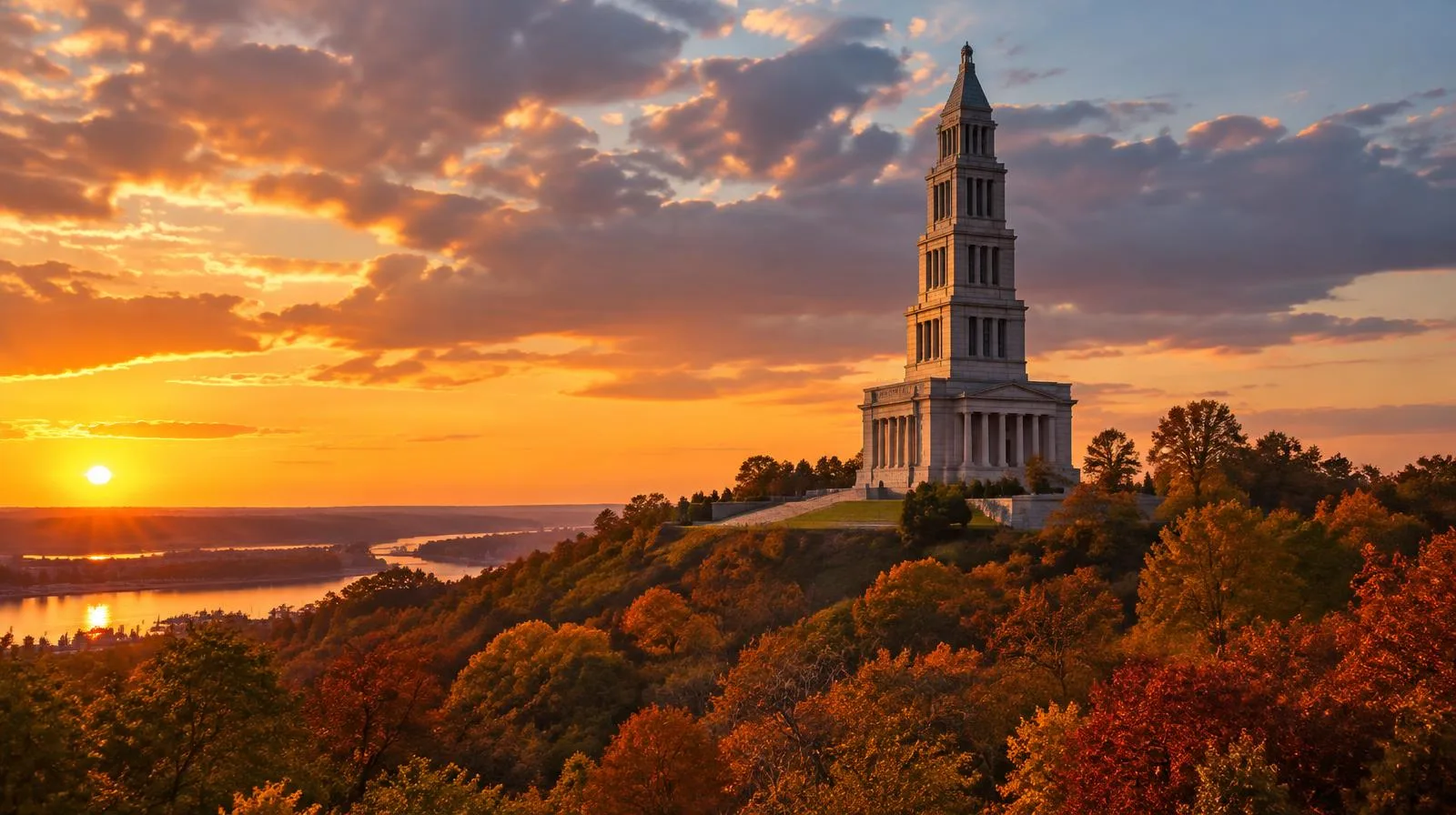
Rising like an ancient beacon above Alexandria, Virginia, the george washington masonic national memorial gives the city’s skyline an unmistakable landmark. Look toward the crest of Shooter’s Hill, also known as Shuter’s Hill, and your eyes are drawn upward to a 333-foot monument. The Memorial Association describes its form as inspired by the ancient Lighthouse of Alexandria in Egypt. For Freemasons and students of the American founding, the attraction reaches beyond its imposing silhouette: this is a place to explore Washington’s Masonic connections, the preservation of objects associated with his life, and the continuing history of Alexandria-Washington Lodge No. 22.
The Pharos of Shooter’s Hill: An American Acropolis
To understand why this monumental building stands in Alexandria, begin with the lodge and its collection rather than a story about a rejected site for the national capital. Alexandria’s connection to Washington, and the lodge’s responsibility for objects associated with him, provided a compelling setting for a national Masonic memorial. Construction began in 1922, and the cornerstone ceremony took place on November 1, 1923. When planning your broader itinerary through the national capital region, as mapped in our Masonic history tour of Washington DC, Alexandria offers a distinct perspective on the relationship between public commemoration and fraternal history.
The vulnerability of historic collections was no abstract concern. On May 19, 1871, fire swept through Alexandria’s City Hall, which housed the lodge and its museum. According to the lodge’s archival account, members rescued the proceedings and much of the Washington memorabilia, although substantial portions of the natural science and art collections were lost. That record supports a story of both destruction and determined preservation, not an unqualified claim that particular Washington relics disappeared in the flames.
The eventual memorial project brought independent Grand Lodges together in an unusually ambitious national undertaking. Charles Callahan and Memorial Association president Louis A. Watres were among those who helped articulate its vision to the architects. The building was dedicated in 1932, although work on the interior continued for decades. Its recognition as a National Historic Landmark in 2015 acknowledges both its architectural importance and the scale of this private effort to honor Washington. It earns its place on a thoughtful traveller’s Masonic travel bucket list through that combination of architecture, association and preservation.
The General as Worshipful Master: Alexandria-Washington Lodge No. 22
The living fraternity at the heart of this story is Alexandria-Washington Lodge No. 22. Its Pennsylvania warrant dates to February 3, 1783, when it was designated Alexandria Lodge No. 39. The lodge’s history distinguishes that warrant from its constitution on February 25. Virginia already had a Grand Lodge, but wartime disruption had interrupted its meetings, helping explain why the Alexandria petitioners initially looked to Pennsylvania rather than their own state.
Washington’s Masonic life had begun elsewhere. He received his degrees at Fredericksburg: initiation on November 4, 1752, advancement to Fellow Craft on March 3, 1753, and raising to Master Mason on August 4, 1753. His later association with Alexandria therefore should not be confused with the beginning of his membership in the fraternity. The Memorial Association records his attendance at Alexandria’s St. John the Baptist celebration on June 24, 1784, and his subsequent honorary membership.
With Washington’s consent, the lodge named him as Master in its application for a Virginia charter. On April 28, 1788, it became Alexandria Lodge No. 22 under the Grand Lodge of Virginia. The lodge’s list of Past Masters records Washington’s tenure from April 1788 to December 1789. He therefore held the office when inaugurated as President of the United States on April 30, 1789. This striking overlap needs no unsupported claim of worldwide uniqueness to make it memorable. The lodge participated in his funeral in December 1799, petitioned to add his name in 1804, and received approval in 1805.
Architecture of Remembrance: The Lighthouse of the Potomac
Architect Harvey Wiley Corbett, of Helmle & Corbett, developed the memorial’s design. The Memorial Association’s account describes Corbett and his partner Frank J. Helmle visiting Alexandria in 1921, inspecting the hill and seeing the lodge’s collection at City Hall. Their commission combined several purposes: a monument to Washington, a home for Masonic activities and a setting for historical collections. The resulting building joins classical architectural language to the vertical ambition of a modern tower.
The official architectural description makes useful distinctions between its parts. The entrance, inspired by the Parthenon, is Doric. Memorial Hall employs a modernized Composite order. The tower’s three sections ascend through Doric, Ionic and Corinthian features, and a pyramid and stylized finial crown the structure. The Association interprets the finial as a symbol of Light and the memorial as a beacon for Freemasonry and Washington’s legacy. These are documented institutional interpretations, rather than proof that every architectural detail corresponds to a particular ritual lesson.
Granite from New Hampshire formed part of the great construction effort described in the memorial’s cornerstone history. Its mass gives the exterior a commanding presence, while the classical orders invite slower observation. Much like the spaces explored in our guide to lodge room architecture and symbolism, this building rewards attention to proportion, setting and symbolism. A visitor may reflect on parallels with Masonic teachings, while keeping personal interpretation separate from the architect’s documented intentions.
Inside Memorial Hall: The Colossus and the Relics
Memorial Hall introduces the monument on a grand scale. Its official tour description identifies eight green granite columns, each 40 feet high and more than four feet wide, alongside a marble floor and two murals by Allyn Cox. At the far end stands Bryant Baker’s monumental bronze Washington. The statue depicts him with Masonic regalia and a gavel; the Smithsonian’s inventory also identifies the hat in his left hand. President Harry S. Truman spoke at its dedication on February 22, 1950. The sculpture is a twentieth-century commemorative work, an important distinction when moving between artistic representations and objects connected directly to Washington.
The murals likewise deserve careful reading. One depicts Washington laying the cornerstone of the United States Capitol on September 18, 1793. The other shows Washington and his officers attending a St. John’s Day observance at Christ Church in Philadelphia on December 28, 1778, not a service in Alexandria in 1783. Their scale and ceremonial subjects make a natural comparison with the institutional interiors explored at the House of the Temple in Washington, D.C. and in our guide to Philadelphia’s Masonic Temple.
Adjacent to Memorial Hall is the Replica Lodge Room. It recreates the lodge’s former City Hall meeting room, occupied beginning on September 16, 1802. Because Washington died in 1799, it cannot accurately be described as a recreation of a room in which he presided. Its significance instead lies in the lodge’s later stewardship of his memory and its own historic furnishings. Objects and associations worth distinguishing include:
- The Washington Apron: Do not assume that the celebrated apron traditionally associated with Lafayette is an Alexandria exhibit. The Grand Lodge of Pennsylvania identifies its Washington apron as part of its museum collection in Philadelphia. It explicitly states that the story of Madame Lafayette embroidering it and Lafayette presenting it in 1784 cannot be documented. That account is tradition, not established provenance.
- The Historic Lodge Furniture: The memorial identifies original 1802 lodge furniture in the Replica Lodge Room. This is a firmer description than claiming that every prominent chair was used by Washington during his term as Master.
- The Cornerstone Trowel: The silver trowel used by Washington at the Capitol cornerstone ceremony is a documented treasure of the lodge. The Memorial Association credits its manufacture to John Duffey and states that it is displayed in the Replica Lodge Room. The lodge’s account describes its ivory handle and silver components.
- The Washington Portrait: The official tour description also identifies the William Joseph Williams portrait of Washington in the Replica Lodge Room. Alongside the furnishings and trowel, it offers another reason to linger over the room’s interpretation rather than treating it simply as an atmospheric reconstruction.
These distinctions strengthen, rather than diminish, the collection’s appeal. An original object, a later reconstruction and a traditional attribution tell different kinds of stories. Read the labels, ask about provenance, and check which objects are available during your visit. For readers exploring the greatest Masonic libraries and museums, that habit is as valuable as recognizing a famous name.
Ascending the Tower: The Appendant Bodies and the Observation Deck
The tower invites visitors to move from the close study of objects toward a broader understanding of the memorial and its setting. Guided tours are included in admission according to the official tours page, which describes an approximate duration of one hour. Confirm the current route before booking, particularly if the observation deck or a specific exhibition is your principal reason for coming. A building with multiple levels should not be mistaken for a promise that every floor and room will be accessible on every tour.
For Masonic travellers, the names of appendant bodies can provide starting points for questions about the fraternity’s wider organization. Rather than arriving with a fixed expectation of particular chapels, degree displays or museum rooms, ask the guide which spaces the current itinerary includes and how they relate to the memorial’s purpose. For those exploring Masonic symbols hidden in Washington D.C., the rewarding exercise is to connect what is actually on display with its documented meaning.
If observation-deck access is included, allow time to enjoy the relationship between hill, city and river. Weather and visibility will shape the experience, so avoid building an itinerary around a guaranteed view of a distant landmark. The shift in perspective is part of the pleasure: after studying Washington’s place within one lodge, consider the larger landscape in which his memory has been preserved.
Sitting in the East: Visiting Alexandria-Washington Lodge No. 22 Today
The memorial is not solely a museum setting. Alexandria-Washington Lodge No. 22 continues to meet there, and its website identifies the South Lodge Room as its meeting place. The posted regular schedule is the second Thursday of each month at 7:30 p.m. Confirm the date directly before travelling, since a standing schedule is not a guarantee that a particular meeting will proceed without changes.
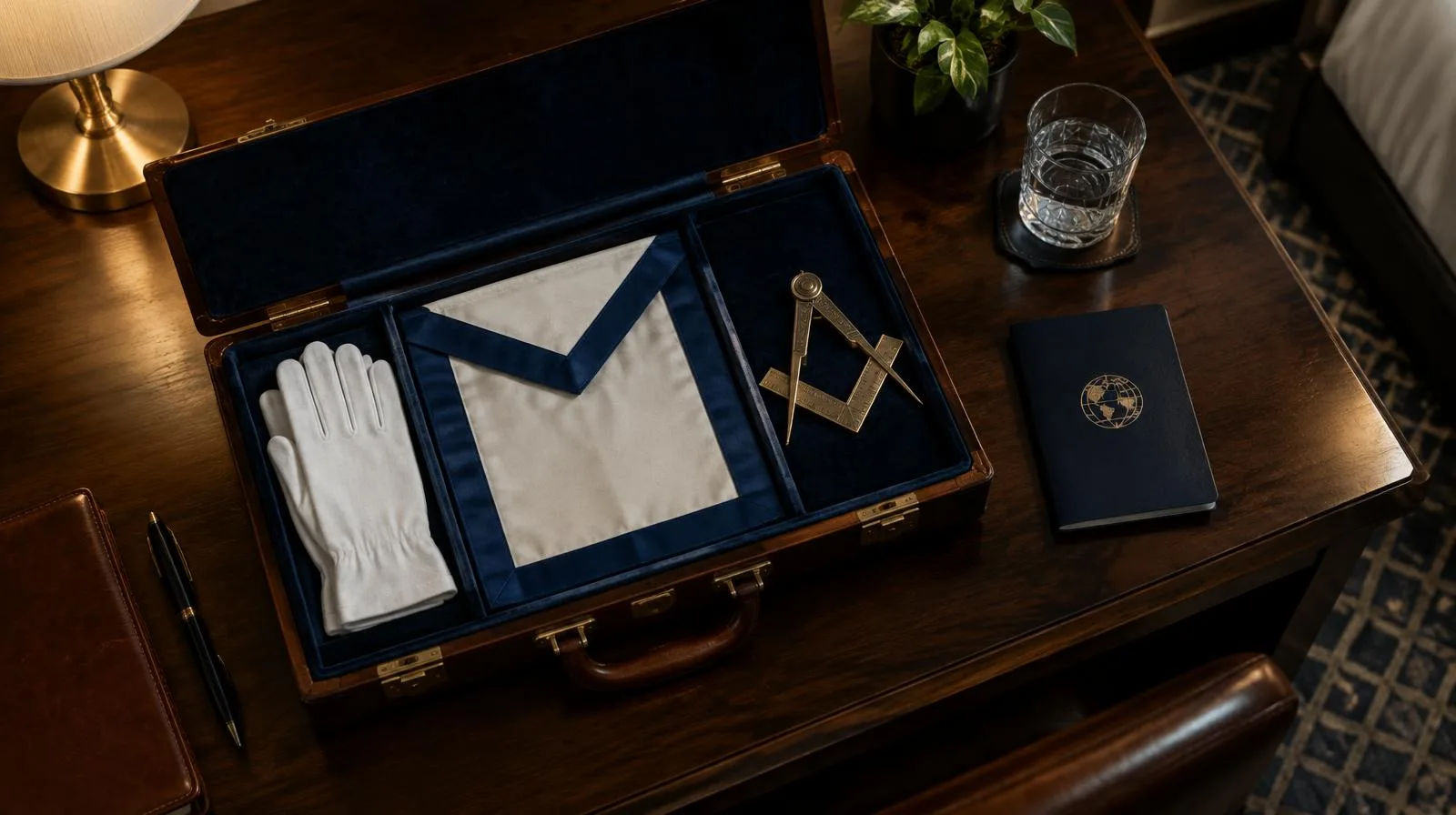
If you are a Brother hoping to attend, arrange the visit separately from your museum admission. Recognition between jurisdictions and verification of a visitor’s standing matter, but the lodge should confirm the documentation and procedures applicable to you. Consult your own Grand Lodge where appropriate, and use our international Masonic visitation protocol as preparation rather than a substitute for local instructions. Ask about dress, arrival time, credentials and whether an examination or introduction will be needed. Once the lodge has advised you what to bring, our practical guide to how to travel with Masonic regalia can help with packing.
Planning Your Visit to Shooter’s Hill
A visit pairs naturally with time in Old Town Alexandria. Keep the memorial reservation as the fixed point of your day, then allow room for walking, meals and other historic attractions. Alexandria’s association with Washington makes it an evocative setting, but the modern city is not an unchanged colonial scene. The most satisfying itinerary gives each site space to tell its own documented story.
- Getting There: The memorial’s address is 101 Callahan Drive, Alexandria, Virginia 22301. Nearby King Street-Old Town Metro station is served by the Blue and Yellow lines. Allow for the uphill approach rather than relying on a universal five-minute walking estimate. Drivers should check current parking arrangements before arrival.
- Ticketing and Hours: The official visitor page currently lists opening on Monday, Thursday, Friday, Saturday and Sunday, with closure on federal holidays. It requires advance reservations and photo identification. Listed admission is $20 per person, with children aged 12 and under admitted free when accompanied by an adult. Verify these details and available tour times on the official website before booking; do not assume daily opening or free access to Memorial Hall.
- Accessibility: Contact the memorial directly about step-free routes, elevator access, seating and the accessibility of the specific tour you intend to take. Avoid relying on a blanket assurance about every room or balcony. The visitor page also states that strollers and baby carriages must be checked, an important consideration for families.
- Photography: The published rules prohibit commercial photography, videorecording and filming on memorial property. Ask staff about current rules for personal still photography, flash and equipment rather than assuming permission. Other posted requirements include proper attire, checking backpacks, and prohibitions on eating, drinking and smoking. Service animals are excepted from the prohibition on animals.
Frequently Asked Questions
Can non-Masons tour the George Washington Masonic National Memorial?
Yes. You do not need to be a Freemason to book a public visit. The memorial offers museum interpretation and guided tours for visitors, while lodge meetings are separate fraternal activities. Reserve in advance, check the current opening days and confirm what your tour includes. Public admission should not be understood as unrestricted access to the entire building.
Is George Washington buried at the memorial?
No. Washington died at Mount Vernon on December 14, 1799, and is buried there. The George Washington Masonic National Memorial honors his memory and Masonic associations; it is not his tomb. Alexandria-Washington Lodge No. 22 is the lodge associated with the building, not the name of a mausoleum. Travellers wishing to visit his burial place should plan a separate visit to Mount Vernon.
How can a visiting Freemason attend a meeting at Lodge No. 22?
Contact the lodge secretary before making plans. A prospective visitor should establish that his jurisdiction is recognized and ask how to demonstrate his membership and good standing. Confirm the meeting date, dress expectations, necessary identification and any examination or introduction requirements directly with the lodge. Do not assume that a museum ticket, a letter of introduction or a particular document by itself guarantees admission to a lodge meeting.
Sources
- Memorial Association: Architecture and symbolism
- Memorial Association: Washington and the lodge’s history
- Alexandria-Washington Lodge: Archival account of the 1871 fire
- Memorial Association: Memorial Hall, murals and Replica Lodge Room
- Grand Lodge of Pennsylvania: Washington apron provenance
- Alexandria-Washington Lodge: History of the silver trowel
- Alexandria-Washington Lodge: Meeting location and schedule
- Memorial Association: Reservations, admission and visitor rules