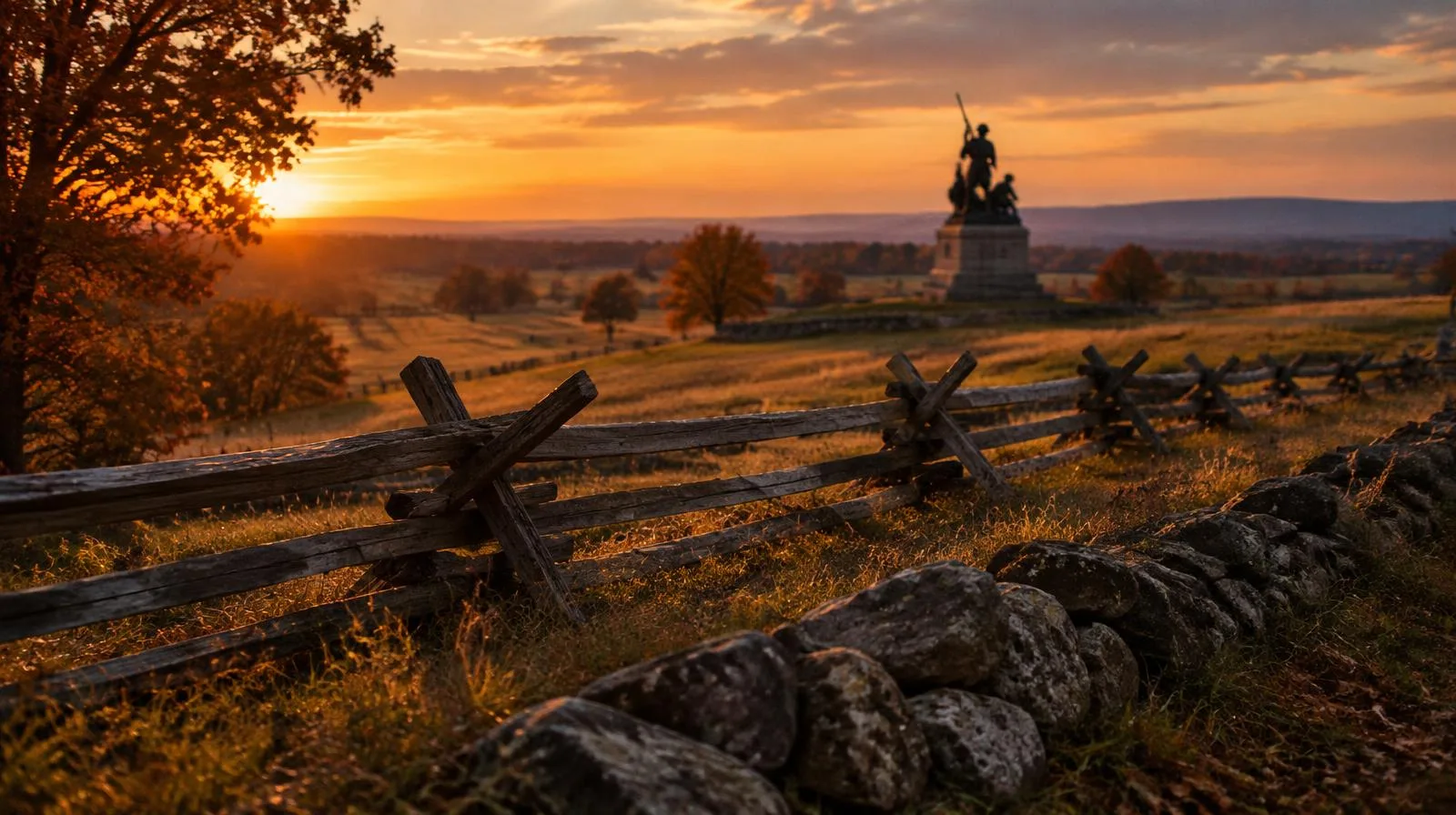
A wounded Confederate general reaches towards a Union captain. Between them passes a watch, a personal possession entrusted to an enemy for delivery to a friend. At Gettysburg, the friend to friend masonic memorial makes this small human transaction the centre of a larger story: men could fight on opposite sides and still recognise an obligation to one another.
It is an arresting scene, but not quite the one sometimes described. The kneeling officer is not the general's old friend. Nor can we confidently say that a Masonic distress sign brought him there. The documented encounter needs neither embellishment. Its power lies in a wounded man's request and a captain's willingness to carry something precious beyond the battle lines.
Who are the soldiers in the Gettysburg Masonic memorial?
The bronze figures represent Confederate Brigadier General Lewis Addison Armistead and Union Captain Henry H. Bingham. The absent third figure, essential to understanding the sculpture, is Union Major General Winfield Scott Hancock. All three were Freemasons. Bingham served on Hancock's staff; Armistead and Hancock had been friends and fellow officers in the United States Army before the Civil War.
On 3 July 1863, Armistead led his men during Pickett's Charge and crossed the stone wall before being wounded. Hancock was also wounded that day. The American Battlefield Trust's account of Armistead records his wish that his watch and other valuables should go to Hancock. Armistead died on 5 July, two days after the charge.
The central event commemorated here is the handover of Armistead's personal effects to Bingham for Hancock. Historical accounts differ over exactly where and how the exchange unfolded, but the transfer itself is well supported. The National Park Service's interpretive marker likewise describes Armistead handing his watch and effects to Bingham.
Keep the identities straight when looking at the bronze. This is not a reunion between Armistead and Hancock. It is an encounter with an intermediary, someone able to carry possessions and a message beyond the wounded man's immediate reach. That distinction makes the sculpture more poignant, not less.
Did Armistead give a Masonic distress sign?
According to a familiar Masonic tradition, Armistead gave a sign asking fellow Masons for assistance when he fell. Some retellings make that signal the reason Bingham came to his aid. The sign claim is disputed and should not be presented as established fact.
The biographical summary of Bingham, citing historian Michael Halleran's research, offers a different explanation: Bingham encountered Armistead by chance while other men were carrying the wounded general from the field. It states that Bingham never claimed to have responded to a Masonic appeal. He accepted the effects for Hancock, Armistead's pre-war friend.
This leaves an important distinction between an event and the explanation later attached to it. Both men being Masons does not, by itself, establish that a ritual signal prompted their meeting. Nor should the statue's carefully composed poses be treated as a literal record of every movement.
For a Masonic reader, acknowledging that boundary need not diminish the memorial. Brotherhood is the meaning its sponsors drew from the encounter; the handover is its historical foundation. For further reading, explore Masonic libraries and museums, approaching commemorative objects with the same questions: what survives, what is documented, and what belongs to interpretation?
How the Grand Lodge and National Park Service created the memorial
The Grand Lodge of Pennsylvania commissioned the memorial, which was dedicated in the National Cemetery Annex on 21 August 1993. Its creation involved more than placing a statue. It formed part of a wider improvement of the annex through cooperation between the fraternity and the National Park Service.
Good Samaritan Lodge's history of the project recalls almost a decade of planning, approvals and coordination. Read that account as the participating lodge's recollection of the undertaking, rather than as independent confirmation of every broader historical claim it makes.
The National Park Service's Freemasonry at Gettysburg marker provides firmer support for the practical contribution. It acknowledges Masonic funding for improvements to the annex in 1993, including a plaza honouring fallen American soldiers and the Friend to Friend memorial.
That wider setting matters. The fraternity's contribution was not simply an object bearing its own message, but support for a public place of remembrance. For travellers pairing Gettysburg with Philadelphia's Masonic Temple, the contrast offers a useful question to carry between visits: how does the Craft present itself within its own home, and how does it speak in a shared civic landscape?
What to look for in Ron Tunison's sculpture
Sculptor Ron Tunison made the encounter intimate in its gestures. Bingham kneels beside Armistead, who reclines against a knapsack. The wounded officer's dependence, rather than a victorious commander's authority, gives the composition its emotional weight. Look first at the relationship between the figures, before turning to the explanatory tablets.
The Smithsonian's sculpture inventory records bronze figures on a granite base, surrounded by benches and a semicircular wall bearing the names of 29 states. The lodge's account explains that these represent states whose soldiers fought at Gettysburg. The setting widens the scene from two individuals to the divided country around them.
The monument's words, A Brotherhood Undivided, express the ideal its sponsors wished to commemorate. They should not be taken to mean that fraternity prevented these men from fighting each other, or erased the conflict between their allegiances. Compassion towards an opponent and agreement with his cause are different things.
This is also a memorial, not Armistead's grave. The American Battlefield Trust places his burial in Baltimore. As with reading Masonic gravestones, begin by asking exactly what an object commemorates before assuming whom, or what, lies beneath it. A cemetery setting does not make every monument a burial marker.
The Soldiers' National Monument cornerstone of 1865
Masonic involvement in Gettysburg's commemorative landscape began long before 1993. The Grand Lodge of Pennsylvania participated in the cornerstone ceremony for the Soldiers' National Monument in 1865. The Smithsonian's record of that monument dates the cornerstone laying to 4 July 1865 and its dedication to 1 July 1869.
These are separate milestones. A ceremonial cornerstone laying does not necessarily mark the start of construction. As Ohio Memory's discussion of cornerstone ceremonies explains, the ceremony can be symbolic rather than the first step in building. Here, the important distinction is between the cornerstone event and the later dedication, not an assumed moment when all work began.
Carry that distinction with you when exploring the Masonic cornerstone trail. Ask what each recorded date actually identifies: a ceremony, a construction stage or a dedication. There is no need to award the Soldiers' National Monument an unqualified title as Gettysburg's first memorial to appreciate its place in the cemetery's history.
Visit it alongside Friend to Friend and the contrast is instructive. The Soldiers' National Monument uses allegorical figures, including War, History, Peace and Plenty, beneath Liberty. Tunison's work centres instead on a particular exchange between named men. One gives remembrance a public, symbolic language; the other asks us to attend to an individual obligation.
How to visit the Friend to Friend Masonic Memorial
Find the memorial in Gettysburg's National Cemetery Annex, near Steinwehr Avenue and South Washington Street. Distinguish the annex from the main cemetery when planning your route. Do not mistake the memorial's location for the battlefield spot where Armistead was wounded: this is a commemorative setting, not a marker identifying where he fell.
For a thoughtful visit, follow a simple sequence:
- Read the Freemasonry at Gettysburg interpretive marker just inside the annex gate for the wider history of Masonic support.
- Walk around the sculpture where paths permit, looking at the figures before reading the explanatory tablets.
- Include the Soldiers' National Monument in your cemetery visit to compare the two approaches to remembrance.
The National Park Service's conditions page lists cemetery access as thirty minutes before sunrise to thirty minutes after sunset. Check before you go for current hours, closures and access arrangements. If mobility is a concern, ask park staff about the most suitable route rather than assuming every approach is step-free.
Allow others quiet, avoid obstructing paths and treat the setting as more than a photographic backdrop. For a longer journey, consider our travel planning tips for Freemasons alongside the Masonic history itinerary for Washington DC. Leave room in your schedule to reflect, rather than treating each memorial as another stop to complete.
If you also hope to enter a lodge building, consider which Masonic halls you can visit separately. Check arrangements with the venue before travelling; access to this outdoor memorial should not be taken as evidence of access to any working lodge.
Frequently asked questions
Where is the Friend to Friend Masonic Memorial?
It stands in Gettysburg's National Cemetery Annex, near Steinwehr Avenue and South Washington Street. Check the park's current access information before travelling.
Who are the two men in the statue?
They are Confederate General Lewis Armistead and Union Captain Henry Bingham. Bingham received Armistead's personal effects for Union General Winfield Scott Hancock, Armistead's pre-war friend.
Is the Masonic distress sign story true?
It is a disputed tradition, not an established explanation for the encounter. The handover of personal effects is better supported than the claim that a Masonic sign summoned Bingham.
When was the memorial dedicated?
The memorial was dedicated on 21 August 1993. Commissioned by the Grand Lodge of Pennsylvania, it features a bronze sculpture by Ron Tunison.
Sources
- Smithsonian: sculpture, materials and inscriptions
- Gettysburg Freemasons: memorial history and Masonic involvement
- Historical Marker Database: National Park Service interpretive marker
- Wikipedia: Bingham biography and summary of Halleran's research
- American Battlefield Trust: Lewis Armistead biography
- Smithsonian: Soldiers' National Monument chronology and sculpture
- Ohio Memory: ceremonial cornerstones and construction
- National Park Service: cemetery hours and current conditions
- Square & Travel: museums, libraries and interpreting collections