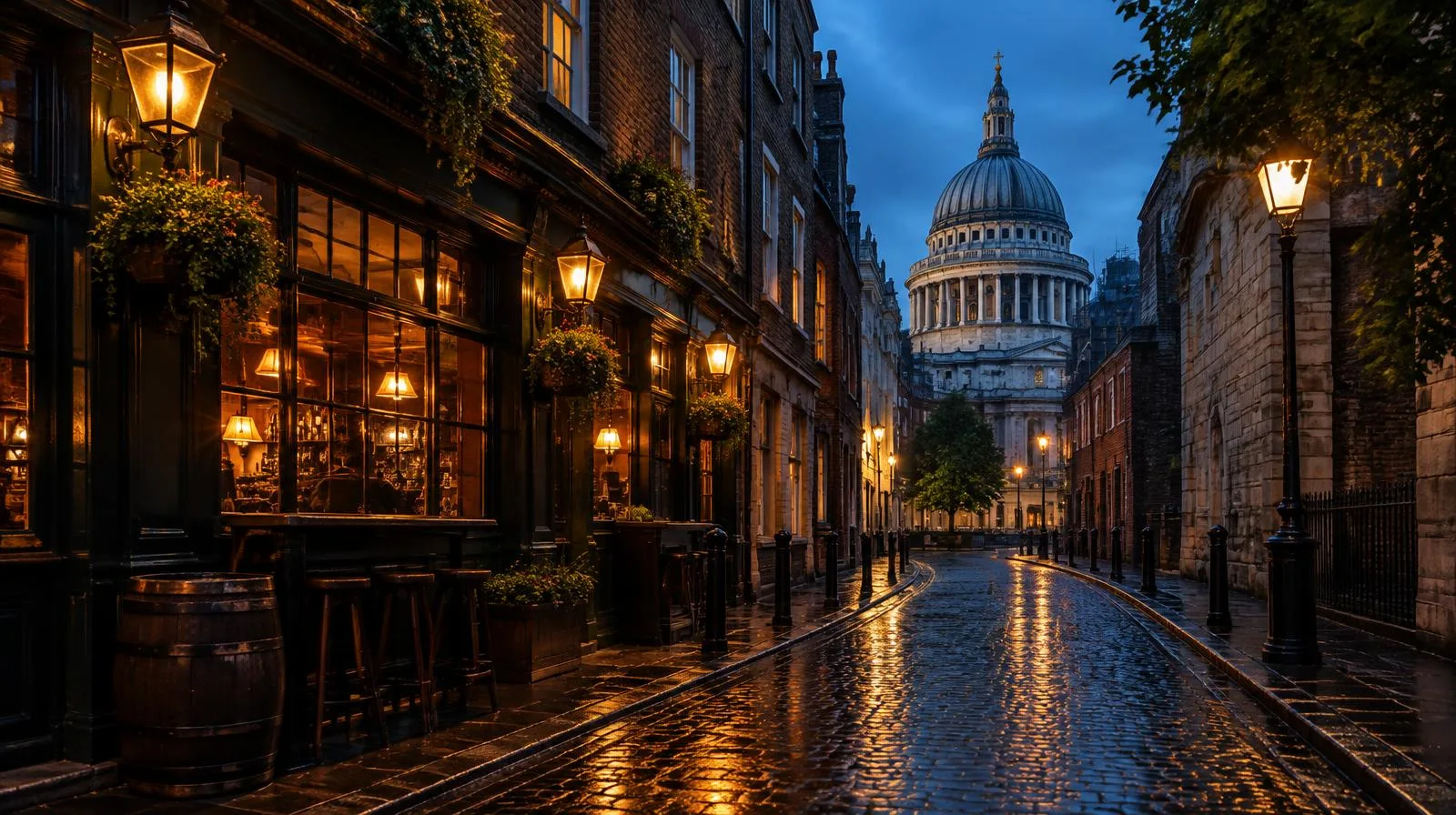
Imagine chairs scraping across a floor, a table cleared for business, conversation drifting up from the bar. Search for masonic pubs london and this is the world you hope to recover: not monumental temples, but rooms where fellowship and organisation shared the same table. The most evocative stop, however, may involve a tavern sign rather than a pint.
This is a pub crawl with a difference. Its landmarks include a demolished tavern, historical addresses and a surviving banqueting hall. Follow the evidence to Great Queen Street and the story becomes architectural. Carry it beyond London to Cheshire, and the room above the pub becomes something more than an exercise in imagination.
Was Freemasonry really born in a London pub?
Not quite. Freemasonry predates the gathering traditionally dated to 24 June 1717 at the Goose and Gridiron in St Paul's Churchyard. In the United Grand Lodge of England's historical account, four existing London lodges came together there, formed the first Grand Lodge and elected Anthony Sayer as Grand Master.
The distinction matters, as does the evidence. John Hamill's 1717 and all that explains that the evidence for that particular event is James Anderson's account in his Constitutions of 1738. Historians disagree about its reliability. Hamill defends the traditional account against scholars who question it; the disagreement should not disappear behind a confident pub anecdote.
The four meeting places were the Goose and Gridiron, Crown Ale-House, Apple-Tree Tavern, and Rummer and Grapes, as listed in Douglas Franklin's discussion of drink and Freemasonry. For related reading, turn to Freemasonry and beer. Here, the important distinction is between a lodge and its premises: documenting one does not automatically establish the survival of the other.
St Paul's and the Devil Tavern: begin with what survives
The Goose and Gridiron: a sign, not an original bar
Begin with St Paul's Churchyard as the historical setting. The Goose and Gridiron is not an original-interior pub visit: London Picture Archive holds an 1895 watercolour showing its demolition in London House Yard. That record gives us something firmer than the vague suggestion that the tavern has simply changed beyond recognition.
London Museum holds a painted wood and iron sign that hung outside the tavern. Its production date is 1801 to 1835, so it belongs to the establishment's later history, not the gathering traditionally dated to 1717. It is a documented survival, without needing to call it the only or most important one.
A replica offers another way into the story. UGLE's museum tour description places it at the entrance to the Museum of Freemasonry's North Gallery. Check current arrangements before visiting either museum: a collection record does not establish that an object is on display.
The Devil Tavern: a historical site on Fleet Street
Make the Devil Tavern site a separate waypoint, using a current map rather than treating this article as turn-by-turn directions. Historian David Harrison identifies the tavern as a meeting place of the Premier Grand Lodge during the 1720s. It was not one of the founding four.
Henry Harben's Dictionary of London places its former site at Child's Place, adjoining Child's Bank on the south side of Fleet Street. His account records the rebuilt bank occupying the site. This establishes a historical location, not today's occupier or an accessible tavern room.
The interest here lies in recovering a meeting culture. Continue that theme through chocolate houses, coffee and the clubs around early Freemasonry, rather than expecting every significant address to yield an untouched interior.
The Rummer and Grapes, Apple-Tree and Crown: tracing old addresses
These names belong in the story, but they do not all provide equally secure modern destinations. Treat Westminster and Covent Garden as optional historical areas to investigate, not compulsory legs of a verified walking circuit. Plot journeys separately and resist adding precise map pins where the evidence supplies only a street or traditional location.
The Rummer and Grapes: Channel Row, Westminster
A discussion of William Hogarth's Night, quoting Bernard E. Jones, identifies the Rummer and Grapes in Channel Row, Westminster, as a lodge meeting place. That supports the historical address without requiring an unverified attribution to Anderson.
The same discussion considers whether Hogarth depicted the tavern, but also presents an alternative location for the scene. Enjoy the artistic footnote as an interpretation, not a reliable street map. It does not establish a surviving room or present-day entrance.
The Apple-Tree Tavern: the Charles Street tradition
The Apple-Tree is traditionally associated with Charles Street, Covent Garden. The Survey of London securely identifies that former street as the northern stretch of Wellington Street between Tavistock Street and Russell Street. It does not, in the passage used here, identify the tavern itself.
That distinction limits what we can promise. The street history helps interpret the traditional address, but it does not establish a tavern footprint. Treat a visit as an exploration of the setting rather than a search for a verified doorway.
The Crown Ale-House: a traditional location near Drury Lane
The Crown is traditionally placed in Parker's Lane near Drury Lane. Its place among the four tavern names is supported by Franklin's account; the evidence used here does not independently establish that street attribution or a modern site. Keep the location provisional rather than claiming a precise stop.
For travellers drawn to this kind of documentary detective work, overlooked Masonic sites offers a related reading trail. The pleasure lies partly in knowing when a promising connection remains a question.
Finish at the Connaught Rooms and Freemasons' Tavern
Great Queen Street offers a more tangible conclusion. Historic England records the former Freemasons' Tavern façade as incorporated into the Connaught Rooms, describing demolition in 1927. The venue's own historical summary instead highlights a change to hotel use in 1909. These brief accounts do not provide enough detail to reconcile the building sequence confidently.
What can be said more securely is that significant fabric survives. UGLE's architectural account identifies the Connaught Rooms' Grand Banqueting Hall as the Victorian replacement for an earlier Masonic hall. This is more than historically interesting ground beneath an entirely unrelated building.
Look, too, for the plaque commemorating the Football Association's foundation at the tavern in 1863. Historic England records its unveiling in 2013. It is a useful reminder that the premises' significance extends beyond the Craft.
Pair this stop with Freemasons' Hall London, while keeping the hall and former tavern distinct. For the social thread connecting meeting room and dining room, continue with festive board and table lodge traditions.
Practical advice: what can you actually visit?
- Plan historical waypoints, not guaranteed pub interiors. Check a current map, pedestrian access and transport options. This article does not verify a continuous route or its duration.
- Build the day around confirmed access. The Museum of Freemasonry welcomes public visitors, but check opening and tour arrangements before you go. UGLE notes that ceremonial areas depend on availability in a working building.
- Ask about the Connaught Rooms. It operates as an events venue. Enquire about interior access or refreshments rather than assuming that historical interest guarantees entry.
- Choose drinking stops separately. Check current opening hours and food service, and allow for water and lunch. A pleasant pause needs no invented Masonic pedigree.
Our guide to Masonic halls open to the public is a useful companion when deciding what sort of visit to seek. Keep museum sightseeing, venue access and attendance at a lodge meeting as separate enquiries.
Beyond London: the Bears Paw and Domville Lodge
Cheshire belongs in a separate itinerary. At the Bears Paw in Frodsham, Harrison records an Antients lodge founded in 1770 and meeting there until 1794. Historic England lists the building on Main Street as Grade II. Check current opening and access arrangements; the lodge connection does not establish which interior features survive from its meetings.
At the Spread Eagle in Lymm, Harrison supplies a particularly evocative recollection. Formerly a member of Domville Lodge No. 4647, he describes preparing its room above the pub: setting out furniture, unrolling the carpet and placing the tracing board. The Warrington Guardian's 2024 centenary report also identifies the Spread Eagle as the lodge's meeting place.
Read about Masonic tracing boards for a companion to that scene. Brethren considering attendance should first contact the lodge and consult Masonic visitation guidance. Neither the historical account nor the newspaper report establishes current admission arrangements.
Frequently asked questions
Can I drink in the original Goose and Gridiron?
No. London Picture Archive documents its demolition in an 1895 watercolour. London Museum holds a later tavern sign, while the Museum of Freemasonry has a replica. Check display arrangements separately.
Does every stop have a plaque?
The evidence does not establish a plaque trail. The documented example here commemorates the Football Association's foundation at the former Freemasons' Tavern on Great Queen Street.
Do I need to be a Freemason to explore this history?
No. The Museum of Freemasonry welcomes the public. For other sites, check access individually; this article does not promise entry to buildings or admission to lodge meetings.
Does Domville Lodge still meet above a pub?
Harrison describes its upstairs room at the Spread Eagle, and reporting in 2024 places the lodge at that venue. Ask the lodge to confirm its current meeting place and visiting arrangements.
Sources
- Quatuor Coronati: John Hamill on the evidence for 1717
- London Museum: the Goose and Gridiron tavern sign
- London Picture Archive: the tavern's demolition
- British History Online: Child's Place and the Devil Tavern site
- Survey of London: Charles Street and Wellington Street
- United Grand Lodge of England: the surviving banqueting hall
- Historic England: Freemasons' Tavern façade and Football Association plaque
- David Harrison: the Bears Paw, Spread Eagle and Devil Tavern
- Warrington Guardian: Domville Lodge's 2024 centenary