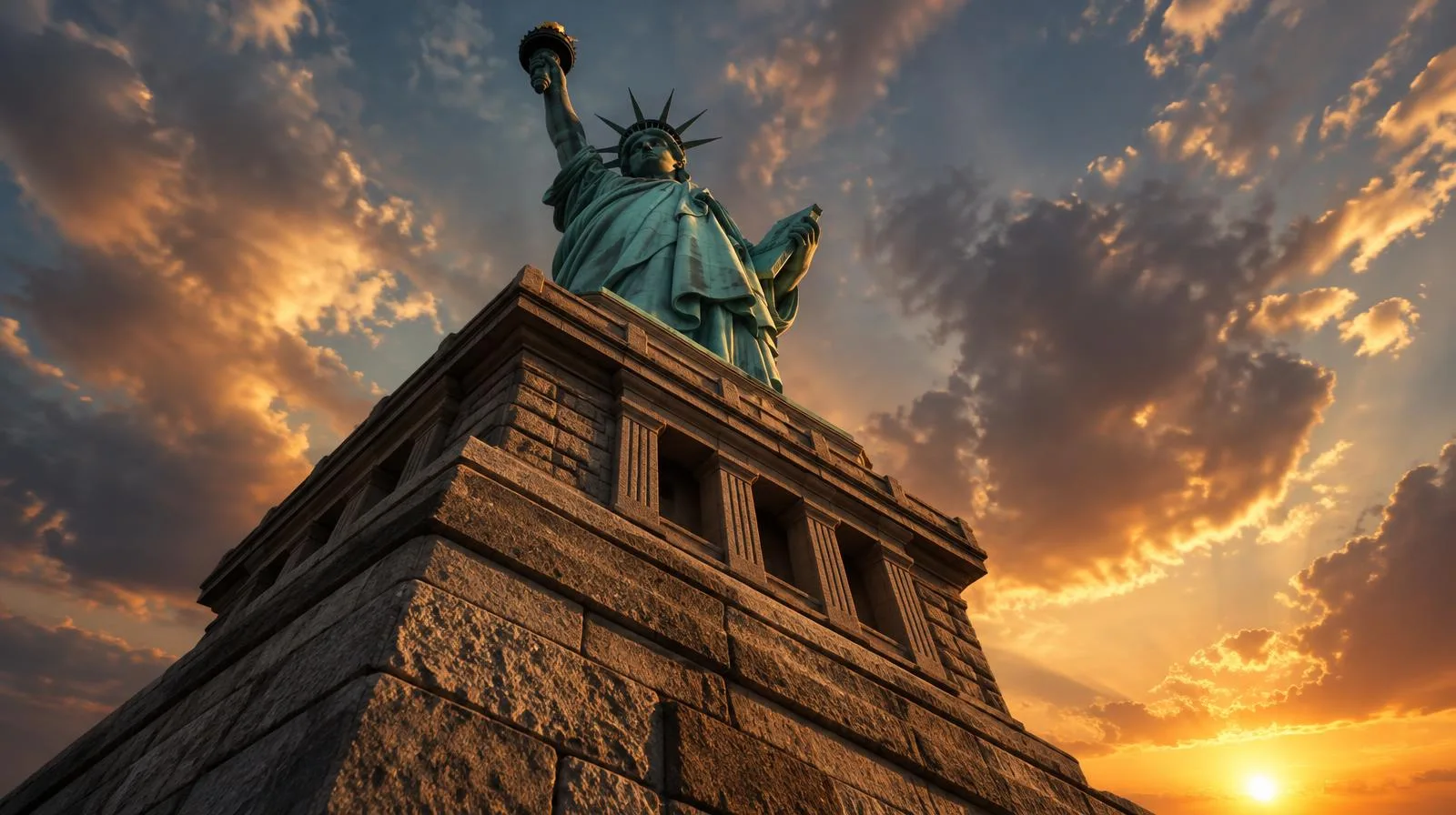
Rain poured over Bedloe’s Island as William A. Brodie, Grand Master of Masons in New York, laid the cornerstone of the Statue of Liberty’s pedestal on 5 August 1884. This masonic cornerstone ceremony took place at an unfinished building site. The familiar monument was still an uncertain prospect, and the money needed to complete its pedestal was running short.
For a Masonic traveller, a rewarding discovery awaits beneath the grand outline: a plaque commemorating that wet beginning. Dedicated a century later, it names Brodie and records the occasion. Start with its inscription, and a different monument trail emerges, traced through foundation stones, newspaper reports and commemorative images rather than guesses about hidden symbols.
What is a Masonic cornerstone ceremony?
A Masonic cornerstone ceremony accompanies the laying of a building’s foundation stone with the fraternity’s ceremonial observances. Its details need to be checked against the particular occasion and jurisdiction. At Tain’s old Free Church, for example, a newspaper report describes the application of the level, square and plumb to the stone, followed by strokes of a mallet and a blessing.
Corn, wine and oil also belong to this ceremonial language. An educational paper published by the Grand Lodge of Iowa describes them as elements of consecration and gives their symbolic meanings as nourishment, refreshment and joy. These are ritual associations, not construction instructions. For related reading, turn to corn, wine and oil in Freemasonry.
Nor should the ceremony be presented as an unchanged survival from Solomon’s Temple. In his account of its evolution, S. Brent Morris traces the recognisable ritual through eighteenth-century developments and notes differences between Grand Lodges. Biblical associations belong to Masonic tradition, not proof that today’s ceremony was performed in antiquity.
On this trail, keep the general tradition separate from the individual event. Where a report names corn, wine and oil, that detail can be included confidently. Where an inscription records only Masonic honours, leave the unrecorded choreography alone.
Liberty’s pedestal: the ceremony of 5 August 1884
The National Park Service historical handbook confirms that Brodie laid the pedestal’s cornerstone with Masonic ceremony on 5 August 1884. The pedestal was built within Fort Wood, whose eleven-pointed walls enclosed a substantial concrete foundation. Granite formed the pedestal’s outer wall, backed by a massive concrete shaft.
The weather comes into focus in Untapped New York’s account, drawing on contemporary newspaper reporting. Torrential rain kept many invitees away, but the ceremony proceeded. Hold that wet, unfinished scene in mind when looking at a monument whose presence now seems inevitable.
The centenary plaque records attendance extending beyond Grand Lodge members: representatives of the United States and French governments, Army and Navy officers, foreign legations and distinguished citizens. That is evidence of a broad gathering. It does not, by itself, settle the formal status of any Grand Lodge proceedings associated with the occasion.
Nor did the ceremony guarantee completion. The handbook records that work stopped later in 1884 as the American Committee approached the end of its funds. Construction resumed after the financial problem was resolved in 1885. The pedestal’s final stone was placed on 22 April 1886, when workmen scattered silver coins from their own pockets into the mortar.
Finding and photographing the Liberty Island plaque
The tangible destination is the plaque dedicated by the Masons of New York on 5 August 1984. The Historical Marker Database entry provides its inscription, photographs and mapped location on Liberty Island. Save the entry before travelling so you can show park staff precisely what you hope to find.
Read both dates. The plaque commemorates the 1884 laying but is itself a 1984 memorial. Photograph the complete inscription, then a wider view showing its setting, wherever permitted. A close-up preserves the wording; the wider photograph helps you remember which object you actually saw.
Do not treat a marker listing as confirmation of today’s visitor route. Ask staff about current accessibility and whether the available approach requires pedestal admission. The same question belongs in any itinerary involving Masonic halls open to the public: what, exactly, will you be able to see?
The National Park Service visit planner states that general admission does not include the pedestal interior. Pedestal and crown access require the appropriate tickets, with limited availability. Check before you go. The time on a ferry ticket refers to joining the security queue, not the boat’s departure.
Keep the plaque enquiry separate from your broader sightseeing plans. Confirm access before making it the centrepiece of the day, and check current security restrictions before packing photographic equipment. For the wider journey, continue with our Masonic travel planning guide.
Washington’s cornerstone trail: the Capitol and the Monument
The United States Capitol
On 18 September 1793, President George Washington laid the Capitol’s cornerstone in a Masonic ceremony. The Architect of the Capitol’s account describes an engraved silver plate beneath the stone and three worshipful masters bearing corn, wine and oil for its consecration. Here, the ceremonial substances are explicitly documented.
The plate was made by Caleb Bentley, whom the account identifies as a Quaker clockmaker and silversmith. That description establishes his occupation and religious affiliation, not whether he was a Freemason. His contribution is worth remembering without assigning him a membership status the source does not establish.
Do not expect an original cornerstone neatly labelled for inspection. The Senate’s historical account explains the uncertainty over its precise location. The Architect of the Capitol identifies representations of the ceremony in the Cox Corridors and on the Senate Bronze Doors. Ask which features current visitor routes include.
Use the episode as a starting point for a Masonic history tour of Washington. There is plenty to consider in the documented procession, engraved plate and consecration before attempting any interpretation of the city’s geometry.
The Washington Monument
The Washington Monument offers another dated cornerstone ceremony: 4 July 1848. A Library of Congress catalogue entry identifies Benjamin B. French, Grand Master of the Masons, laying the cornerstone in a commemorative lithograph.
Notice the image’s date as well as its subject. The print dates from about 1893, not the ceremony itself. It is a later depiction, not an eyewitness photograph. Keep that distinction in mind while exploring Masonic symbols in Washington’s landmarks: commemoration and contemporary testimony answer different questions.
Scottish foundation stones beyond the grand monuments
At Hawick Cottage Hospital, the evidence moves from national monuments to a local institution. Historic Environment Scotland records an inscribed foundation stone on the east gable stating that it was laid with Masonic honours on 30 August 1884 by the Earl of Mar and Kellie, Grand Master Mason of Scotland. The hospital opened on 31 August 1885.
Consider it a research-led detour when planning a Masonic history journey through Scotland. Check the building’s present use, the stone’s visibility and lawful access before travelling. A heritage designation is a useful research lead, not an invitation to enter private premises.
Tain supplies a more detailed ceremonial account. Tain & District Museum reproduces a newspaper report of the old Free Church’s foundation ceremony in late August 1843. It describes a cornucopia of corn, wine and oil in silver cups, and coins and documents carried in a sealed bottle. The level, square and plumb were applied to the stone.
The report also describes a request from inhabitants and others, followed by a lodge vote agreeing to participate. That local decision is as revealing as the ceremonial objects: it records how this particular occasion came about, rather than asking us to assume an automatic Masonic role.
How to recognise reliable evidence on site
Begin with the inscription, identify who placed it and when, then compare it with an institutional history or contemporary account. Take that habit into other investigations, whether reading a Masonic gravestone or examining stonemasons’ marks on European cathedrals. Let the object set the questions before a theory supplies the answers.
- Separate the dates. Foundation laying, opening, completion and commemoration may describe different events.
- Record the exact wording. Preserve names and titles rather than paraphrasing them from memory.
- Distinguish the objects. A commemorative plaque is not the foundation stone it recalls.
- Leave gaps visible. Do not transfer a ritual detail or deposited object from one ceremony to another.
Frequently asked questions
Was the Statue of Liberty’s cornerstone laid by Freemasons?
The cornerstone of its pedestal was laid with Masonic ceremony by William A. Brodie, Grand Master of Masons in New York, on 5 August 1884. Preserve the distinction between the statue and its pedestal.
Were objects deposited at these cornerstone ceremonies?
The Capitol account records an engraved silver plate beneath the stone. The Tain report describes coins and documents carried in a sealed bottle. Neither establishes what was deposited at Liberty’s ceremony, so their contents should not be borrowed for that story.
Can I photograph the Masonic centenary plaque?
The Historical Marker Database documents the plaque with photographs. Before your visit, confirm current access and photography arrangements with park staff, including whether the available route requires pedestal admission.
Does a Masonic ceremony prove ownership of a landmark?
Do not use ceremonial participation as proof of ownership. Read Liberty’s plaque for what it records: a cornerstone laying, its presiding Grand Master and those present. Establishing ownership requires separate evidence.
Sources
- National Park Service historical handbook: construction of Liberty’s pedestal
- Historical Marker Database: Liberty Island centenary plaque
- MasonicWorld: S. Brent Morris on the ceremony’s evolution
- Grand Lodge of Iowa: corn, wine and oil symbolism
- Architect of the Capitol: the first cornerstone ceremony
- Library of Congress: Washington Monument cornerstone lithograph
- Historic Environment Scotland: Hawick Cottage Hospital inscription
- Tain & District Museum: Free Church foundation ceremony report
- National Park Service: planning a Liberty Island visit