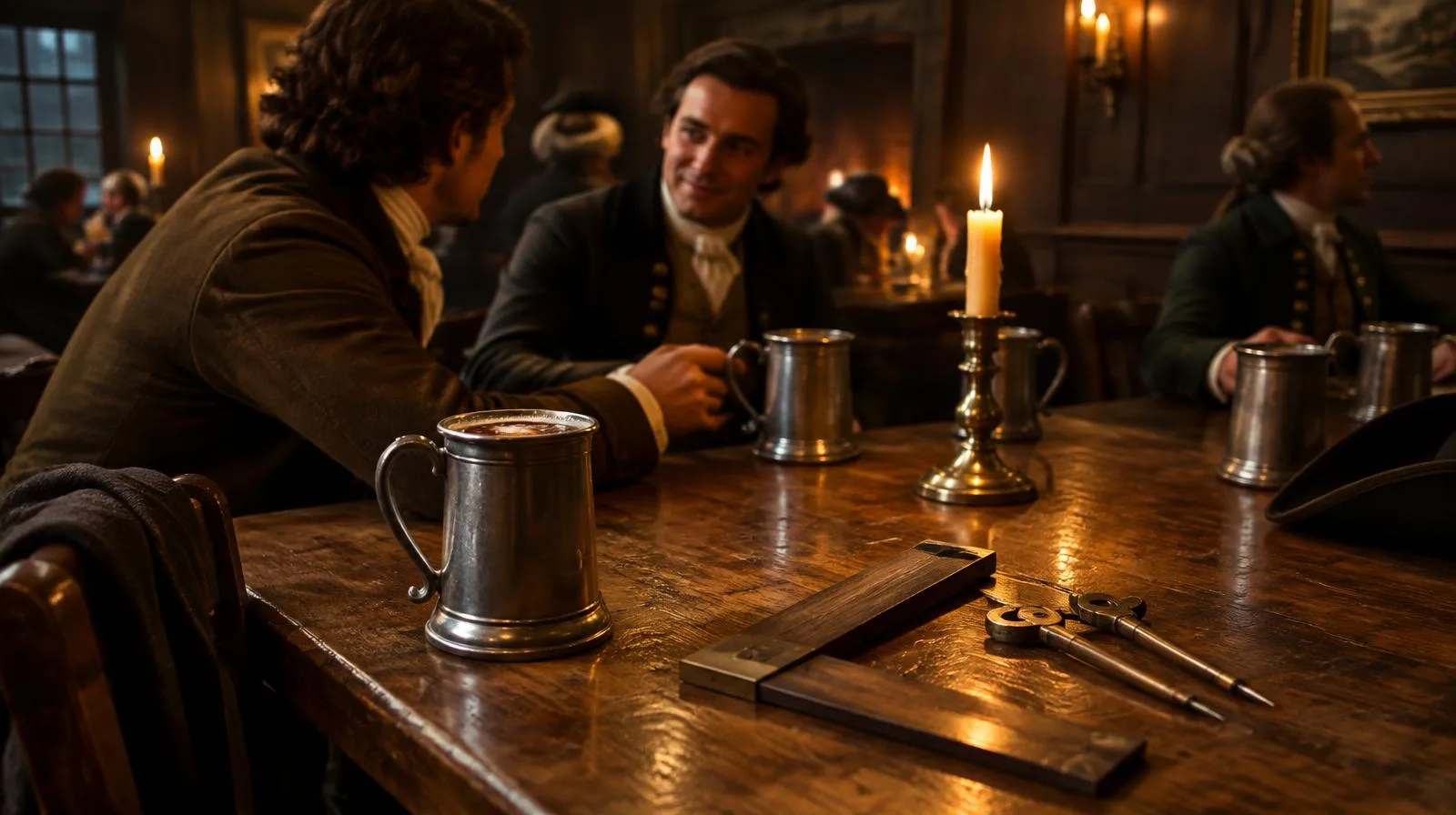
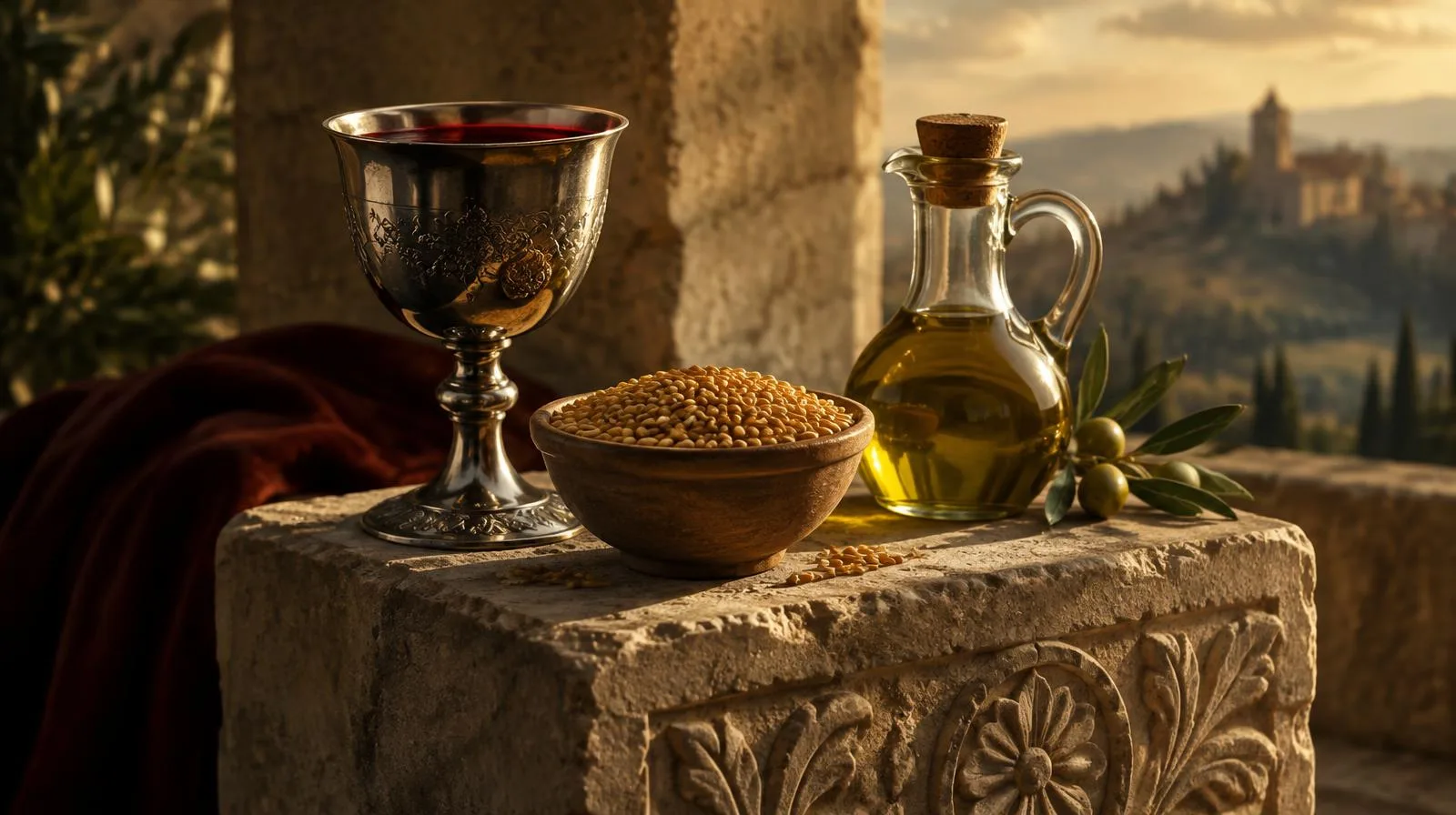
Pour the wine onto the stone, not into the glass. That is the unexpected starting point for corn wine and oil freemasonry: a familiar drink becomes an emblem, and a building begins its ceremonial life with a wish for joy. At the laying of the United States Capitol cornerstone, wine was part of the consecration, not merely the celebration afterwards.
At a Table Lodge, the language changes again. In one published vocabulary, a glass becomes a cannon, red wine becomes strong red powder, and drinking becomes firing. Follow those transformations and a richer story emerges: wine as symbol, ceremonial substance and refreshment. Yet its presence in ritual never meant that every lodge permitted alcohol.
What do corn, wine and oil mean in Freemasonry?
The three substances express the conditions of a flourishing life. An address published in The Freemason's Chronicle in 1889 describes them together as symbols of prosperity and abundance. Separately, corn represents health, strength and plenty; wine brings joy; oil offers consolation, gladness and peace.
The emphasis changes with the ceremony and jurisdiction. In The Spirits and Freemasonry, Douglas Franklin describes wine as refreshment in ritual teaching, joy and gladness at a foundation stone, and joy and cheerfulness in comparable English ceremonies. These meanings belong to the same family, but are not an identical formula.
Franklin also records the traditional Masonic account of workers at King Solomon's Temple receiving corn, wine and oil. The workings he discusses assign the allowance differently. This is ritual tradition, not independent evidence of ancient employment arrangements, and should be read as symbolic instruction rather than a surviving payroll.
A vessel of wine can therefore evoke refreshment without requiring anyone to drink it. For readers interested in how familiar objects acquire ceremonial meaning, lodge room architecture and symbolism offers a related subject to explore. Here, the important distinction is between the material itself and the meaning assigned to it.
Why is wine poured on a Masonic cornerstone?
A cornerstone ceremony brings that symbolism into public view. The 1889 Chronicle address explains that corn, wine and oil had been poured upon a foundation stone to express hopes that the building would rise prosperously and fulfil its intended purpose. The ceremony looks beyond construction towards the people the building will serve.
The Capitol provides a documented example. According to the Architect of the Capitol's account, George Washington laid its cornerstone on 18 September 1793. He placed an inscribed silver plate in the foundation trench and lowered the stone onto it. Those accompanying him included Masonic officers bearing the corn, wine and oil used in its consecration.
A later account reproduced by Phoenixmasonry also describes the application of the square, level and plumb to test the stone. That detail belongs to its retrospective description; the Architect of the Capitol's account establishes the consecration with corn, wine and oil without describing those tests.
The occasion included a procession, music, spectators and subsequent feasting. The ceremonial substances were thus part of a public civic event, not simply refreshments for those attending. Continue with our Cornerstone Trail if this intersection of buildings and ceremony interests you. When researching a particular stone, look for a record of its laying rather than relying on symbolism alone.
Wine in lodge consecration and hall dedication
A lodge, a hall and a public building are not interchangeable things. Constituting a lodge concerns a Masonic body; dedicating a hall concerns premises intended for Masonic use; laying a foundation stone marks a building's beginning. The published ceremonies connect these occasions without making them identical.
Daniel Sickels's General Ahiman Rezon, published in 1868, gives a revealing description of hall dedication. Its procession includes officers carrying vessels of corn, wine and oil. A ceremonial object called the Lodge, covered with white linen and carried by four brethren, is placed before the altar, with vessels and lights arranged around it.
Wine is brought forward as ceremonial equipment, not passed around as hospitality. Franklin likewise identifies it as an element of consecration in the constitution of a new lodge, associated with refreshment. Its assigned meaning is distinct from its use as a beverage.
These descriptions establish ceremonial uses, not a universal modern instruction sheet. They demonstrate that wine could serve purposes other than social drinking. They do not, by themselves, establish why those uses persisted or whether a particular alcohol restriction exempted them.
Was alcohol actually banned from Masonic lodges?
Restrictions certainly existed. But the attractive shorthand that alcohol disappeared from the lodge while ceremonial wine escaped prohibition is too simple. The policies cited here differ, and ritual did not automatically provide an exemption.
A useful example is Village Lodge's 2017 policy announcement. It reports that the Grand Lodge of Ohio introduced an alcohol ban in 1934 and later repealed it, allowing individual lodges to establish their own rules. Village Lodge then permitted alcohol on its premises, but expressly excluded the dedicated meeting area, Table Lodges and other Masonic rituals.
Elsewhere, permission could be conditional. A published Ceremony of Seven Toasts hosted by the Grand Lodge of British Columbia and Yukon requires dispensation from the Grand Master if wine or beer is served. It also requires a non-alcoholic alternative for anyone who does not wish to drink wine.
Read alongside Freemasonry and beer and Freemasonry and coffee, these examples invite a more careful view of refreshment. Wine has a documented ceremonial place, but that is not proof of uninterrupted use in every lodge, nor permission to disregard local rules.
Table Lodge cannons, red powder and seven toasts
At the dining table, the emphasis shifts from consecration to organised fellowship. The Table Lodge programmes cited here prescribe an opening, toasts and a closing, rather than simply a meal with speeches. For the broader dining context, turn to the Festive Board and Table Lodge traditions.
A programme associated with Connecticut supplies a vocabulary identified as deriving from early French Table Lodge ritual. Glasses are cannons; bottles are casks; knives are swords; forks are pickaxes. Red wine is strong red powder, white wine is strong white powder, and water is weak powder. To drink is to fire.
Thus firing a cannon charged with strong red powder means drinking red wine, not discharging a weapon. Franklin describes the use of firing glasses to produce a sharp report on the table with a toast. The coordinated sound and action make the company participants rather than merely listeners.
The Connecticut programme gives this sequence of seven toasts:
- Our country.
- The Holy Saints John.
- The memory of departed brethren.
- The Grand Master.
- The lodge or lodges.
- Visiting brethren.
- All Freemasons wheresoever dispersed.
Its first toast precedes grace and dinner. Later toasts are interspersed with songs, addresses and recognition of visitors. Remembrance and welcome therefore have defined places in the evening, alongside the meal itself.
The Ceremony of Seven Toasts hosted by the Grand Lodge of British Columbia and Yukon expressly permits adaptations to suit the lodge and those organising the programme. It recommends a complete dinner, suitable surroundings and glasses rather than paper cups. These are instructions for that published form, not a timetable or dining code to impose on every host.
Following the tradition as a visiting traveller
In Washington, begin with the Capitol's documented ceremony and its artistic representations. The Architect of the Capitol identifies a depiction in the Cox Corridors and another on the Senate Bronze Doors. Ask whether either can be included in your visit, and check before you go. Our Washington Masonic history itinerary is a starting point for a broader trip.
In London, Freemasons' Hall welcomes public visitors and offers guided visits involving the hall and Museum of Freemasonry. Begin with our Freemasons' Hall visitor's guide, then confirm current arrangements with the venue. If ceremonial vessels or historic drinking glassware are your particular interest, enquire about relevant displays rather than assuming specific objects will be exhibited.
Attending a Table Lodge requires a different approach. The cited Ceremony of Seven Toasts specifies a securely tiled setting, meaning access is controlled, and verification of visiting brethren. Consult our international Masonic visitation guidance, contact the host in advance and ask about eligibility, dress, reservations and non-alcoholic refreshments.
The rewarding encounter need not involve a drink. A vessel, a printed programme or a recorded foundation ceremony can reveal how wine was used to express refreshment, joy or fellowship. Understanding which ceremony, whose rules and what evidence survives makes the visit more interesting, not less.
Frequently asked questions
What does wine symbolise in Freemasonry?
The published sources discussed here associate wine with refreshment, joy, gladness and cheerfulness. The wording depends on the ceremony and jurisdiction. Ceremonial use does not necessarily involve drinking it.
Do all Table Lodges have seven toasts?
Seven toasts appear in the programmes cited here, but they should not be treated as a universal requirement. The published Ceremony of Seven Toasts expressly permits variations and adaptations.
Must a Freemason drink alcohol at a Table Lodge?
Not under the cited Ceremony of Seven Toasts, which requires a non-alcoholic option. Village Lodge's 2017 policy prohibited alcohol at Table Lodges altogether. Ask your host about the applicable arrangements.
Does ceremonial wine escape lodge alcohol bans?
Not necessarily. Village Lodge's 2017 policy excluded alcohol from Masonic rituals despite permitting it elsewhere on the premises. Historical symbolism does not override the relevant rules.
Sources
- Grand Lodge of British Columbia and Yukon: Douglas Franklin on wine and Masonic ceremonies
- Masonic Periodicals: The Freemason's Chronicle on cornerstone symbolism, 1889
- General Ahiman Rezon, mirrored text: dedication of Masonic halls
- Architect of the Capitol: the first cornerstone ceremony
- Phoenixmasonry: retrospective account of the Capitol cornerstone ceremony
- Village Lodge: alcohol policy announcement, 2017
- Connecticut Freemasons programme, archived by Mason33: vocabulary and seven toasts
- Grand Lodge of British Columbia and Yukon: Ceremony of Seven Toasts
- United Grand Lodge of England: visiting Freemasons' Hall