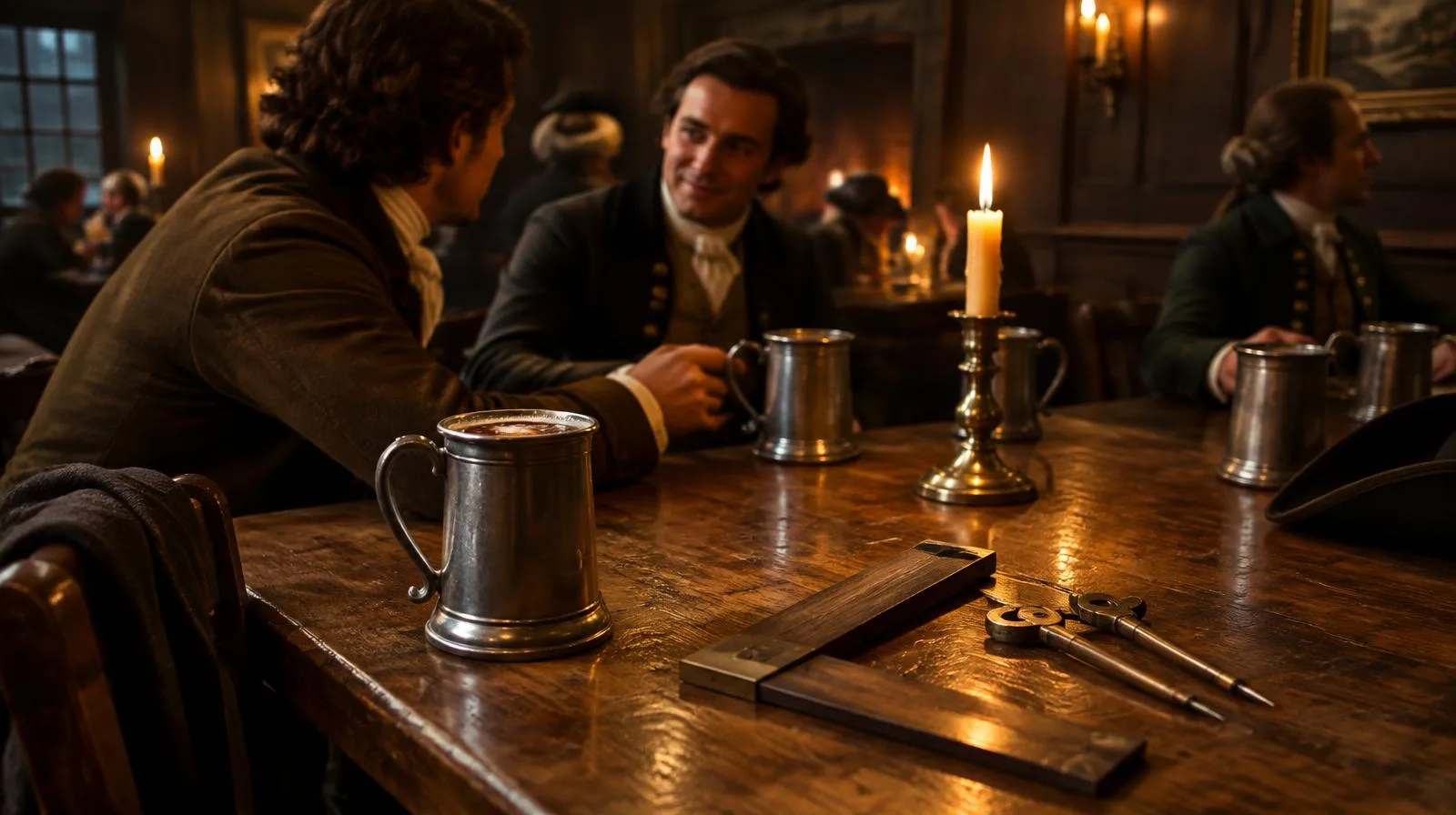
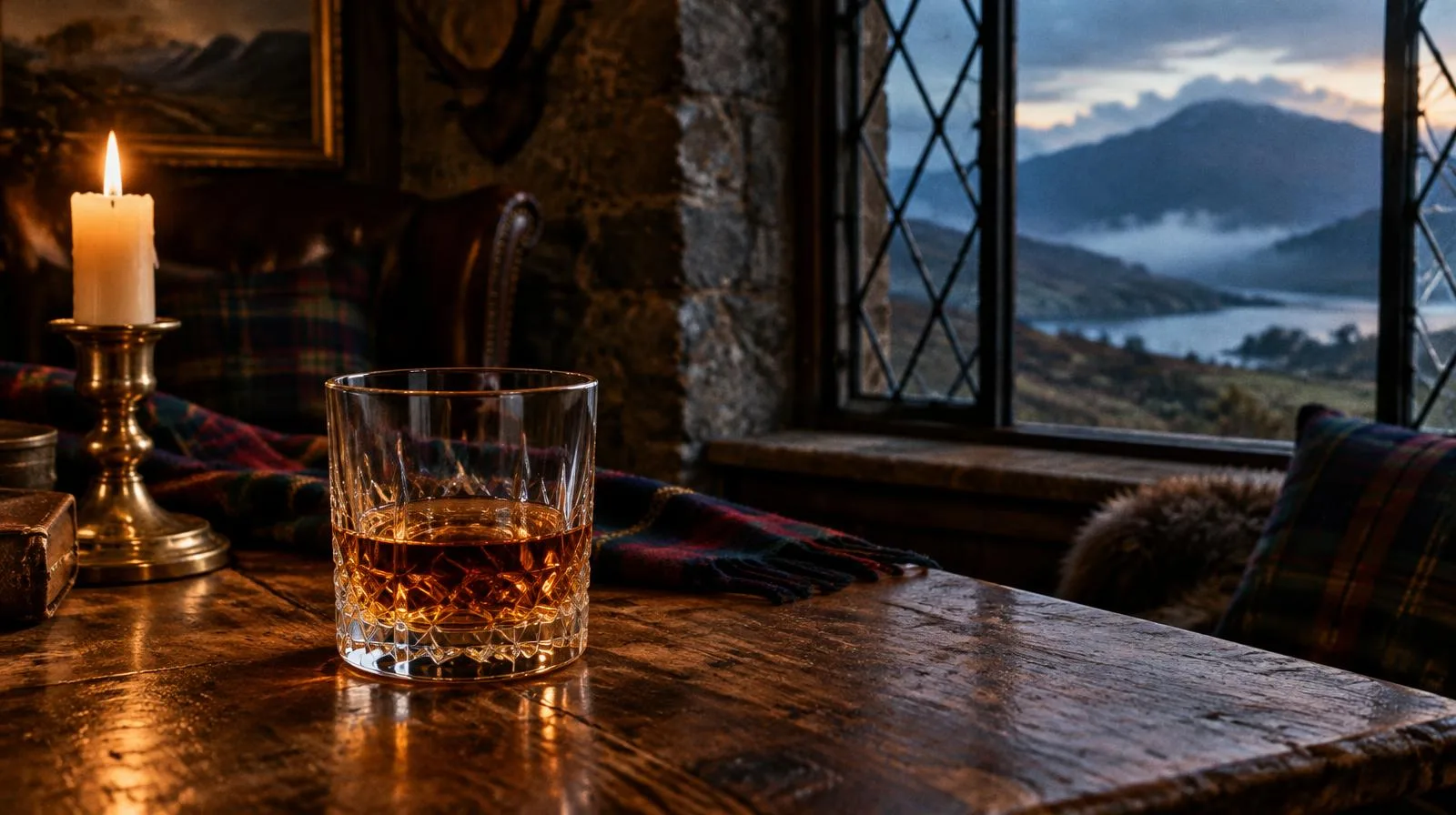
A small glass catches the light; someone opens a volume of Burns. It is an inviting picture of freemasonry and whisky, but the most interesting detail is not in the glass. Robert Burns was no honorary ornament to the Craft. The University of Glasgow describes him as a dedicated Freemason who served as Senior Warden of Lodge St Andrew, Dumfries, until his death in 1796.
That office gives the familiar toast a different weight. Behind the convivial image lies a history of responsibilities, friendships and literary patronage. Today, a Glasgow research project is examining those connections, while London’s Yorick Lodge offers a documented example of whisky appreciation shaping Masonic sociability. The journey between them is worth taking, provided we distinguish the surviving record from the stories we might like to tell over a dram.
Robert Burns: the Freemason behind the toast
Glasgow’s account places Burns’s Masonic connections in Ayrshire, Edinburgh and Dumfries. These were relationships extending across his adult life, not simply an affiliation added to his reputation afterwards. For the traveller, that changes the question from whether Burns belonged to the Craft to how it fitted into the society in which he lived and wrote.
The literary connection matters just as much. The university identifies Masonic influence in A Man’s a Man for a’ That, performed at the opening of the Scottish Parliament in 1999. Its researchers treat Freemasonry as a significant part of Burns’s intellectual and social world. That is not the same as claiming that the fraternity owns the poem’s meaning or supplies the only way to read it.
There is also a tangible survival. Glasgow identifies Burns’s original Masonic apron as displayed in the Grand Lodge of Scotland’s museum in Edinburgh. An object associated with his Masonic life offers a firmer starting point than imagining what he drank at an undocumented gathering.
For a companion journey, turn to our Robert Burns Masonic trail. Keep the poet, his writing and his relationships at the centre of your plans. A toast can be a pleasing act of remembrance, but it cannot replace an understanding of the man being remembered.
What is Glasgow’s Burns and Freemasonry project investigating?
In December 2024, the University of Glasgow’s Centre for Robert Burns Studies appointed Patrick Jamieson to a three-year PhD funded by the Grand Lodge of Scotland. The university describes the Scottish Masonic Scholarship as the first in-depth academic study of its kind, with unprecedented access to Grand Lodge archives. Those descriptions belong to the university’s announcement, rather than an independent assessment of all earlier Burns scholarship.
The important question is what Masonic relationships contributed to Burns’s writing, career and subsequent reputation. In the research announcement, Jamieson reported that early study of records concerning Burns’s patrons was beginning to corroborate previous theories about assistance from a Masonic network. That is a promising research direction, not a completed verdict on every relationship.
The planned doctorate includes scholarly outcomes, public presentations and exhibition curation. These offer possibilities for encountering the research beyond an academic publication, although the announcement should not be treated as a current exhibition calendar. Check the university’s latest information before planning a visit around an event.
Glasgow also highlights Freemasonry’s contribution to commemorating Burns through public memorials and Burns Suppers. Our article on Masonic festive boards and dining traditions offers a related subject to explore. Commemoration, hospitality and historical evidence can enrich one another, but a later custom does not automatically establish what happened during Burns’s lifetime.
The Grand Lodge single malt: association is not ancestry
The Grand Lodge of Scotland’s official description documents a contemporary association with single malt whisky. That is useful evidence of an institutional connection. It is not, by itself, evidence about the origins of Freemasonry, the beliefs of a distillery’s founders or the contents of an eighteenth-century lodge supper.
This distinction matters because several different questions can become muddled together. Did a particular person belong to a lodge? Did an institution associate itself with whisky? Did a lodge organise a tasting? Each requires its own evidence. A sound answer to one cannot silently become an answer to the others.
Nor should a modern association be projected backwards onto Burns. The sources discussed here establish his Masonic involvement and describe research into its significance. They do not provide a drinks list for a particular meeting he attended. Leaving that detail open is more honest than furnishing an attractive scene from imagination.
The same care is useful when exploring Freemasonry and beer. A shared drink may provide an occasion for fellowship without explaining the origins or meaning of everything around it. The interesting question is how people use a common enthusiasm to sustain conversation and companionship, not whether every refreshment conceals a symbolic pedigree.
Yorick Lodge: how London acquired a whisky lodge
Yorick Lodge No. 2771 offers a well-documented example of a shared interest reshaping lodge life. Metropolitan Grand Lodge records its consecration on 31 October 1899, with founders drawn principally from theatrical management and the legal profession. Its whisky identity came much later.
A committee formed in September 2022 to develop Yorick into a whisky special-interest lodge. In November 2023, members unanimously agreed that it would be known as the Metropolitan Whisky Lodge while retaining its historic name. The Metropolitan account, published in September 2024, reported that five existing brethren remained active members and held office.
That date matters: the report describes continuity at the time of the transition, not a permanently fixed list of officers. Its central story is nevertheless clear. An existing lodge was adapted rather than replaced by a new foundation, with a shared enthusiasm providing a fresh direction for its social life.
The published format places the buffet and themed tastings after the lodge meeting. Describing Yorick as a whisky lodge should therefore not suggest that a tasting constitutes its Masonic ceremony. Its venue is Freemasons’ Hall on Great Queen Street, also the subject of our Freemasons’ Hall London visitor’s guide.
Yorick’s meetings page lists the third Tuesday in March, September and November. Treat that as a planning lead, not an invitation or an immutable calendar. Confirm the date and the arrangements appropriate to your visit before committing to travel.
Were America’s famous whiskey distillers Freemasons?
For this article, we have not established a documented Masonic affiliation for Jack Daniel. That is a statement about the evidence available for this revision, not a finding that he was not a Freemason. It would be equally unwarranted to turn this limited review into a verdict on famous American distillers as a group.
The Tennessee Encyclopedia’s account of Jack Daniel Distillery is useful business history. We do not use it here as evidence of Daniel’s Masonic status. An account written to explain a business cannot be expected to settle every question about its founder’s associations.
What should a researcher seek instead? The Museum of Freemasonry identifies minute books as principal sources for lodge history, alongside records such as annual returns and correspondence. A named lodge, an identifiable entry and a clear connection to the right individual would provide a stronger basis than an unsourced list of famous Freemasons.
Jurisdiction also matters. The museum holds the archives of the United Grand Lodge of England and its predecessor bodies. Its individual membership records cover lodges in England and Wales and overseas areas where English Freemasons established lodges. They are not a universal register of everyone who has belonged to the Craft.
The museum explains that Freemasonry is organised through independent Grand Lodges, including separate state Grand Lodges in the United States. Research should follow the relevant jurisdiction. For an unresolved attribution, not established here is a more accurate conclusion than either confident acceptance or confident denial.
How to explore the whisky and Masonic connection today
Begin in Edinburgh with something you can encounter beyond the printed page. The Grand Lodge’s museum is at Freemasons’ Hall, 96 George Street. Glasgow’s announcement identifies Burns’s apron as displayed there, but ask whether it will be on view when arranging your visit. A published description is not a guarantee that a particular object will always be accessible.
The Grand Lodge says museum tours are open to anyone and free of charge. They do not run at weekends or on public holidays and depend on volunteer guides. Although drop-in visits are mentioned, advance booking is preferred to ensure a guide is available. Check before you go, particularly if the museum is the centrepiece of your day.
Consider that stop alongside our Masonic history tour of Scotland, leaving time to look closely rather than simply photograph the exterior. For another planning companion, see which Masonic halls you can visit. Always confirm the particular building’s current access arrangements directly.
For Yorick, ask the lodge secretary about the relevant date, visitor eligibility, dress and dining arrangements. Do not treat public access to a building as confirmation that you may attend a meeting inside it. If travelling under another constitution, seek advice from your own Masonic authorities before making arrangements; our international Masonic visitation guide is a useful companion topic.
If a tasting forms part of your plans, arrange transport that does not require driving afterwards, and ask about alcohol-free arrangements if needed. The worthwhile part of the journey should be the history and the company, not how much anyone drinks.
Frequently asked questions
Was Robert Burns really a Freemason?
Yes. The University of Glasgow identifies him as a dedicated Freemason throughout his adult life, serving as Senior Warden of Lodge St Andrew, Dumfries, until his death in 1796.
Does Scotland’s Grand Lodge have a whisky connection?
Yes. Its official single malt description documents a modern institutional association. That should not be confused with evidence about Burns’s drinking habits or the refreshments at a particular historical lodge meeting.
Where does London’s whisky lodge meet?
Yorick Lodge meets at Freemasons’ Hall, Great Queen Street. Its published schedule lists the third Tuesday in March, September and November. Confirm dates and visiting arrangements beforehand.
Can non-Masons visit the museum in Edinburgh?
Yes. The Grand Lodge says its museum tours are available to anyone. Booking is preferred, and tours depend on volunteer availability, so check current arrangements before travelling.
Sources
- University of Glasgow: Scottish Masonic PhD Scholarship
- University of Glasgow: Burns research, patronage and surviving apron
- Grand Lodge of Scotland: documented single malt association
- Metropolitan Grand Lodge: Yorick’s history and whisky identity
- Yorick Lodge: venue and published meeting schedule
- Tennessee Encyclopedia: Jack Daniel Distillery business history
- Museum of Freemasonry: researching lodge and chapter records
- Museum of Freemasonry: membership records and jurisdiction
- Grand Lodge of Scotland: museum access and booking guidance