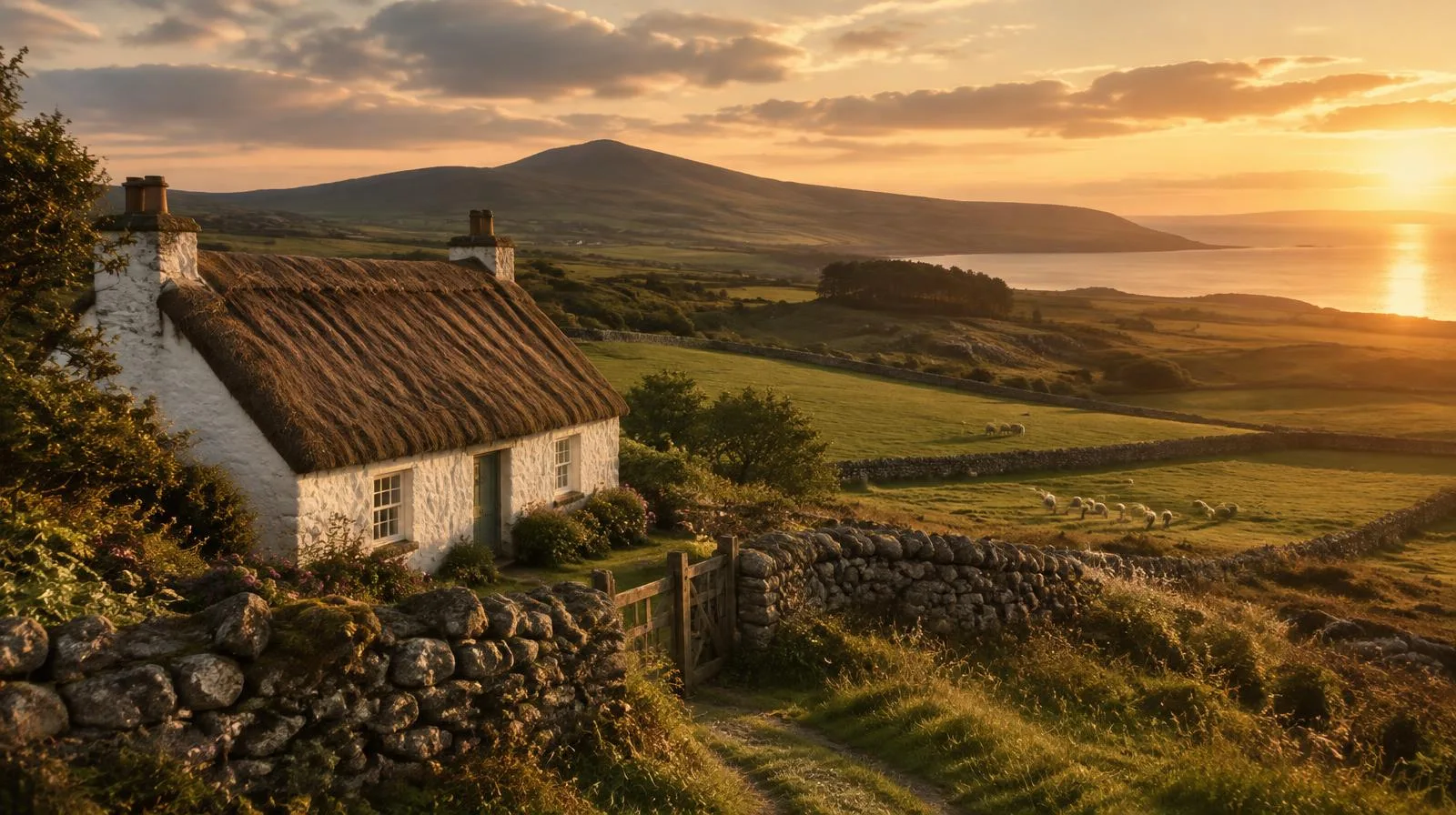
A red-shuttered, thatched house in Tarbolton offers a more intimate beginning than any grand monument. Here, the National Trust for Scotland tells us, Burns learned to dance, debated with friends and became a Mason. Follow the Robert Burns Freemason trail from this modest setting, and the familiar ceremonial portrait gives way to a young man seeking conversation and company beyond the farm.
Then follow him to Edinburgh, where a painting turns brotherhood into theatre, and finally to Dumfries, where he still held lodge office when he died. The painting’s historical claims have been debated on the floor of Grand Lodge itself. This is a journey worth taking precisely because the documented life is as compelling as the tradition.
Ayrshire: where did Robert Burns become a Freemason?
Burns was initiated into Lodge St David No. 174, Tarbolton, on 4 July 1781. He was passed to Fellowcraft and raised to Master Mason on 1 October that year. The Grand Lodge of Scotland records that Alexander Wood, a Tarbolton tailor, introduced him to the Craft. Burns was then living with his father at Lochlea farm.
Keep the lodge names separate. Burns entered St David, not St James, although his later service at St James became central to his Masonic reputation. St David’s account explains that the lodges were operating in union under its charter when Burns joined. After that union broke apart, Burns went with the brethren who re-established St James.
The institutional trail survives in two places. St David now meets in Mauchline as Lodge St David (Tarbolton) Mauchline No. 133. St James continues in Tarbolton as Lodge Tarbolton (Kilwinning) St James No. 135. Different numbers on modern signs do not mean you have found the wrong lodges.
For a physical starting point, choose the Bachelors’ Club on Sandgate Street. Its restored living space and upstairs meeting rooms bring Burns’s social world within reach. The debating society and Masonic lodge were separate institutions: the Trust’s essay by Dr Corey E Andrews describes Burns’s involvement with the Bachelors’ Club before his initiation into St David. Their shared association with this house should not blur that distinction.
Tarbolton St James: Burns as a working lodge officer
St James records Burns as its Depute Master from 1784 to 1788, following his election on 27 July 1784. This was not merely a famous name added to a roll. Grand Lodge explains that the Master’s role could be honorary, leaving Burns to carry out much of the practical work. It also notes surviving minutes in his handwriting and others bearing his signature.
Read his Farewell to the Brethren of St James’s Lodge, Tarbolton before visiting. The BBC dates the song to 1786, when Burns believed he would leave Scotland for Jamaica. Its affection is unmistakable: these were companions he expected to miss, not simply useful acquaintances.
The song brings together fellowship, moral aspiration and memories of presiding over the lodge. Our guide to Masonic dining and festive-board traditions offers a companion to that social setting. Read it alongside Freemasonry and beer, but keep Burns’s own words at the centre: his attachment reaches beyond an evening’s entertainment.
St James’s address is 67 Montgomerie Street. Its website offers a virtual museum and directs enquiries to the secretary. Ask what historical material can be seen rather than assuming every object is publicly displayed. For a wider Scottish itinerary, consider our guide to Kilwinning and Mary’s Chapel.
Edinburgh: Burns, Canongate Kilwinning and the disputed painting
In Edinburgh, Burns’s Masonic connections helped bring him into cultivated company. Grand Lodge’s account of a University of Glasgow research project describes archival work examining those networks and their role in his career. Friendship, introductions and patronage deserve careful study, not a mysterious explanation for every success.
One firm date anchors this stop. Lodge Canongate Kilwinning No. 2 recorded Burns’s admission as a member on 1 February 1787. Its account of the lodge identifies the Chapel of St John as its historic meeting room, still used today. Enquire about access before building a visit around the interior.
The famous image is Stewart Watson’s The Inauguration of Robert Burns as Poet Laureate of Lodge Canongate Kilwinning, 1st March 1787. Masonic writer Scott J. Watson places it in Freemasons’ Hall, Edinburgh, and dates it to 1846. It is a retrospective composition, painted decades after Burns’s death, not eyewitness documentation.
Scott J. Watson reports that the controversy reached the floor of the Grand Lodge of Scotland, which appointed a special subcommittee to investigate the laureateship claim. The question is therefore not a recent objection imposed on an unquestioned tradition. Masons themselves have argued over what the evidence can sustain.
Canongate Kilwinning’s defence of the tradition acknowledges the absence of an inauguration entry in the minutes for 1 March. It suggests an informal ceremony during Harmony, the social gathering, when minutes were not taken. That is a possible explanation, not documentary confirmation. Burns’s membership is recorded; the claimed inauguration remains disputed.
View the painting as evidence of how later generations celebrated Burns, rather than as a reliable attendance list. Grand Lodge also reports that his original Masonic apron is displayed in its museum. These offer different encounters with his memory, a personal object and a commemorative image. Their presence at Grand Lodge does not establish that they are displayed together.
Planning the Burns Masonic trail: what can you visit?
Use Ayrshire, Edinburgh and Dumfries as a biographical sequence, not a promise of the shortest driving route. Establish access first, then arrange transport and overnight stops. For a longer journey, consider the broader Masonic history tour of Scotland, leaving room to linger rather than filling every day with appointments.
- Alloway: add Burns Cottage and the Robert Burns Birthplace Museum for the poet beyond the lodge. The Trust’s visitor information describes the connecting Poet’s Path and public transport via Ayr. Check current opening arrangements.
- Tarbolton: check Bachelors’ Club separately from St James. The Trust’s published schedule includes a winter closure, so a Burns Night trip does not guarantee admission. Access to the upper room involves steps.
- Edinburgh: Freemasons’ Hall is at 96 George Street. Grand Lodge advertises free museum tours open to anyone, subject to volunteer-guide availability. Tours do not run at weekends or on public holidays. Although drop-in visits are offered, booking is preferred. Ask whether the Burns painting and apron will be available to view.
- Lodge visits: state whether you want to see a historic interior or attend a meeting. For related reading, turn to Masonic halls open to the public and international lodge-visiting protocol.
Check before you go, especially if an interior is the main reason for travelling. Explain what you hope to see and mention any access requirements. Treat a general welcome as an invitation to enquire, not confirmation that someone will be available when you arrive.
Dumfries: Burns’s final lodge and service until 1796
End the Masonic route in Dumfries. Burns joined Lodge St Andrew No. 179 on 27 December 1791 and was elected Senior Warden in 1792. Grand Lodge states that he remained Senior Warden until his death in 1796. This final office matters: Freemasonry was not simply an Ayrshire enthusiasm or a chapter in his Edinburgh celebrity.
There is an essential practical qualification. Grand Lodge identifies St Andrew as dormant. Do not plan the finish as though Burns’s lodge were an operating attraction with a public reception desk. Here the trail ends with an institution and its history, not a promised lodge-room visit.
For places to investigate today, DG Culture lists Robert Burns House on Burns Street and the Robert Burns Centre on Mill Road. Check their current arrangements. They provide a broader Burns context for this final stop, without needing to identify an unverified surviving room as his lodge room.
Before Burns Night: bring the words back to the table
The first Burns Supper took place at Burns Cottage in Alloway on 21 July 1801, the anniversary of his death. The National Trust for Scotland describes friends gathering under the leadership of the Reverend Hamilton Paul, reciting poetry and singing songs. The celebration subsequently settled on Burns’s birthday, 25 January.
That gathering should not automatically be labelled a lodge meeting. Burns belongs to a much wider public, even while Freemasonry forms an important part of his life and commemoration. Keep Freemasonry and whisky for further reading, but bring the Farewell on this journey. After Tarbolton, its imagined separation from friends feels less ceremonial and more human.
Frequently asked questions
Was Robert Burns really a Freemason?
Yes. His initiation into Lodge St David No. 174, Tarbolton, on 4 July 1781 is documented. He later held office at St James in Tarbolton and St Andrew in Dumfries.
Was Burns Poet Laureate of Canongate Kilwinning?
That is a disputed lodge tradition. His admission as a member on 1 February 1787 is recorded, but the claimed inauguration on 1 March is not recorded in that meeting’s minutes.
Can non-Masons follow the Burns Masonic trail?
Yes. Heritage properties provide public starting points, and Grand Lodge advertises museum tours open to anyone. Check current arrangements and enquire separately about other lodge interiors rather than assuming public access.
Which lodge did Burns belong to when he died?
Burns was Senior Warden of Lodge St Andrew, Dumfries, when he died in 1796. Grand Lodge describes that lodge as dormant today.
Sources
- Grand Lodge of Scotland: initiation and early lodge service
- Lodge St David: lodge identities and Burns chronology
- National Trust for Scotland: Burns, the Bachelors’ Club and Freemasonry
- Canongate Kilwinning: evidence and the laureateship tradition
- Scott J. Watson: the painting and Grand Lodge debate
- Grand Lodge of Scotland: research, apron and final office
- National Trust for Scotland: Bachelors’ Club visitor information
- Grand Lodge of Scotland: museum tours and booking advice
- National Trust for Scotland: the first Burns Supper