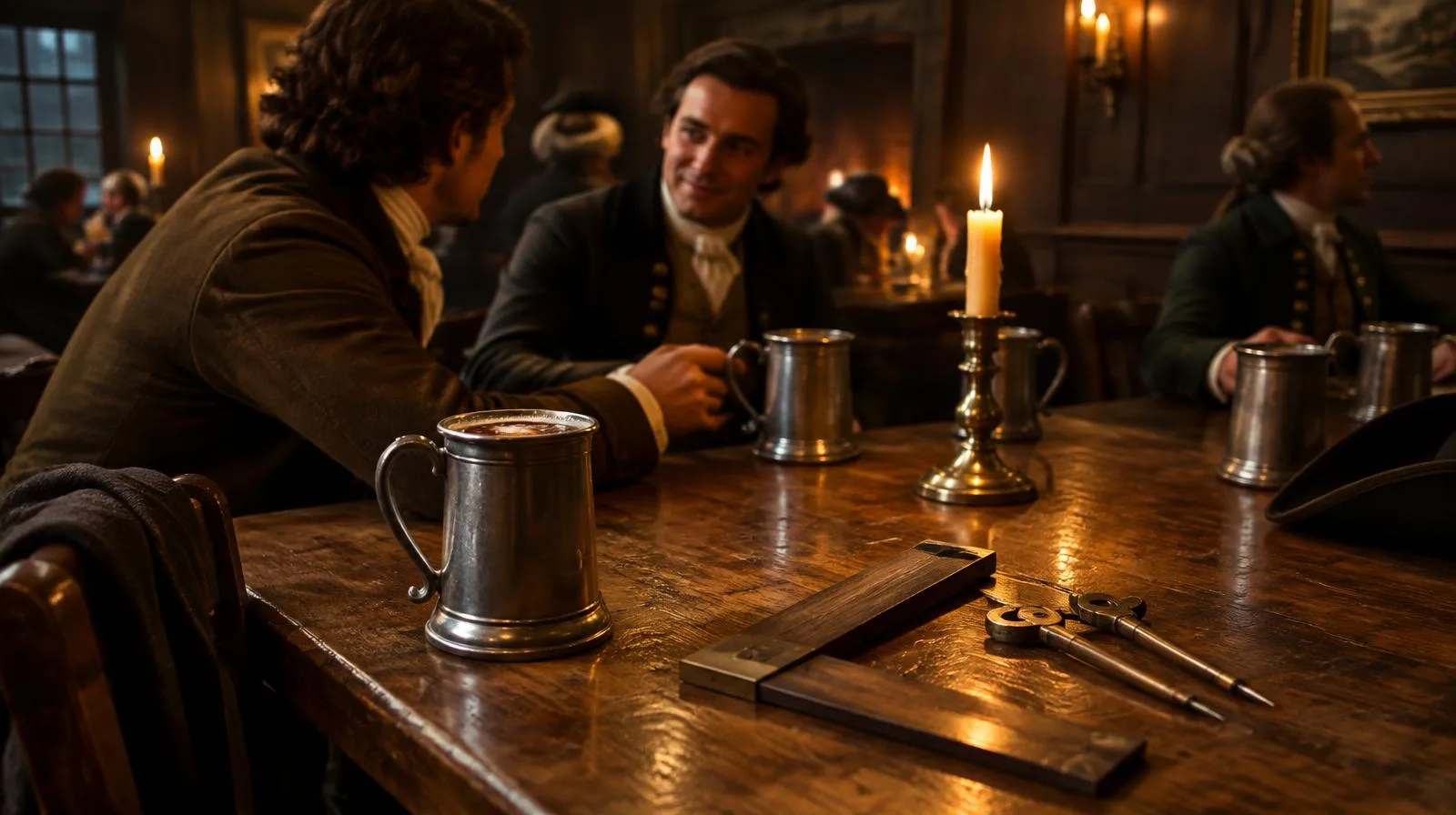
Forget the monumental entrance and the marble staircase. The familiar story of freemasonry and beer leads instead to an alehouse in St Paul’s Churchyard, where, according to the traditional account, four London lodges gathered for a feast and chose a Grand Master. The Goose and Gridiron is a wonderfully earthy address for an institution so often imagined through grand temples and solemn ceremony.
Yet this is not simply a story about brethren enjoying a drink. It involves fines for drunkenness, an officer charged with keeping pleasure from becoming excess, and a satirist who showed a Freemason in thoroughly undignified circumstances. First, though, a qualification: the Craft existed before 1717. The alehouse story describes the traditional foundation of its first Grand Lodge, not Freemasonry’s first breath.
Which four taverns appear in Grand Lodge’s founding story?
According to the United Grand Lodge of England’s accepted account, the gathering took place on St John’s Day, 24 June 1717. Four existing lodges came together at the Goose and Gridiron and elected Anthony Sayer as Grand Master. This is the conventional starting point for the Premier Grand Lodge, one of the bodies that eventually united to form today’s UGLE.
The lodges were identified by their meeting places. In James Anderson’s later account, their addresses form a small map of convivial London:
- The Goose and Gridiron Ale-house, St Paul’s Churchyard. The venue for the traditional founding assembly and feast, and the meeting place of one participating lodge.
- The Crown Ale-house, Parker’s Lane near Drury Lane. Another of the four, placing an alehouse firmly within the institutional story.
- The Apple-Tree Tavern, Charles Street, Covent Garden. Anderson’s account places the preliminary gathering here in 1716.
- The Rummer and Grapes Tavern, Channel Row, Westminster. The fourth house in Anderson’s list, extending the story beyond the neighbourhood of St Paul’s.
These names matter because the lodges already existed. A tavern did not conjure Freemasonry into being. Rather, the traditional narrative describes established groups organising together, with an annual assembly and feast integral to their plans. Sociability was not an embarrassing footnote to the proceedings.
There is a documentary catch. Anderson published his connected account in 1738, more than twenty years afterwards; Grand Lodge’s surviving minute record begins in 1723. Historians Andrew Prescott and Susan Mitchell Sommers argue that the evidence instead points towards a foundation in 1721. John Hamill’s response defends the traditional account. The honest formulation is that 1717 remains UGLE’s accepted foundation date, while its documentary basis is debated.
Nor should this London anniversary swallow the wider history. Our guide to Kilwinning and Mary’s Chapel offers a companion perspective on tradition and early lodge records. For another strand of reading, turn to chocolate, coffee and the clubs of early Freemasonry, without assuming that every convivial institution shared the same origins.
Refreshment, intemperance and the lodge’s drinking fines
A drinking story needs more than a picturesque pub sign. It needs the moment when somebody says that enough is enough. In the Masonic material considered here, that boundary runs between refreshment and intemperance.
The Junior Warden’s responsibility expresses the distinction particularly clearly. An installation charge reproduced by Wasatch Lodge tells him to be temperate himself and to ensure that the Craft does not convert refreshment into “intemperance and excess”. This is not a prohibition on enjoyment. It is a demand that enjoyment remain governed by judgement.
Wasatch’s discussion also emphasises that refreshment means more than drink: rest, nourishment and spiritual renewal belong within the idea. Read this alongside the festive board and table lodge, where the communal meal takes centre stage. Equally, Freemasonry and coffee is a useful companion subject. Fellowship should never be reduced to the contents of a glass.
The eighteenth-century record gives the moral language teeth. In Freemasonry and Social England in the Eighteenth Century, Gilbert W. Daynes reproduces a 1742 by-law of the Lodge of Felicity, No. 58. A member judged by a majority during lodge hours to be “Disguised in Liquor” was to pay two shillings for the lodge’s use.
Daynes reports that early lodge by-laws imposed drinking penalties, that persistent breaches could lead to permanent exclusion, and that lodge minutes confirm penalties were inflicted. The distinction matters: the Felicity passage is a rule, not a named offender’s conviction. It cannot support an invented anecdote about a particular brother being marched out.
The charges quoted by Daynes also warned against neglecting families or becoming unable to work through drunkenness. These were practical concerns, not merely ceremonial language. Fines did not prove that everyone behaved well; they showed that good behaviour could not simply be assumed.
Hogarth’s Night: an unflattering view of Masonic drinking
William Hogarth supplied a much less reassuring picture. In Night, part of The Four Times of Day, a Freemason is assisted through a chaotic street scene near Charing Cross. A chamber pot is emptied from above; a coach has overturned; a bonfire adds to the disorder. This is refreshment without much evidence of restoration.
The Royal Academy dates the paintings behind the series to 1736 to 1737 and the publication of the prints to 1738. Painting and print should not be confused: the familiar printed satire belongs to 1738.
The British Museum’s description of a copy after Hogarth identifies the drunken Freemason as probably Sir Thomas De Veil, a magistrate. “Probably” deserves to stay. This is a satirical image with interpretative questions, not a securely captioned record of an identified man leaving a documented lodge meeting.
Nor does it establish what he drank or prove that drunkenness defined the Craft. Its force lies in the gap between moral standing and visible conduct. Beside the Junior Warden’s charge and the lodge fines, Hogarth offers an uncomfortable counterpoint: ideals are easier to proclaim than to carry safely home.
John Molson: a brewer with a Masonic connection
Famous brewers make tempting additions to Masonic history, but an impressive surname is not evidence of initiation. John Molson offers a specific example rather than a speculative roll-call of brewing dynasties.
The Dictionary of Canadian Biography records his arrival in Montreal in 1782 and involvement in Thomas Loid’s brewing enterprise. After acquiring the brewery, Molson returned from England in 1786 and took charge of its management, enlarging the operation and buying grain for malting and brewing.
The biographical summary on Wikipedia records his service as provincial grand master at Montreal from 1826 to 1833. That identifies a brewer who also held senior Masonic office, rather than someone whose business merely stood near a lodge.
The overlap is worth noting without turning it into a theory of commercial success. A brewing career and a Masonic appointment do not, by themselves, show that one caused the other. Nor does a famous brewer’s involvement establish what was served at any particular lodge dinner.
Following the tavern story in London today
Begin around St Paul’s Churchyard to understand the setting of the traditional Goose and Gridiron gathering. Treat the outing as historical geography, not a promise of an authenticated surviving tavern interior. If you also intend to enter the cathedral, consult its visitor information: sightseeing and worship have different arrangements, and details can change.
Keep the London Masonic pub crawl alongside your planning, but distinguish historic addresses from modern businesses with familiar names. A satisfying walk need not pretend that every doorway has remained unchanged since Anderson’s day.
A practical anchor is Freemasons’ Hall on Great Queen Street. UGLE advertises guided visits to the museum and ceremonial areas, together with a Masonic walking tour. Check before you go: this is a working building, and particular rooms can become unavailable even after a booking.
For documentary exploration, the Museum of Freemasonry’s research resources provide routes into lodge records, periodicals and early minute-book publications. Pair that research with further reading on Masonic libraries and museums. Walking the city supplies a sense of place; reading its records helps separate that feeling from what can actually be demonstrated.
Horus Lodge: when beer enthusiasts helped sustain a lodge
The modern ending turns the old story around. Instead of lodges gathering in drinking houses, an interest in beer helped bring renewed life to an existing lodge.
In UGLE’s account of the Masonic Craft Beer Society, its founders describe conversations during the first lockdown developing into online gatherings and later events in person. They were subsequently introduced to Horus Lodge No. 3155, which faced difficulties continuing after COVID.
Horus’s own history states that the society took custody of its warrant in May 2022. This was an existing lodge, warranted in 1906, not a wholly new foundation. The distinction gives the episode its interest: a shared enthusiasm became a means of preserving institutional continuity.
There is no need to make beer either the Craft’s secret ingredient or its guilty pleasure. The historical thread is fellowship under discipline. An alehouse could provide a meeting place; a feast could help bind lodges together; a shared interest could help sustain one. The warning against excess remains the necessary companion to all three.
Frequently asked questions
Was Freemasonry founded in a pub?
Not Freemasonry itself, which predates 1717. The traditional account places the foundation of the first Grand Lodge at the Goose and Gridiron Ale-house on 24 June 1717. Historians debate that account’s documentary basis.
Did early lodges fine members for drunkenness?
Yes. Daynes’s study reports penalties recorded in lodge minutes. It also reproduces the Lodge of Felicity’s 1742 rule imposing a two-shilling fine on members judged drunk during lodge hours.
Does Masonic refreshment mean drinking beer?
No. Refreshment encompasses more than alcohol, including rest and nourishment. The Junior Warden’s charge discussed here emphasises temperance and preventing excess, rather than requiring anyone to drink.
What is Horus Lodge’s connection with beer?
Horus Lodge No. 3155 describes itself as the official lodge of the Masonic Craft Beer Society. Its history records the society taking custody of its warrant in May 2022.
Sources
- United Grand Lodge of England: the accepted foundation chronology
- Masonic Sourcebook: Anderson’s account and the four taverns
- University of Glasgow: Prescott and Sommers on the disputed foundation
- Wasatch Lodge: the Junior Warden and refreshment
- Manchester Association for Masonic Research: Daynes on drinking penalties
- Royal Academy of Arts: Hogarth’s Night and its publication history
- Wikipedia: John Molson’s provincial grand mastership
- United Grand Lodge of England: tours and access caveats
- Horus Lodge No. 3155: lodge history and the May 2022 transition