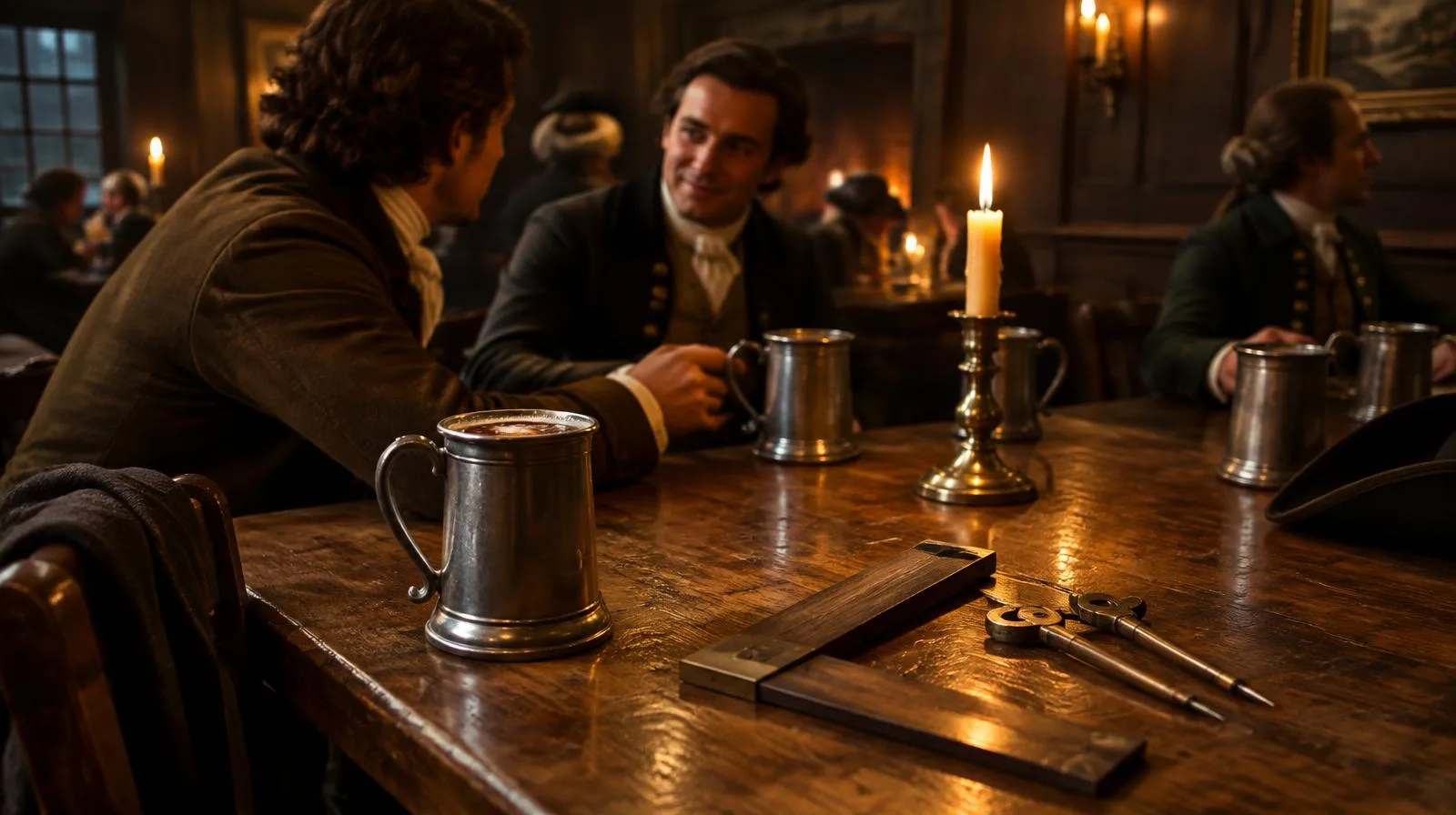
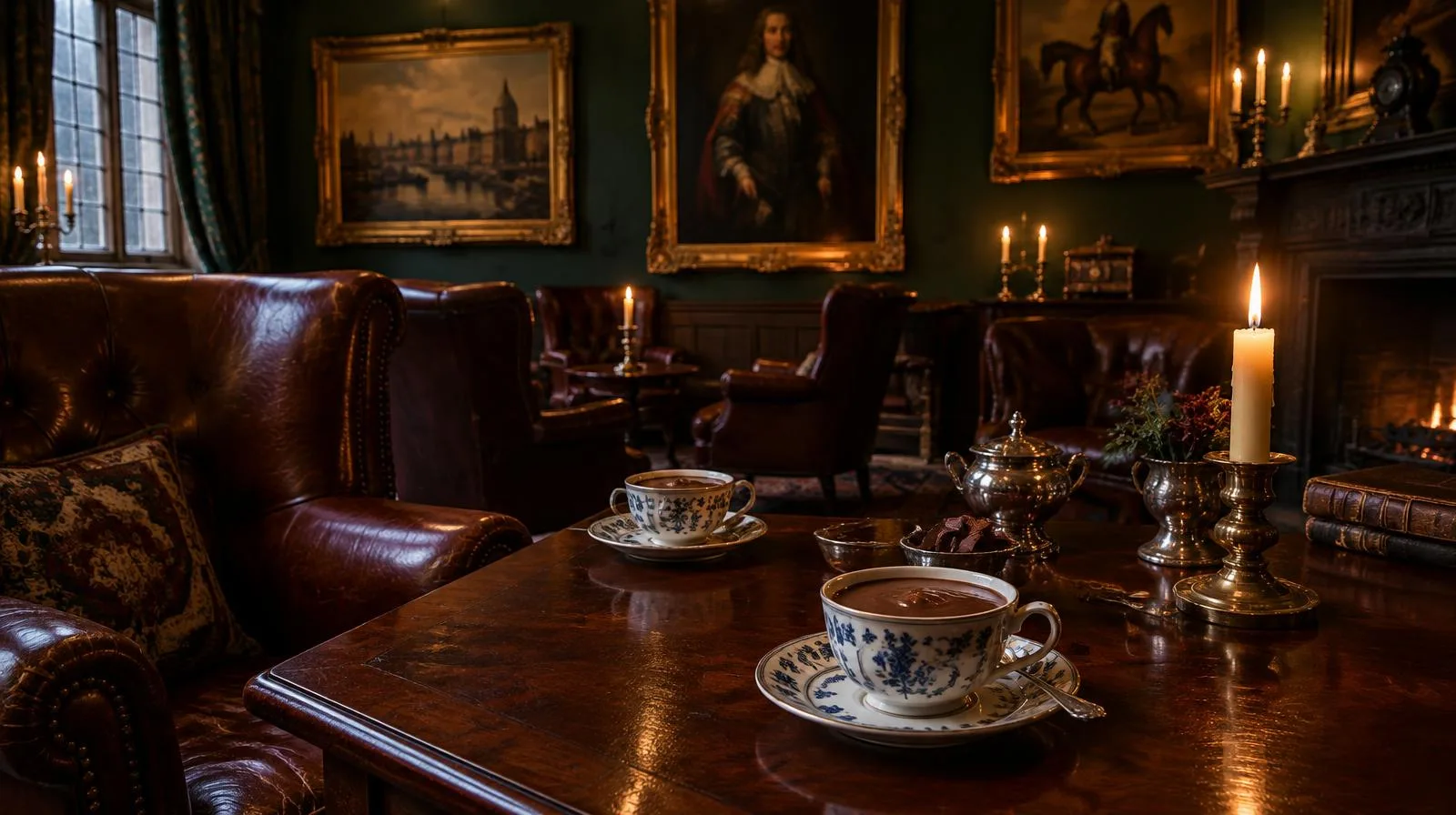
Picture a room where the drink brings you through the door, but the company keeps you there. Conversation gathers around tables; familiar faces return; someone wants a room reserved for their own circle. To explore chocolate houses and freemasonry is to ask how refreshment, conversation and belonging became intertwined, and where an inviting historical comparison stops short of proof.
White’s began as a chocolate house in 1693. Its transformation into a club offers a compelling window into London’s associational life. But was a chocolate house a nursery for the lodge, or simply another expression of a sociable age? The answer requires more than an atmospheric room and a famous name. It takes us from St James’s Street to disputed foundation stories, and even to Milton Hershey.
How White’s Chocolate House became a gentlemen’s club
Historic England identifies Francis White as the founder of White’s chocolate house in 1693. The Grub Street Project’s compilation of historical sources, including the Survey of London, places the original establishment on the east side of St James’s Street, on or close to the site of the present Boodle’s clubhouse.
The address deserves care. Summaries disagree over White’s earliest premises and subsequent moves. The ratebooks quoted by the Survey of London place Francis White on the east side in 1693 and across the street by 1698; the ratebooks for 1697 are missing. For a traveller, the essential distinction is between the original chocolate house and the later clubhouse, rather than a neat story behind one surviving door.
Historian Antonia Taddei explains that White’s began reserving rooms for its more fashionable customers around the turn of the century. Its popularity had attracted people with whom aristocratic patrons did not necessarily want to mix, particularly when gambling. Her account places White’s alongside other establishments that developed from coffee houses into clubhouses.
Taddei thus offers a commercial and social explanation for the transition. A useful way to read it is as a change from purchasing refreshment to controlling one’s company. That is an interpretation of the evidence, not a finding about whether particular Freemasons participated. We need not settle that separate question to appreciate the importance of the reserved room.
What happened inside London’s coffee houses?
Coffee houses supplied more than coffee. London Museum describes them as places for conversation, socialising and business, serving food and other drinks, including alcohol. Its record of Thomas Rowlandson’s coffee-house watercolour identifies bottles, glasses and a waiter struggling with a wine bottle. The picture dates from around 1800 to 1820, so it should not be mistaken for an eyewitness view of early Grand Lodge society.
An earlier material trace offers a smokier perspective. A pipe excavated from the site of Tom’s Coffee House accompanies London Museum’s discussion of business, news, gossip and company amid tobacco smoke. The museum also connects the tobacco trade to enslaved African labour in Britain’s American colonies. Comfortable sociability had an uncomfortable material foundation.
These records discourage an overly tidy contrast between the sober coffee room and the convivial tavern. They also suggest a better question than which drink inspired fellowship: what activities did these establishments accommodate? Read alongside coffee and Freemasonry and Freemasonry and beer, the chocolate-house story becomes part of a broader enquiry into meeting places, rather than a competition between beverages.
Did chocolate houses help create speculative Freemasonry?
The strongest evidence here concerns coffee-house club culture, not chocolate houses specifically. In an essay published by the Bibliothèque nationale de France, Pierre Noël argues that the system of Masonic degrees, though inspired by craft organisation, owes much to clubs and English sociability. He describes clubs emerging from coffee houses where gentlemen drank, smoked, read newspapers and discussed politics.
Set beside Taddei’s account, this invites a comparison: hospitality could provide a setting in which a group developed a distinct identity. But that comparison is our synthesis, not documentary proof that White’s generated a lodge. The sources presented here do not establish such a descent, nor do they amount to a comprehensive investigation ruling out every possible connection.
Chronology provides another reason for caution. The United Grand Lodge of England records Elias Ashmole’s initiation at Warrington in 1646 and further evidence of gentlemen becoming Freemasons from the 1660s. White’s opened in 1693. Taken together, those dates make a White’s-centred origin story untenable, although they do not explain how every aspect of later Freemasonry developed.
UGLE itself describes Masonic origins as uncertain and identifies the influence of medieval stonemasons’ legends, imagery and customs. For an architectural companion to this discussion, consider stonemasons’ marks in European cathedrals. The historical questions surrounding craft organisation deserve attention alongside those surrounding fashionable sociability.
The title’s claim should therefore be read as an interpretative lens, not a literal foundation statement: club culture helps us examine the social environment of organised Masonry. It does not supply a complete explanation of ritual or origins. Likewise, Masonic festive boards and dining traditions offer a related subject to explore, not a shortcut to proving institutional ancestry.
The tavern foundation story, and its historical limits
UGLE retains the traditional account of the first Grand Lodge’s formation at the Goose and Gridiron in St Paul’s Churchyard on 24 June 1717. In that account, four existing London lodges assembled and elected Anthony Sayer as Grand Master. The named setting is a tavern, not White’s Chocolate House.
The tradition is influential, but its evidential foundation is disputed. Andrew Prescott and Susan Mitchell Sommers, in their reassessment of the earliest Grand Lodge, challenge the reliability of James Anderson’s account, published in 1738. They argue that diary entries and a rough minute book point instead towards establishment in 1721. This is a scholarly argument, not an uncontested replacement date.
By 1723, UGLE records the publication of the first Constitutions, quarterly meetings and the recording of proceedings. These are firmer points from which to discuss written rules and durable organisation. Comparing them with club development can be illuminating, provided resemblance is not treated as evidence that the institutions developed through an identical process.
For the traveller, distinguish the event being commemorated, the evidence for it and the survival of its setting. Approach the London Masonic pub crawl with those questions in mind. A memorable address can orient a historical walk without resolving the arguments attached to it.
Was Milton Hershey a Freemason?
The supplied archival extracts do not confirm Milton Hershey’s Masonic membership. They provide neither a lodge identification nor an initiation record for him. That is a statement about these extracts, not the result of an exhaustive search of lodge registers or the entire Hershey archive, and it should not be turned into a claim of non-membership.
There is a documented club connection. Hershey Community Archives describes his social relationship with architect C. Emlen Urban through the Hamilton Club in Lancaster, Pennsylvania. It identifies the Hamilton as a private men’s club and explains that Hershey nurtured relationships there that became valuable when planning his chocolate factory and surrounding community.
That passage supports an account of social connections. It does not identify those encounters as Masonic initiation. The responsible editorial choice is therefore to leave Hershey’s Masonic affiliation unresolved here, rather than award him an unsupported Masonic biography. His documented relationship with Urban is interesting in its own right.
Visiting White’s and tracing London’s club culture today
Start outside White’s at 37 and 38 St James’s Street. Historic England lists the clubhouse at Grade I, and its photographic archive dates the building to 1787 to 1788. You are looking at a later architectural expression of the institution, not the chocolate house Francis White opened in 1693.
Plan an exterior stop, not a walk-in visit. White’s is a private club; CAMRA’s venue listing flags restricted club access. Do not assume that historic designation confers public admission. If a visit has been privately arranged, check before you go. For an interior glimpse without crossing a private threshold, the Survey of London’s photographs show the morning-room and staircase.
Look beyond the principal frontage. The Survey of London explains that the street’s seventeenth-century development no longer survives, but traces of its layout remain in courts including Blue Ball Yard and Pickering Place. Reading street patterns as well as buildings makes a richer walk: historical continuity need not mean original brickwork.
For a complementary destination, turn to Freemasons’ Hall in London, checking current visitor arrangements before setting out. Continue the documentary enquiry through Masonic libraries and museums. Clubland offers an evocative setting; records allow us to ask more exact questions about the societies that gathered within it.
Frequently asked questions
Was White’s Chocolate House a Masonic lodge?
The sources used here do not identify White’s as a Masonic lodge. That limited finding should not be expanded into a categorical assertion that no lodge ever met there.
Did Freemasonry begin in a chocolate house?
The evidence presented does not support that claim. UGLE records Ashmole’s initiation in 1646, while its traditional Grand Lodge foundation account names the Goose and Gridiron tavern in 1717.
Can you visit the original White’s Chocolate House?
The present clubhouse is not the original chocolate house. Plan to view the later building from the street, and do not assume public access to its private interior.
Is Milton Hershey’s Masonic membership documented?
Not in the supplied archival extracts. They document his Hamilton Club connections but leave the separate question of Masonic affiliation unresolved.
Sources
- Historic England: White’s foundation and later clubhouse
- Grub Street Project: White’s original location and early moves
- University of Oxford: Antonia Taddei on London clubs
- London Museum: coffee-house conversation and refreshments
- Bibliothèque nationale de France: Masonic degrees and club culture
- United Grand Lodge of England: speculative Masonry and Grand Lodge history
- University of Glasgow repository: reassessing the traditional 1717 foundation
- Hershey Community Archives: Hershey, Urban and the Hamilton Club
- British History Online: St James’s Street and its surviving layout