Before Florence becomes another sequence of photographs, give it a different question: what could it cost to join a lodge here? The Tommaso Crudeli Freemasonry trail leads to a poet who taught Italian to English visitors, delighted in sharp conversation and found himself in the custody of the Inquisition. Behind the beautiful setting lies a struggle over friendship, religious authority and the freedom to think differently.
Spend your first day in Florence, where Crudeli joined the Craft, and your second in Poppi, his birthplace and a place of confinement after prison. Approach this as a journey through the settings of his life, rather than a promised succession of lodge rooms and prison cells. The distinction matters: the documented persecution is compelling enough without turning every doorway into a relic.
Who was Tommaso Crudeli, and which lodge did he join?
Treccani’s scholarly biography places Crudeli’s birth in Poppi, in the Casentino, in 1703. It records studies in Florence and a law degree at Pisa in 1722, although he did not practise as a lawyer. Following a period as a tutor in Venice, he settled in Florence and taught Italian to foreigners, principally English visitors.
He was neither merely a victim nor simply a name in a lodge history. His poetry, wit and criticism of clerical hypocrisy made him a distinctive figure in Florence’s intellectual society. Treccani describes his friendships with influential English residents, including Charles Fane and Horace Mann, and his preference for their company over the opportunities of a court appointment.
In 1735 he joined the Florentine lodge established by Englishmen and served for a time as its secretary. Nicholas Hans’s historical study identifies it as Italy’s first lodge. Its foundation date requires care: Treccani places its beginnings between 1731 and 1732, while Hans cites Antonio Cocchi’s diary entry recording his admission on 4 August 1732. The lodge was therefore operating by that date.
Cocchi also recorded staying for dinner. That small detail restores the human scale of early lodge life: an admission followed by a meal, rather than a ceremony floating free of ordinary companionship. Read it alongside Freemasonry and beer and the festive board and Masonic dining, while resisting the temptation to reconstruct the menu or conversation.
Clement XII’s 1738 bull and Crudeli’s arrest
On 28 April 1738, Clement XII issued In eminenti apostolatus specula, condemning Masonic associations. Its text, reproduced within the later papal document Providas Romanorum, objects to assemblies bringing together men of different religions, their binding oaths and their secrecy. Joining or supporting these associations attracted the penalty of excommunication.
The Florentine struggle was already under way. Treccani’s biography of the inquisitor Paolo Ambrogio Ambrogi describes his investigations of the lodge and his efforts to obtain secular assistance against it. Grand Duke Gian Gastone refused that assistance. After the change of dynasty, conflict between ecclesiastical and governmental authority continued rather than resolving into a straightforward alliance.
Crudeli was arrested on 9 May 1739. Ambrogi’s biography describes accusations that were partly false, personal hostility towards the poet and an attempt to use his prosecution to restore the Inquisition’s diminished authority in Tuscany. The same account records prolonged imprisonment while Crudeli was in gravely poor health.
This was more than an abstract disagreement about ritual. A particular man became vulnerable within a contest over jurisdiction, influence and belief. For companion reading on another social setting, turn to Freemasonry and coffee. Here, however, keep fellowship and prosecution distinct: an inquisitor’s allegations should not become the traveller’s unquestioned description of what lodge members actually did.
Why is Crudeli called the first martyr of Freemasonry?
The designation belongs to Masonic remembrance. The Grand Lodge of British Columbia and Yukon’s biographical page explicitly remembers Crudeli as the first martyr of Universal Freemasonry and attributes the ruin of his health to imprisonment. Read that as a commemorative interpretation of his suffering, not as a precise description of a judicial sentence.
The chronology deserves particular care. Treccani’s concise entry dates his release from prison to 1740, with an obligation to remain confined in Poppi. The British Columbia and Yukon page gives April 1741 and contains inconsistent dates for his death. Rather than flatten these accounts into a single date, it helps to distinguish prison, confinement and pardon.
Daniele Santarelli’s biography in Ereticopedia supplies that fuller sequence. It records a transfer in June 1740 from the Holy Office’s prisons to the government-run Fortezza da Basso. A sentence followed on 20 August 1740 for reading prohibited books and blasphemy, with confinement to Poppi and subsequently Pontedera. A pardon followed in April 1741.
Crucially, Ereticopedia says that Crudeli spent his final years mainly in Florence before dying at Poppi in 1745. Poppi should therefore not be presented as the setting of an uninterrupted final imprisonment. Nor should the title of martyr substitute for this sequence of detention, restriction, pardon and later death.
His writing also had an afterlife. Treccani records the posthumous publication of his Poesie in 1746, their prohibition by the Inquisition and their reprinting in 1767. The collection included his translations of La Fontaine’s fables. Remembering those poems prevents the story of persecution from swallowing the poet.
Day one: finding Crudeli’s Florence today
Begin with Via Maggio. A 2012 announcement for Florence’s Museum of Masonic Symbols associates this street with the early English lodge, describing its meeting place as a tavern and hotel. Treat that attribution as a historical lead for a walk, not as authentication of a particular room in which Crudeli was initiated.
Pause with the lodge’s chronology in mind: established by Englishmen, operating by 1732, joined by Crudeli in 1735. His work as a language teacher and his English friendships offer a documented way into this history. They are more useful than imagining hidden signs in every piece of masonry.
For further reading, keep lesser-known Masonic sites on your list. On this walk, the important discipline is to separate a street associated with a historical gathering from a building whose identity and surviving fabric have been established.
The museum announcement gives an address at Via dell’Orto, 7, and describes Masonic objects and reconstructed ceremonial spaces. Before including it in your day, confirm whether the museum is operating, whether that address remains valid and whether an appointment is necessary. Treat the announcement as a record of what was advertised in 2012, not as today’s visitor information.
If access cannot be confirmed, retain the street walk and your other Florence plans. There is no need to manufacture a substitute shrine. For a wider architectural itinerary, consider which Masonic halls you can visit, checking each proposed stop directly before committing your time.
Day two: Poppi and the meaning of confinement
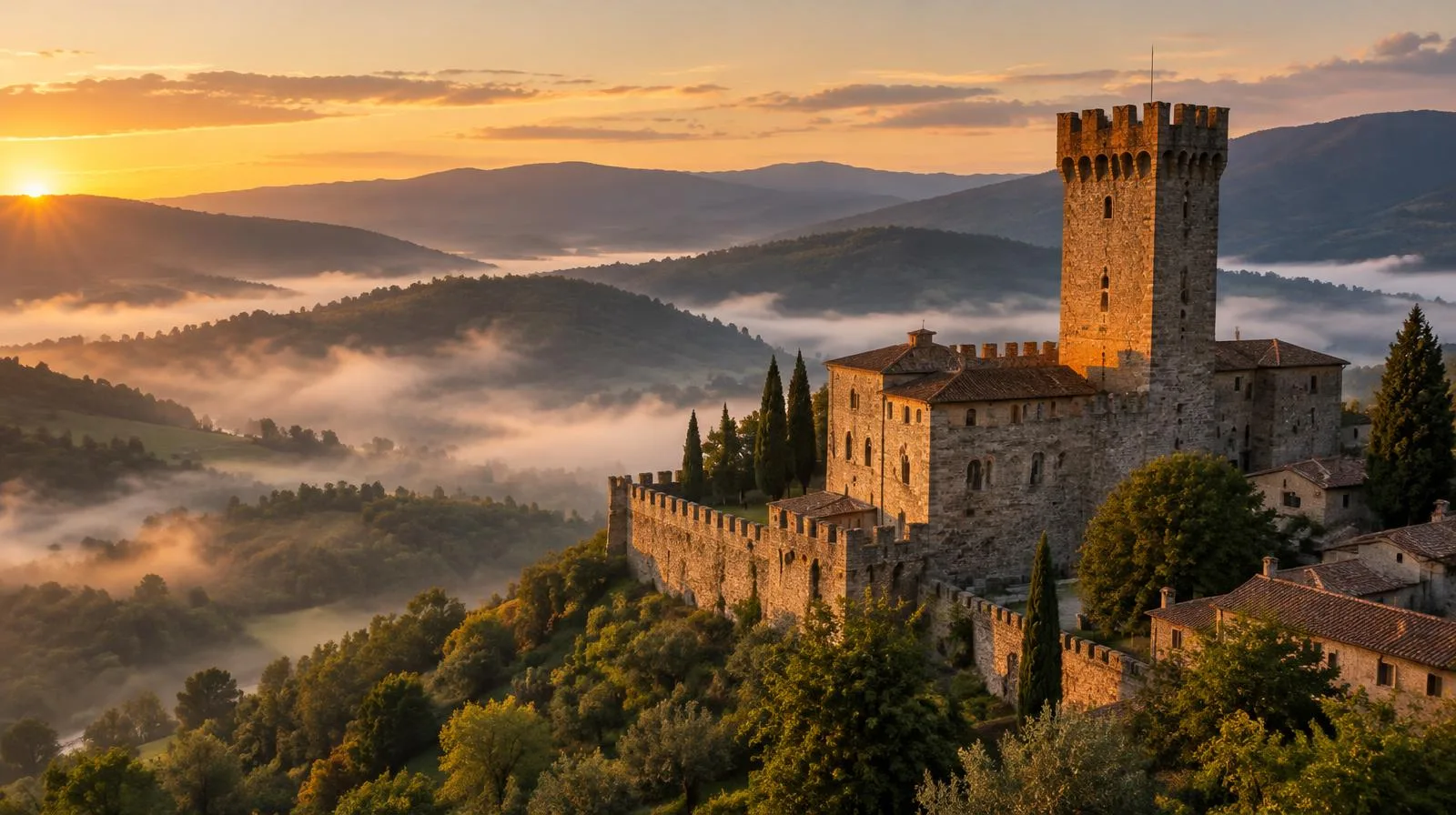
Use the second day for Poppi in the Casentino. Here the journey turns towards the town where Crudeli was born, experienced confinement and eventually died. Those connections justify the visit, but remember the intervening movements described by Ereticopedia. His biography does not fit neatly into a permanent retreat from Florence to his birthplace.
Allow time for the town’s wider history rather than making every stop carry a personal association. The Ecomuseo del Casentino identifies an exhibition and information space at Poppi’s castle and lists exhibitions held there. This makes the castle a useful cultural enquiry point, subject to current access arrangements.
Ask what is presently on display and whether any documented material concerning Crudeli can be consulted. Do not build the day around an assumed permanent exhibition about him. If someone suggests a house, room or commemorative object, ask what establishes its connection and whether access is permitted. An attribution and an original document answer different questions.
Bring a short biography to read here. Teaching, poetry, friendship and restricted liberty deserve space alongside the arrest. If that reading prompts a more substantial investigation, make Masonic libraries and museums part of your onward planning, rather than expecting a street walk to settle every archival question.
Planning the two-day Florence and Poppi trail
Keep the itinerary flexible around confirmed access and transport. Florence provides the first day’s historical setting; give Poppi a separate day rather than squeezing it between unrelated bookings. This is a suggested pace, not a timed route or a claim that every specialist interior will be available.
- Before departure: check transport connections, the return journey and the distance from your arrival point to each stop. If driving, confirm parking and local access restrictions.
- For Florence: verify specialist museum arrangements directly. Ask whether advertised ceremonial rooms are reconstructions or historic interiors, and distinguish them in your notes.
- For Poppi: check castle access, current exhibitions and any research appointment before you go. Ask about steps and accessible routes where needed.
- For lodge visits: make separate arrangements rather than assuming a meeting forms part of this historical walk. Start with our travel-planning guide for Freemasons.
Carry the chronology, but leave room for the man. Florence supplies the setting of his friendships and intellectual life; Poppi brings birthplace, confinement and death into view. Neither needs an invented relic to make the journey worthwhile.
Frequently asked questions
Was Tommaso Crudeli executed for being a Freemason?
The documented sequence is imprisonment, confinement, a pardon in 1741 and death at Poppi in 1745. His designation as the first Masonic martyr is a commemorative tradition, not evidence of an execution.
Did Crudeli join Italy’s first Masonic lodge?
He joined the Florentine lodge in 1735. Nicholas Hans identifies it as Italy’s first. Treccani dates its foundation to between 1731 and 1732, and Cocchi’s diary records an admission in August 1732.
Were his books burned in Piazza della Signoria in 1747?
Treat that claim cautiously. Treccani documents publication of his poems in 1746, their prohibition by the Inquisition and reprinting in 1767. Those facts alone do not demonstrate a public burning.
Can you visit Crudeli’s lodge room or confinement house?
Plan a journey through Florence and Poppi, with any proposed interior visit subject to verification. Ask for both documentary authentication and current access permission before treating a room as part of Crudeli’s personal trail.
Sources
- Treccani: imprisonment, confinement, death and poetry
- Treccani: scholarly biography of Tommaso Crudeli
- Treccani: Ambrogi and the Florentine prosecution
- Grand Lodge of British Columbia and Yukon: papal text reproducing In eminenti
- Grand Lodge of British Columbia and Yukon: Crudeli’s Masonic commemoration
- Pietre-Stones: Nicholas Hans on the early Florentine lodge
- Pietre-Stones: 2012 announcement of Florence’s Masonic museum
- Ereticopedia: sentence, confinement, pardon and final years
- Ecomuseo del Casentino: exhibitions at Poppi’s castle