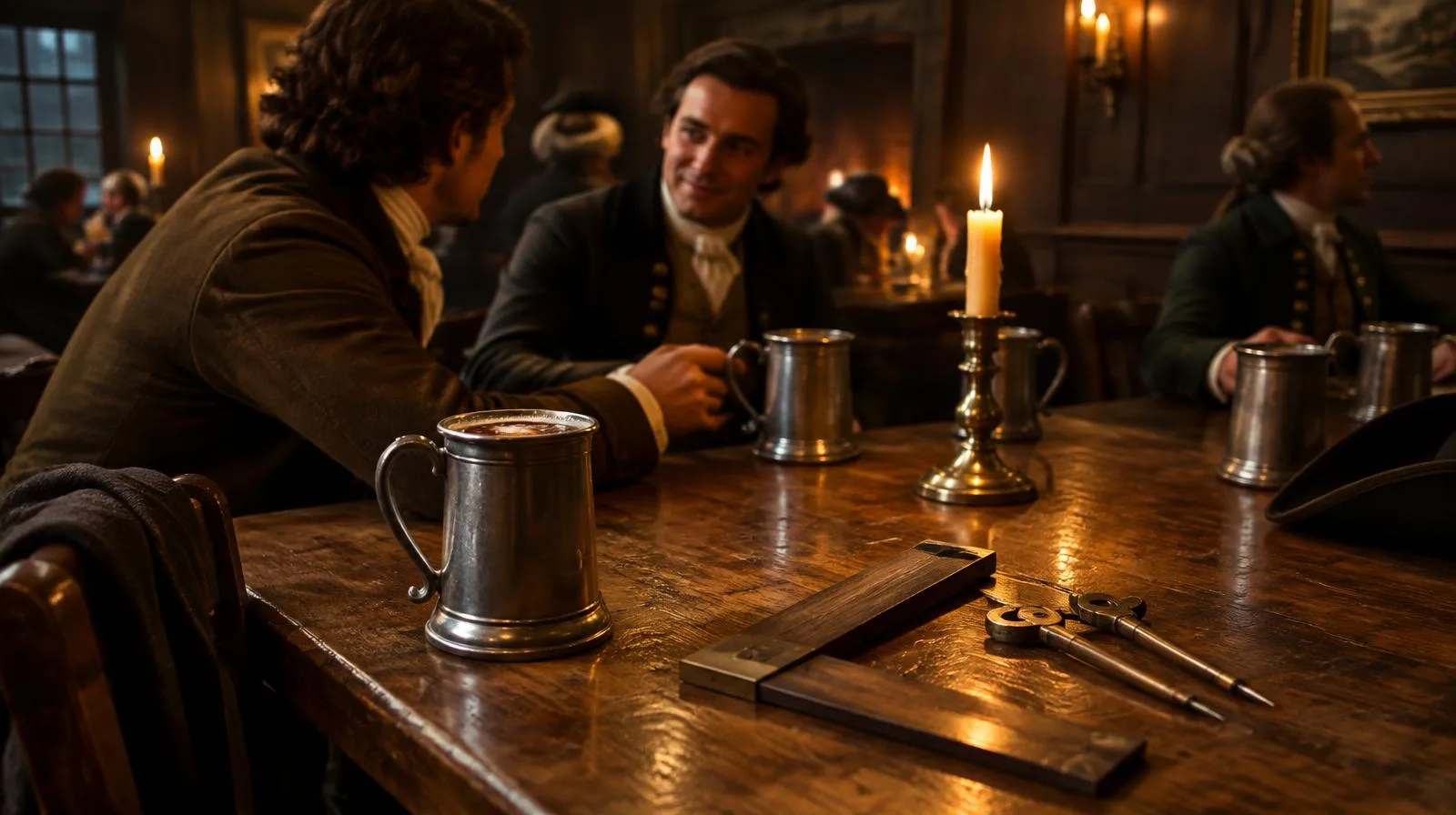
A wooden barrack, a prison ship, a provincial town whose boundaries you were forbidden to cross: captivity could take several forms. Within that restricted world, French prisoners found ways to practise Freemasonry. The story of prisoner of war masonic lodges begins with an arresting contrast: men held as enemies gathering as brethren.
In Malta, one lodge bore the evocative name Les Amis en Captivité. In Britain, prisoners organised lodges whose documents and seals later drew the attention of Masonic historians. Before following them, discard one misleading image. The barbed wire of our title is metaphorical, not Napoleonic. Their actual surroundings, and the fellowship they sustained within them, deserve a closer look.
What did Napoleonic captivity really look like?
Barbed wire belongs later in the nineteenth century, not to a later century than these wars. Britannica dates the first American patents to 1867. For this story, think instead of barracks, castle walls, prison hulks and restrictions imposed through parole.
John T. Thorp, the historian of French prisoners’ lodges, distinguished between ordinary soldiers and sailors, mostly confined in hulks or barracks, and officers permitted to reside in designated towns. The latter lived within assigned limits and under conditions. A town lodging did not make its occupant a free traveller.
That distinction matters when imagining a captive lodge. A gathering among officers on parole had a different setting from one inside a prison establishment. Thorp describes harsh conditions for confined prisoners. His account should encourage us to ask where a particular lodge operated, rather than picture every meeting taking place behind the same locked door.
Thorp also places military lodges in the background: Freemasonry was familiar within the French army, with lodges attached to many regiments. Captive Masons were preserving an association they already knew. Alongside the broader subject of Freemasonry’s international expansion, this offers a sobering reminder that movement across borders could be involuntary.
Les Amis en Captivité: Malta’s lodge and the 1811 question
The Wikipedia overview of Maltese Freemasonry reports that French prisoners established Les Amis en Captivité in 1811 under a warrant from Marseille. It connects those prisoners with the aftermath of the French occupation of Malta. Treat this as a secondary account of the lodge’s origins, rather than confuse it with the later English record.
The reported French foundation and the recorded English warrant have different dates. Lane’s Masonic Records gives Loge les Amis en Captivité a warrant dated 6 October 1819, records number 716, and lists Malta as its meeting location. It also records erasure in 1823.
The secondary overview explicitly identifies the 1819 warrant as coming from the United Grand Lodge of England. The careful formulation is therefore a reported foundation among French prisoners in 1811, followed by an English warrant in 1819. Lane’s entry anchors the latter date without independently establishing the earlier foundation.
The same overview says that most prisoners were repatriated between April and August 1814, after which the lodge’s members were predominantly non-French. On that account, its later history involved a changed community, not simply the original captive membership continuing unchanged.
The ending remains less tidy. The Times of Malta dates Governor Maitland’s suppression to 1819; the Wikipedia overview gives 1820. Both connect the intervention with concerns about the Carbonari. Lane records erasure in 1823. These are the dates supplied by the sources; their relationship should remain unresolved here rather than be explained by an undocumented administrative sequence.
For a wider itinerary, pair this episode with our Masonic guide to Malta. Keep the lodge’s name and documentary record at the centre of the enquiry, rather than starting with an attractive building and working backwards.
French prisoners’ lodges in England: the documentary trail
Thorp’s French Prisoners’ Lodges, published in 1900, assembled accounts of twenty-six lodges and chapters, with facsimiles of documents and seals. Its coverage runs from 1756 to 1814. That total belongs to a longer history of warfare and captivity, not exclusively to the Napoleonic era.
He nevertheless states that a considerable number were established by soldiers and sailors captured during the Napoleonic wars. In his explanation, prisoners already accustomed to Freemasonry devoted time to its ceremonies as a relief from enforced idleness and monotony.
His related paper, Freemasons’ Lodges among French Prisoners of War, includes case studies at Ashburton, Ashby-de-la-Zouch and Plymouth. Its stated scope also includes prisoners’ reception in English lodges and English members of prisoners’ lodges. The enquiry extends beyond isolated French gatherings to contact with the surrounding Craft.
Documents make this history more tangible. A seal or certificate offers something to examine: a name, a place, an association. For research, ask what each object actually establishes and whether its date falls within the period you are studying. Readers can also turn to French Freemasonry and Rue Cadet for a separate strand of their French Masonic itinerary.
What did a lodge offer men who could not go home?
Thorp’s explanation, relief from monotony, should not sound slight. His account places Masonic ceremonies within the prisoners’ response to enforced idleness. We may reasonably read that as an effort to preserve purpose and continuity, while recognising that this is interpretation, not a record of every participant’s feelings.
Set beside the subject of chocolate houses, coffee houses and Masonic sociability, captivity raises a sharper question: how could an associational life be maintained when others controlled where one could live and move?
There is no need to add a sweeping claim about political reconciliation or the prisoners’ private loyalties. The documented subject is compelling enough: men continuing Masonic activity while held captive, and a historian tracing both their own lodges and their reception in English ones.
If you want to pursue that history, make provenance your first question. Who created a document, when, and for what purpose? Keep those questions beside you when planning research through Masonic libraries and museums. An identifiable record is a better starting point than an untraceable anecdote.
Visiting Valletta, Norman Cross, Portchester and Princetown
Plan this journey around two interests: the documentary history of captive Freemasonry and the wider experience of imprisonment. The stops below are selected for those purposes, not offered as a promised circuit of surviving prisoner lodge rooms. Check current opening and access arrangements before you go.
Valletta: begin with a research question
If your Malta itinerary begins in Valletta, take the lodge’s recorded name and dates with you. Lane’s location entry says Malta; it supplies no street address. We therefore give no doorway or room to seek out. For a separate contemporary visit, consult international Masonic visitation protocol and seek advice before making arrangements. Keep that enquiry distinct from identifying the historical lodge’s premises.
Norman Cross: look closely at prisoners’ handiwork
Peterborough Museum’s Norman Cross collection includes model ships, playing cards, needlework boxes and straw marquetry. Prisoners used materials including bone, straw and wood offcuts. According to the museum, most of the objects in its collection were made for sale at the prison market.
Look at them first as evidence of skill and resourcefulness under confinement. Any proposed Masonic identification deserves its own supporting documentation. The museum also reports that Nene Park Trust has acquired the Norman Cross site. Check arrangements separately for the collection and the historic site before planning both into a day.
Portchester Castle: a surviving setting for prisoner theatre
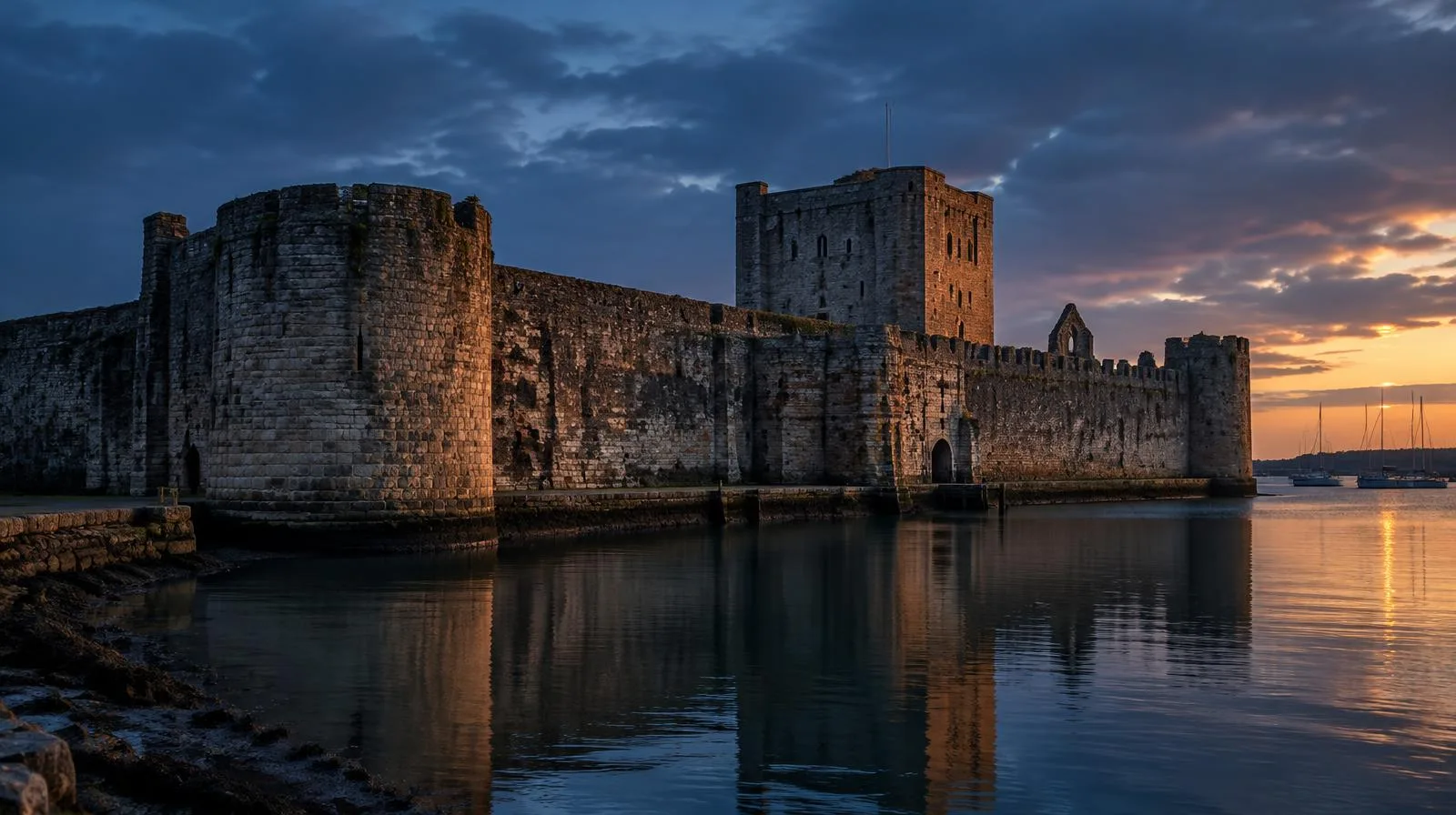
French prisoners created a theatre in Portchester’s keep in 1810. English Heritage explains that the ground-floor room remains little altered, while the original wooden stage has disappeared. The stage recreated for visitors draws on memoirs, documents and a prisoner’s drawing.
Visit for that documented theatrical history, an illuminating comparison with prisoners organising lodge life. Do not treat the comparison itself as identification of a Masonic room. Check access to the keep and its interpretation before travelling. If adding Masonic halls open to the public to the journey, check those arrangements separately too.
Princetown: prisoner labour and remembrance
The Fondation Napoléon’s account describes St Michael and All Angels at Princetown as largely constructed by French prisoner labour. It also recounts the memorial to French prisoners who died at Dartmoor. These provide a different focus: work undertaken in captivity, death and subsequent remembrance.
The account notes that the church was not always open when it was written. Seek current information about the church and any proposed cemetery or memorial visit before setting out. For anyone also interested in reading Masonic gravestones, make identification a separate enquiry rather than infer it from a connection with prisoner history.
Frequently asked questions
Were Napoleonic prisoners held behind barbed wire?
No. Barbed wire developed later in the nineteenth century. The settings discussed here include barracks, hulks and a castle, alongside designated towns where officers lived under parole restrictions.
Was Les Amis en Captivité founded in 1811 or 1819?
The secondary Malta account reports a French prisoner foundation in 1811 under a Marseille warrant. Lane records a warrant dated 6 October 1819, identified by the secondary account as English. Keep those stages distinct.
Did every French prisoner camp have a lodge?
Thorp suggested that large groups of prisoners would probably contain enough Masons to work a lodge. That is his inference, not a camp-by-camp finding. His 1900 book covers twenty-six lodges and chapters across 1756 to 1814.
Can visitors see an original prisoner lodge room?
We recommend collections, captivity sites and places of remembrance here, rather than a particular original lodge room. For any room advertised as such, ask for the historical identification and current visiting arrangements before planning your journey.
Sources
- Digital Humanities Institute: Lane’s record for Loge les Amis en Captivité
- Wikipedia: secondary account of Freemasonry in Malta
- Times of Malta: Freemasonry and the law in Malta
- Internet Archive: John T. Thorp’s French Prisoners’ Lodges
- Cedar City Lodge: Thorp’s paper on French prisoners’ lodges
- Peterborough Museum: Norman Cross collection and historic site
- English Heritage: the French prisoners’ theatre at Portchester
- Fondation Napoléon: Dartmoor Prison’s French connection
- Encyclopaedia Britannica: the development of barbed wire