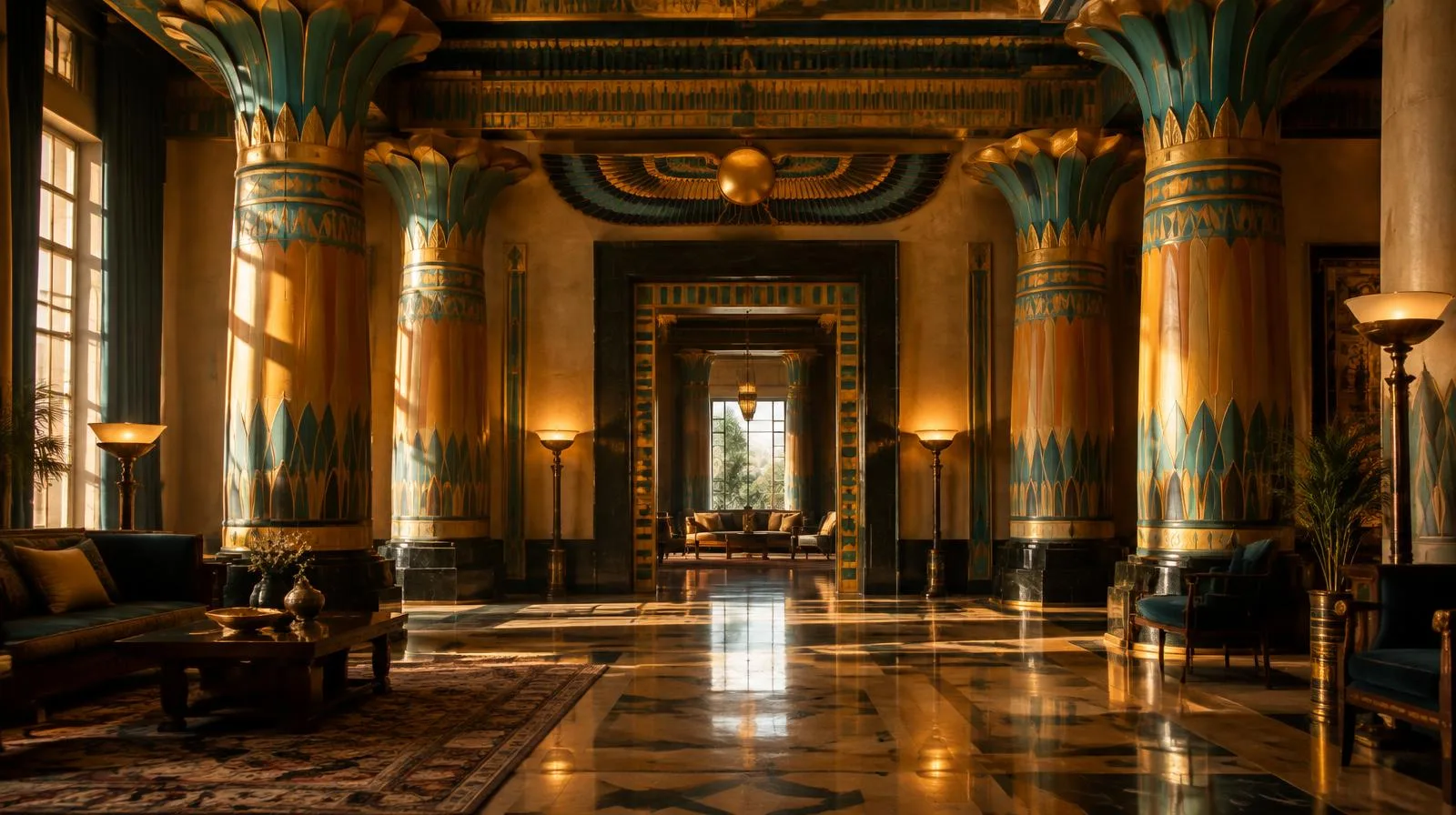
Marble, bronze, dark wood: London’s Freemasons’ Hall knows how to make an entrance. Yet one room’s name promises a different journey altogether. Lodge Room No. 10 is known as the Egyptian Room, an unexpected starting point for anyone seeking an Egyptian Masonic temple without leaving London. The name invites you to imagine antiquity behind an Art Deco façade.
Across the Atlantic, Philadelphia’s Egyptian Hall makes that invitation explicit, with Egyptian columns and hieroglyph-covered walls. Such decoration can make a modern meeting room feel centuries removed from the street outside. But atmosphere is not ancestry. These places become more interesting, not less, when we distinguish the Egypt their designers borrowed from the history their buildings can actually prove.
London’s Egyptian Room: a working lodge room
Begin with the distinction between a room and a building. Freemasons’ Hall is an Art Deco peace memorial to Freemasons who died during the First World War. The Museum of Freemasonry describes its principal public and ceremonial interiors in marble, bronze, brass and dark wood. That description concerns the wider Hall, not a catalogue of the Egyptian Room’s decoration.
The United Grand Lodge of England identifies Lodge Room No. 10 as the Egyptian Room and records its use by some of London’s largest lodges. Its account of the 2023 Open House Festival places the room among spaces rarely seen by the public. Here, the secure facts are the room’s identity, its working purpose and its documented opening for that event.
A ceremonial interior deserves attention as a place of assembly as well as an architectural spectacle. Look at how the gathering space relates to its decorative frame, rather than treating every ornament as a clue to remote origins. For a companion reading, turn to lodge room architecture and symbolism.
Our Freemasons’ Hall visitor’s guide is a starting point for planning. For this particular room, ask the Hall directly: UGLE’s published tour descriptions do not name Lodge Room No. 10. That leaves its inclusion unconfirmed, rather than establishing a permanent admission policy.
Why did Masonic lodges choose Egyptian architecture?
Freemasons did not have Egypt to themselves. The Metropolitan Museum of Art places Egyptian Revival within a broader taste that extended through nineteenth-century American decorative arts into the 1920s. Obelisks, sphinxes, pyramids and hieroglyphs appeared across architecture and other artistic media. Egyptian design offered an alternative to more familiar historical styles.
Printed scholarship helped circulate its forms. Following Napoleon’s Egyptian campaign, artists and scientists catalogued monuments and discoveries. The first volumes of the Description de l’Égypte appeared in 1809. The Met identifies that publication, its later edition and the decipherment associated with the Rosetta Stone as important stimuli to European and American interest.
Alongside this wider fashion stood Masonic traditions connecting Egypt with the history of building. Together, they provide useful context for these interiors. They do not, however, establish why each patron commissioned a particular design. Without a commission’s own records, a claim about its intended lessons or symbolism remains interpretation.
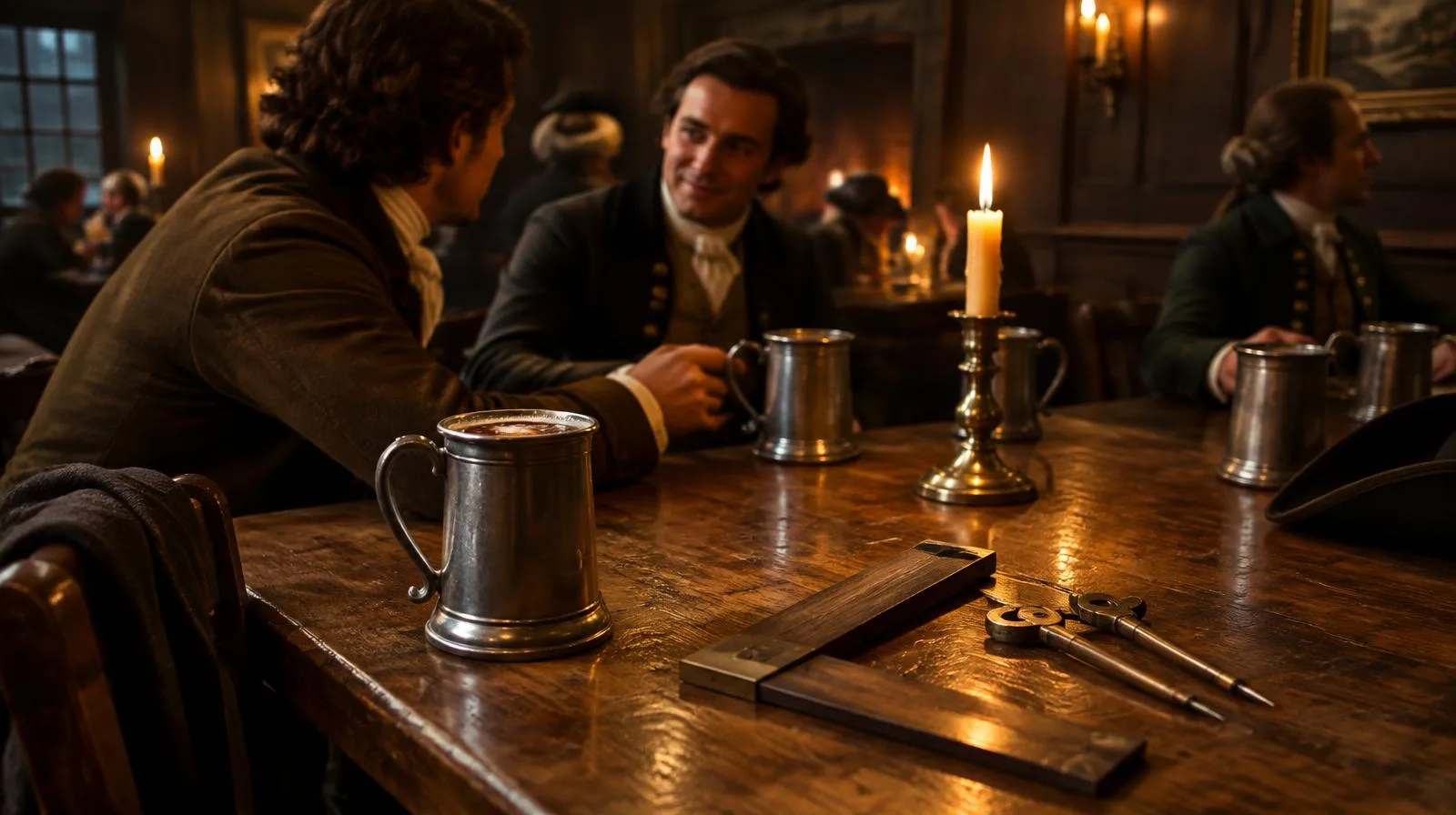
Philadelphia offers a more concrete contrast. Its institutional history records tavern meetings before dedicated premises. Read alongside Freemasonry and beer, that progression invites a revealing comparison: a fraternity could move from borrowed meeting space to elaborate ceremonial architecture without acquiring a different ancient ancestry.
Did Freemasonry originate in ancient Egypt?
The Egyptian connection begins in inherited stories, not an unbroken institutional archive. Historians John Hamill and Pierre Mollier identify the manuscript Old Charges as an early link between Masonry and Egypt. These texts traced the history of building through biblical antiquity and onwards into England.
This is tradition about the dignity and transmission of an art, not a verified register of modern lodges. The same distinction is useful when approaching the Masonic legend of York: a narrative can have historical influence without every episode being historical fact.
Another strand came through imaginative literature. Hamill and Mollier highlight Jean Terrasson’s Séthos, in which an Egyptian prince undergoes trials before initiation into the mysteries of Isis. Its significance concerns the transmission of ideas and imagery, not evidence that an Egyptian lodge system survived into modern times.
Masonic scholar S. Brent Morris makes the central distinction in his discussion of Pike, Mackey and the ancient mysteries. Their early theories of descent from ancient mystery traditions could serve as teaching devices, but failed as historical fact. Borrowing symbols, recognising parallels and proving institutional descent are different undertakings.
None of this diminishes the rooms. An Egyptian-inspired interior is evidence of a later engagement with antiquity. Enjoy its imaginative force, then ask what its records establish about its construction, decoration and use. Those questions lead to firmer ground than a resemblance between ceremonies or symbols.
Boston, Lincolnshire: an Egyptian temple on an English street
For an exterior that makes the Egyptian choice unmistakable, turn to Boston in Lincolnshire. Historic England dates its Freemasons’ Hall to 1860 to 1863 and identifies its model as the Temple of Dendur in Nubia. Two great palm columns and hieroglyphic inscriptions give a relatively small building a commanding presence.
This also corrects a tempting shorthand. Thebes in this article’s title is an evocation, not a claim that every building discussed copies that ancient city. Boston has a specifically identified model elsewhere. A recognisable Egyptian appearance does not make different archaeological sources interchangeable.
The Lincolnshire heritage record describes gault brick and ashlar, with plain red brick at the sides and rear. It cautiously reports that the hieroglyphic inscription apparently commemorates construction during Queen Victoria’s reign and wishes the building prosperity. Preserve that qualification rather than presenting the reported translation as certain.
For photography, consider both the ceremonial front and the building’s more practical fabric, wherever these can be seen from a lawful public viewpoint. The heritage descriptions establish architectural interest, but do not establish current interior visiting arrangements. Enquire before making an interior visit central to your plans.
Philadelphia’s Egyptian Hall, and Alexandria’s architectural puzzle
Philadelphia supplies a securely documented interior. The Masonic Temple’s own history names James H. Windrim as architect, dates the beginning of construction to 1868 and completion to 1873. Crucially, it separates the building from its decoration: Egyptian Hall was the first room decorated and was dedicated in 1889.
The institution records that interior design continued until 1908. A temple’s completion and the dedication of a celebrated room need not be the same event. Keep those dates separate when comparing interiors or captioning photographs.
Visit Philadelphia describes Egyptian columns and hieroglyph-covered walls within a building containing seven differently decorated meeting halls. Egypt is one architectural language among several. Continue with our Philadelphia Masonic Temple guide for the wider visit.
Alexandria, Virginia, needs more careful wording. The George Washington Masonic National Memorial’s landmark nomination classifies it as Neo-Classical Revival and Art Deco. Classification and inspiration, however, are separate questions.
California Freemason associates its design with the Lighthouse of Alexandria in Egypt, while another published account identifies the Lighthouse of Ostia. These descriptions differ. Neither should be used casually to turn the entire memorial into an equivalent of Philadelphia’s Egyptian Hall.
The Memorial’s own design history names Frank J. Helmle and Harvey Wiley Corbett as its architects and explicitly states that they were not Freemasons, correcting another claim found in the magazine account. Our Alexandria memorial guide offers a companion itinerary, but its architecture deserves assessment on its own terms.
How to visit and photograph Egyptian Revival Masonic rooms
Build the journey around confirmed access rather than an enticing photograph. Consult Masonic halls open to the public, then check the venue’s own information for your intended date. Ask about the particular room you want to see, not simply whether the building opens.
- London: ask specifically about Lodge Room No. 10. UGLE warns that the Grand Temple, Vestibules or Museum can become unavailable after booking, sometimes at short notice.
- Philadelphia: the Temple’s visitor information says visits are guided and independent wandering is not permitted. Check current itineraries and closures.
- Boston: treat the exterior as your planning starting point until current interior access is confirmed. A heritage description is not an admission notice.
- Photography: ask about cameras, flash, tripods and publication. At Alexandria, the Memorial’s published restrictions prohibit commercial photography and filming on the property. Check before you go.
Where photography is permitted, start with the whole room before concentrating on details. Record the relationship between ornament and structure, and avoid processing that obscures the difference between painted decoration and carved material.
Captions deserve equal care. Separate construction from decoration dates, and distinguish inscriptions from proposed translations. The approach also serves anyone reading Masonic gravestones: observe first, consult the record, and leave uncertainty visible.
Frequently asked questions
What does Egyptian Masonic temple mean here?
Here, it describes a Masonic building or room with Egyptian-inspired architecture or decoration. It is a descriptive label, not a claim of ancient construction or direct institutional descent from Egypt.
Can you visit London’s Egyptian Room?
It opened during the 2023 Open House Festival. UGLE’s published tour descriptions do not name it, so ask specifically about Lodge Room No. 10 before booking.
When was Philadelphia’s Egyptian Hall dedicated?
The Temple’s official history records its dedication in 1889 and identifies it as the first room decorated. The surrounding building was completed in 1873.
Do Egyptian motifs prove an Egyptian origin for Freemasonry?
No. They show artistic influence, not institutional continuity. Traditions connecting Masonry with Egypt belong to the history of Masonic ideas, but are not proof of uninterrupted descent.
Sources
- United Grand Lodge of England: Egyptian Room and Open House access
- Metropolitan Museum of Art: Egyptian Revival and its published inspirations
- UCL Press: Hamill and Mollier on Egypt in Masonic imagery
- Pietre-Stones Review of Freemasonry: S. Brent Morris on ancient-origin theories
- Historic England: Boston’s Egyptian-style Freemasons’ Hall
- Lincolnshire Heritage Explorer: Boston’s materials and reported inscription
- Masonic Temple, Library & Museum: Philadelphia’s construction and decoration
- Virginia Department of Historic Resources: memorial architectural classification
- United Grand Lodge of England: tour descriptions and access limitations